


 Save
 Copy
 Add to Collection
 Export to Google Docs
 Share
(1) Some time afterward, God put Abraham to the test. He said to him, “Abraham,” and he answered, “Here I am.” (2) And He said, “Take your son, your favored one, Isaac, whom you love, and go to the land of Moriah, and offer him there as a burnt offering on one of the heights that I will point out to you.” (3) So early next morning, Abraham saddled his ass and took with him two of his servants and his son Isaac. He split the wood for the burnt offering, and he set out for the place of which God had told him. (4) On the third day Abraham looked up and saw the place from afar. (5) Then Abraham said to his servants, “You stay here with the ass. The boy and I will go up there; we will worship and we will return to you.” (6) Abraham took the wood for the burnt offering and put it on his son Isaac. He himself took the firestone and the knife; and the two of them went together.
יחדיו. בלב תמים, זה לעקוד, וזה להשתחוות.
Together. With an innocent heart, this one to bind, and this one to worship.
(ז) וַיֹּ֨אמֶר יִצְחָ֜ק אֶל־אַבְרָהָ֤ם אָבִיו֙ וַיֹּ֣אמֶר אָבִ֔י וַיֹּ֖אמֶר הִנֶּ֣נִּֽי בְנִ֑י וַיֹּ֗אמֶר הִנֵּ֤ה הָאֵשׁ֙ וְהָ֣עֵצִ֔ים וְאַיֵּ֥ה הַשֶּׂ֖ה לְעֹלָֽה׃ (ח) וַיֹּ֙אמֶר֙ אַבְרָהָ֔ם אֱלֹהִ֞ים יִרְאֶה־לּ֥וֹ הַשֶּׂ֛ה לְעֹלָ֖ה בְּנִ֑י וַיֵּלְכ֥וּ שְׁנֵיהֶ֖ם יַחְדָּֽו׃
(7) And Isaac said to Abraham, his father, “My father!” And he answered, “Yes, my son.” And he said, “Here are the firestone and the wood; but where is the sheep for the burnt offering?” (8) And Abraham said, “God will see to him, the sheep for His burnt offering, my son.” And the two of them went together.
ויאמר יצחק אל אברהם אביו ויאמר אבי. כפל הכתוב בדברים אבי אבי, ויאמר ויאמר ג' פעמים, כדי שיתמלא עליו רחמיו: ויאמר הנה האש והעצים ואיה השה לעולה. כמתנכר מידיעה:
And Isaac said to Abraham, his father, “My father!” In the text there is a doubling of the word, avi avi, and the word, vayomer vayomer three times, in order that his heart would be filled with compassion for him. “And he said, here are the firestone and the wood; but where is the sheep for the burnt offering?” Because he was ignorant of the information OR because he was estranged/alienated from his awareness.
וילכו שניהם יחדו. זה לשחוט, וזה לישחט:
And the two of them walked on together. This one to slaughter, and this one to be slaughtered.
(9) They arrived at the place of which God had told him. Abraham built an altar there; he laid out the wood; he bound his son Isaac; he laid him on the altar, on top of the wood. (10) And Abraham picked up the knife to slay his son.
ויקח את המאכלת. אמר, אבי אל תודיע לאמי כשהיא עומדת על הגג או כשהיא עומדת על הבור שמא תפיל עצמה ותמות.
And he took the knife. [According to the Tanchuma quoted above] He said, “My father [when you tell my mother about what happened] do not tell my mother while she is standing on the roof or standing near a well, in case she will fall [faint] and she will die.”
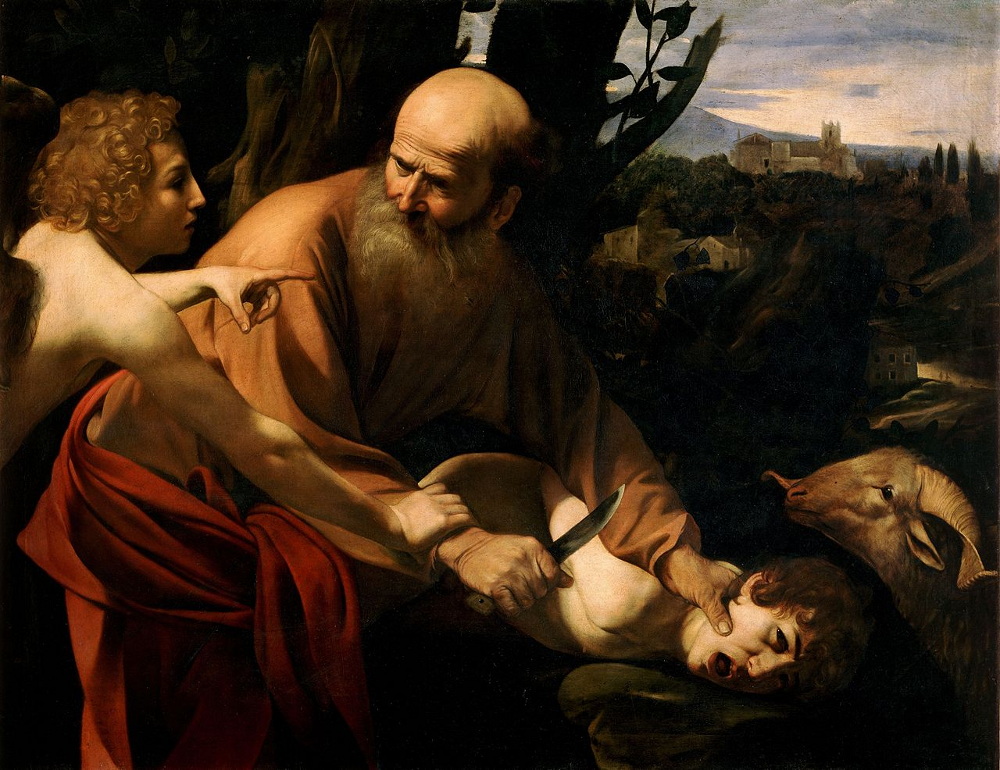
Caravaggio 1573 – 1610
The Sacrifice of Isaac (1603)
oil on canvas (204 × 135 cm) — ca. 1603Galleria degli Uffizi, Florence
The expression on Isaac's face says it all: he is scared to death, with his father about to cut his throat. At this exact moment, an angel intervenes, suggesting that Abraham had better sacrifice a sheep.
Please note the sharp contrast between the unpleasant scene in the foreground and the rustic landscape in the background. This painting was most likely commissioned by Cardinal Barberini, the future Pope Urban VIII. A few years later Caravaggio would make another painting with this popular theme.

Rembrandt Harmensz. van Rijn 1606 – 1669
The Angel Prevents the Sacrifice of Isaac (1635)
oil on canvas (193 × 133 cm) — 1635Hermitage, St. Petersburg
Rembrandt Harmensz. van Rijn biography
At the very last moment, an angel stops Abraham from killing his own son, Isaac. Pretending they set out to slaughter a lamb, Abraham actually intended to sacrifice Isaac to his god. One year on, Rembrandt would make a similar painting.
(יט) וַיָּ֤שָׁב אַבְרָהָם֙ אֶל־נְעָרָ֔יו וַיָּקֻ֛מוּ וַיֵּלְכ֥וּ יַחְדָּ֖ו אֶל־בְּאֵ֣ר שָׁ֑בַע וַיֵּ֥שֶׁב אַבְרָהָ֖ם בִּבְאֵ֥ר שָֽׁבַע׃
(19) And Abraham returned to his servants, and they got up and they went together to Beer-sheba; and Abraham stayed in Beer-sheba.
Richard Elliott Friedman, Commentary on the Torah, p.78
22:19. Abraham went back to his boys. The text does not mention Isaac going back. (And Abraham had specifically told the boys, “We’ll come back to you.”) Both midrash and critical scholarship have dared to raise the possibility that in one version of the story Abraham actually sacrifices Isaace (discussed in Who Wrote the Bible? p. 257). But in the present form of the text itself, Isaac is clearly spared. And that makes this verse extraordinarily powerful. Following the Aqedah, Isaac and Abraham do not go back together. Moreover: following the Aqedah, Isaac and Abraham are never quoted as speaking to each other.
