




 Save
Save Copy
Copy Add to Collection
 Export to Google Docs
 Share
Shareוָאֶתְחַנַּ֖ן אֶל־יְהֹוָ֑ה בָּעֵ֥ת הַהִ֖וא לֵאמֹֽר׃ אֲדֹנָ֣י יֱהֹוִ֗ה אַתָּ֤ה הַֽחִלּ֙וֹתָ֙ לְהַרְא֣וֹת אֶֽת־עַבְדְּךָ֔ אֶ֨ת־גׇּדְלְךָ֔ וְאֶת־יָדְךָ֖ הַחֲזָקָ֑ה אֲשֶׁ֤ר מִי־אֵל֙ בַּשָּׁמַ֣יִם וּבָאָ֔רֶץ אֲשֶׁר־יַעֲשֶׂ֥ה כְמַעֲשֶׂ֖יךָ וְכִגְבוּרֹתֶֽךָ׃ אֶעְבְּרָה־נָּ֗א וְאֶרְאֶה֙ אֶת־הָאָ֣רֶץ הַטּוֹבָ֔ה אֲשֶׁ֖ר בְּעֵ֣בֶר הַיַּרְדֵּ֑ן הָהָ֥ר הַטּ֛וֹב הַזֶּ֖ה וְהַלְּבָנֹֽן׃ וַיִּתְעַבֵּ֨ר יְהֹוָ֥ה בִּי֙ לְמַ֣עַנְכֶ֔ם וְלֹ֥א שָׁמַ֖ע אֵלָ֑י וַיֹּ֨אמֶר יְהֹוָ֤ה אֵלַי֙ רַב־לָ֔ךְ אַל־תּ֗וֹסֶף דַּבֵּ֥ר אֵלַ֛י ע֖וֹד בַּדָּבָ֥ר הַזֶּֽה׃ עֲלֵ֣ה ׀ רֹ֣אשׁ הַפִּסְגָּ֗ה וְשָׂ֥א עֵינֶ֛יךָ יָ֧מָּה וְצָפֹ֛נָה וְתֵימָ֥נָה וּמִזְרָ֖חָה וּרְאֵ֣ה בְעֵינֶ֑יךָ כִּי־לֹ֥א תַעֲבֹ֖ר אֶת־הַיַּרְדֵּ֥ן הַזֶּֽה׃ וְצַ֥ו אֶת־יְהוֹשֻׁ֖עַ וְחַזְּקֵ֣הוּ וְאַמְּצֵ֑הוּ כִּי־ה֣וּא יַעֲבֹ֗ר לִפְנֵי֙ הָעָ֣ם הַזֶּ֔ה וְהוּא֙ יַנְחִ֣יל אוֹתָ֔ם אֶת־הָאָ֖רֶץ אֲשֶׁ֥ר תִּרְאֶֽה׃ וַנֵּ֣שֶׁב בַּגָּ֔יְא מ֖וּל בֵּ֥ית פְּעֽוֹר׃ {פ}

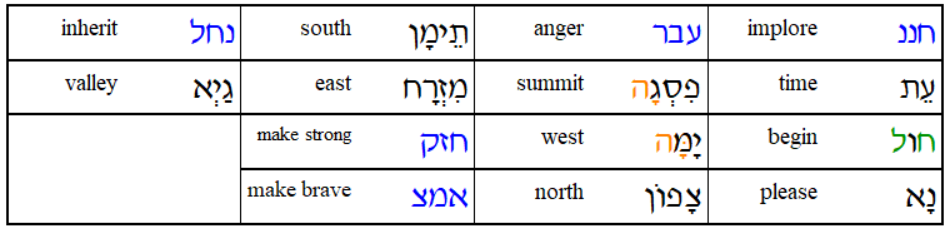
Posuk כג
וָאֶתְחַנַּ֖ן "and I implored"
1) Why specifically this type of shoresh for prayer חננ, compared to the classical shoresh of פלל?
בָּעֵ֥ת הַהִ֖וא "at that Time"
2) What was specific and opportune about "that Time" that motivated Moshe to daven to Hashem now?
לֵאמֹֽר "to say"
3) What is this coming to add as לֵאמֹֽר usually implies "saying to someone else"?
Posuk כד
אֲדֹנָ֣י יֱהֹוִ֗ה "Master Hashem"
1) Why are the 2 Names of Hashem needed? 2) The 2nd Name of Hashem usually does not have any vowels at all. What is the significance of the specific vowels inserted in this instance?
הַֽחִלּ֙וֹתָ֙ "You have begun"
1) What is the Shoresh of the word? 2) What is the significance of the fact that "You (Hashem) have begun"?
עַבְדְּךָ֔ "Your Servant"
1) Moshe does not often refer to himself as a "servant"?
אֶ֨ת־גׇּדְלְךָ֔ וְאֶת־יָדְךָ֖ הַחֲזָקָ֑ה אֲשֶׁ֤ר מִי־אֵל֙ בַּשָּׁמַ֣יִם וּבָאָ֔רֶץ אֲשֶׁר־יַעֲשֶׂ֥ה כְמַעֲשֶׂ֖יךָ וְכִגְבוּרֹתֶֽךָ "your greatness and your strong hand, who is like Hashem, in the Heaven and on the Earth that does like your deeds and your strength"
1) There are 2 separate sections that describe Hashem's qualities and each section contains 2 qualities, thus a total of 4 qualities. What is the difference and what is the similarity between these 2 sections and these 4 qualities? 2) Why specifically are these 4 expressions used to describe Hashem qualities at this point in Moshe's life? 3) What is the reason that Hashem is described as אֵל֙ (compared to the other 2 Names of Hashem used previously in this posuk) at this point and what is the reasons that Hashem is described also as בַּשָּׁמַ֣יִם וּבָאָ֔רֶץ "in the Heaven and the Earth"?
Posuk כה
אֶעְבְּרָה־נָּ֗א וְאֶרְאֶה֙ "I will PASS, please, and I will SEE"
1) Why is Moshe requesting 2 things; to PASSOVER to Israel 2) to SEE Israel? 2) Hashem only grants Moshe his 2nd request, namely to SEE Israel and not to PASSOVER, why, what is the difference between the 2? 3) Why is the word נָּ֗א "Please" inserted between אֶעְבְּרָה and וְאֶרְאֶה֙ and not at the end of וְאֶרְאֶה֙ ?
הָאָ֣רֶץ הַטּוֹבָ֔ה אֲשֶׁ֖ר בְּעֵ֣בֶר הַיַּרְדֵּ֑ן הָהָ֥ר הַטּ֛וֹב הַזֶּ֖ה וְהַלְּבָנֹֽן "The good Land which is on the other side of the Jordan, this good Mountain and the Levanon"
1) What is the meaning of הָהָ֥ר הַטּ֛וֹב הַזֶּ֖ה וְהַלְּבָנֹֽן "This Good Mountain and the Levanon"?
2) Moshe is requesting to see 3 things. What is the intrinsic difference between the 2 separate groupings of הָאָ֣רֶץ הַטּוֹבָ֔ה and הָהָ֥ר הַטּ֛וֹב הַזֶּ֖ה וְהַלְּבָנֹֽן ?
Posuk כו
וַיִּתְעַבֵּ֨ר "and He was Angered" - This shoresh עבר has been used already in this parsha to mean "go over". What is the connection between "Angry" and "Go Over"?
רַב־לָ֔ךְ "There is much to you" - What exactly is the meaning of this statement? and how is this a consolation to Moshe for not being allowed to enter the Land of Israel?
אַל־תּ֗וֹסֶף דַּבֵּ֥ר אֵלַ֛י ע֖וֹד "Do not add to speak to mean further" - This point really seams to be repeated, especially in this posuk?
Posuk כז
עֲלֵ֣ה ׀ רֹ֣אשׁ הַפִּסְגָּ֗ה "Go up to the top of the lookout point"
1) 3 expression of going "up" in these 3 words?
2) Why does Moshe need to go to a הַפִּסְגָּ֗ה compared to a הר "Mountain"?
וְשָׂ֥א עֵינֶ֛יךָ "and lift up your eyes"
1) The word עין "eye" is mentioned twice in this posuk plus the word ראה is also mentioned and not עבר (passover). What is the significance of "Eye & See".
יָ֧מָּה וְצָפֹ֛נָה וְתֵימָ֥נָה וּמִזְרָ֖חָה "West, North, South and East"
1) Why does Moshe have to look in all 4 directions? Based on the 4 directions, it would seem that Moshe also has to look "behind him"?!
2) What is the shoresh meaning of each of these 4 directions?
3) Why does Moshe have to start in the direction of the East?
Posuk כח
וְצַ֥ו אֶת־יְהוֹשֻׁ֖עַ "and command Yehoshua" - It does not tell as what Moshe is supposed to Command Yehoshua?
כִּי־ה֣וּא יַעֲבֹ֗ר לִפְנֵי֙ הָעָ֣ם הַזֶּ֔ה וְהוּא֙ יַנְחִ֣יל אוֹתָ֔ם "because he will pass in front of the nation and he will cause them to inherit the land"
1) What is the need to mention both steps of 1) יַעֲבֹ֗ר "Passover" 2) יַנְחִ֣יל "inherit"
אֲשֶׁ֥ר תִּרְאֶֽה "which you will see"
1) Is this not obvious?
2) Is this not "rubbing salt into the wound" of Moshe, saying that you will only "see" the Land and not "passover"?
Posuk כט
וַנֵּ֣שֶׁב בַּגָּ֔יְא מ֖וּל בֵּ֥ית פְּעֽוֹר "and we sat in the Valley (Gaye) opposite the house of Peor"
1) וַנֵּ֣שֶׁב "and we sat" - Who is "we" referring to? Is it also Moshe?
2) וַנֵּ֣שֶׁב "and we sat" - What is the implication of "sit"?
3) בַּגָּ֔יְא "valley" - What is the significance of sitting in the "valley"?
4) מ֖וּל בֵּ֥ית פְּעֽוֹר "opposite the house of Peor" 1) What is the significance of "opposite"? בֵּ֥ית פְּעֽוֹר "the House of Peor" is the place that the Jewish people committed a most serious sin of Idol Worship to the idol of Peor. Why mention this here?
5) What is the reason that this posuk is place in this context regarding Moshe's prayer to enter the land?
ה' אלהים. רַחוּם בַּדִּין:
רחום בדין. רצ"ל דהא שם של ד' אותיות מדת הרחמים הוא, ואדני הוא מדת הדין. ומפרש רחום בדין, כלומר רחום בדינו ולא במה"ד הקשה. א"נ רצונו לפרש, למה נקוד שם של ד' אותיות דכתיב כאן בנקודות של אלקים, דהיינו חטף סגו"ל וחול"ם וחירי"ק, ולא נקוד כשאר שם של ד'. ולכך נקט רש"י בלשון הקרא אדני אלקים, אעפ"י שכתוב ידו"ד, כלומר שם של ד', אבל לפי קריאת נקודותו דומה כאילו כתיב אלקים. ומפרש דלכך נקוד ידו"ד בנקודת אלקים שהוא מדת הדין, אע"פ שידו"ד מדת הרחמים, לומר לך רחום בדין. והשם הראשון של אדני דכתיב בקרא, לא כוון משה בו כלום רק פירושו רבוני, והוא התחלת דבור. ולפי לשון ראשון צ"ל מה שנקט רש"י אלקים לפי הקריאה של שם של ד' נקט. ואע"ג דלעיל בפרשת לך לך (בראשית טו ב) כתיב נמי ה' אלקים מה תתן לי, ולא פירש רש"י כלום. י"ל דלעיל ה"ק, הן מצד הדין הן מצד הרחמים אני מבקש שתתן לי בנים, מאחר שאמרת לי (שם יב א) לך לך מארצך וגו' ואעשך לגוי גדול. אבל הכא קשה, למה לו להזכיר שם של אדנות שהוא מדה"ד:
אעברה נא ואראה את הארץ הטובה וגו'. למה הפסיק במלת נא בין אעברה ואראה, ולמה עשה שתי חלוקות והזכיר הארץ בפני עצמה, וההר הטוב הזה והלבנון בפני עצמם וביאור הענין הוא שבקש משה על ב' דברים א' בעבור ישראל, וא' בעבור עצמו, ובאה התשובה ויתעבר ה' בי למענכם כי בדבר הנוגע בכם לא נעתר לי ה', אבל מה שנוגע בי נעתר לי ואמר רב לך. די בדבר שהוא יהיה לך לבד, ועוד תרצה לבקש בעבורם. וב' דברים אלו הם שני מיני שלימות אשר הקנה ה' לאברהם, כי מתחילה אמר ה' לאברהם שא נא עיניך וראה מן המקום אשר אתה שם צפונה ונגבה וגו' כי לך אתננה ולזרעך עד עולם. (בראשית יג יד-טו) ש"מ שבראיה לבד קני ליה, ואח"כ חזר מזה ואמר קום התהלך בארץ לארכה ולרחבה כי לך אתננה. (שם יג יז) ש"מ שבראיה לחוד לא רצה שיקנה כ"א מכי דייש אמצרי ויחזיק בה חזקה מעליותא, ועוד שלא אמר ולזרעך עד עולם כ"א לך לבד, ומהו שאמר וראה מן המקום אשר אתה שם וכי ס"ד שיראה מן המקום אשר איננו עומד שם, ועוד כי שם נאמר לשון נא שא נא עיניך וראה דווקא בדבר הנקנה בראיה ולא בדבר הנקנה בחזקה גמורה, וכאן נאמר אעברה נא הזכיר לשון נא דווקא בדבר שצריך העברה ברגלים ממש הלא דבר הוא.
והבט ימין וראה כי מן הארץ הקדושה יש תועלת גשמי, ורוחני, הגשמי הוא התלוי בכל שטח הארץ כולה לאכול מפריה ולשבוע מטובה כי ארץ זבת חלב ודבש היא, והוא הדבר שאינו נקנה כ"א בחזקה ממש מכי דייש אמצרי כדין כל קונה שדה (ב"ק ט) ועליו נאמר לאברהם קום התהלך בארץ לארכה ולרחבה. ולא הזכיר בזה לשון נא כי אין נא אלא בקשה ויען כי החומר של האדם בטבעו הוא נכסף אל אהבה בתענוגים כי כל איש חפץ חיים אוהב ימים לראות טוב. ע"כ לא היה צריך הקב"ה לדבר בלשון נא לשון בקשה כי אדרבה האדם מבקשו בלשון נא, שכן משה אמר על קנין זה שצריך העברה לשון נא שנאמר אעברה נא. וכשהאדם מבקשו מאת ה' ודאי אין הקב"ה צריך לבקשו מן האדם והא בהא תליא, ולא הזכיר בקנין זה לך ולזרעך עד עולם כי אין הארץ נקנית לזרעו עד עולם על כל פנים, שהרי על תנאי היא נתונה אם ישמרו חקיו ותורותיו ינצורו.
You may best understand the sequence of the verses to which Moses referred as follows: “seeing that You G’d have begun to give the Torah through me, and the Torah in the main cannot properly be observed except in the land of Israel, and we have a principle that if someone commences to fulfill a commandment he is given an opportunity to complete it, it follows that I should be allowed to cross the Jordan in order to complete fulfilling the commandment which I began fulfilling when You G’d gave us the land of Sichon under my leadership”. This is the way my great and revered teacher Rabbi Shlomo Aderet explained Moses’ prayer. It is possible to view Moses’ prayer as a plea to allow him to translate into terrestrial reality his spiritual accomplishments in understanding the structure of the emanations. The words אתה החילות להראות are a reference to the enlightenment in these matters he had been granted; by saying אעברה נא ואראה, Moses asks to be allowed to relate all these insights to what needs to be done on earth to bring these two spheres, the celestial and the terrestrial, into tandem. [I have paraphrased this paragraph and condensed it. Ed.]. A Midrashic approach, based on Devarim Rabbah 2,8: the words אתה החילות are a reference by Moses to G’d Who was the first One to refer to the Israelites as rebellious when He said in Numbers 17,25 למשמרת לאות לבני מרי, “as a sign for the rebellious ones,” (the Israelites who had challenged the appointment of Aaron). Seeing that G’d had decreed Moses’ punishment on account of his having addressed the Israelites as שמעו נא המורים, “listen please you rebellious ones,” (Numbers 20,10) and immediately thereafter G’d had decreed that Moses could not enter the land of Israel, Moses now argues that he had been entitled to use this word seeing G’d Himself had already called the Israelites by that adjective. A kabbalistic approach: with the words ”you have begun to show me Your greatness, etc.,” Moses refers to his first encounter with G’d at the burning bush. When he goes on to describe G’d’s attributes, he means that it had been his privilege to acquaint the Jewish people with these attributes of G’d and His accomplish-ments in his capacity as His prophet. (David uses similar language in Psalms 86,8) Seeing that this has been so, Moses begs to be allowed to see the Holy land with his own eyes. The reason the name of G’d is spelled א-ד-נ-י in his plea here is that Moses alluded to Psalm 114 7-8 in which G’d is called אדון חולי ארץ, in connection with turning the rock into a lake of water. That verse referred to the incident at the rock where Moses had become guilty of this punishment. He now begs forgiveness by alluding to his sin in this indirect way. The word י-ה-ו-ה with the vowels of “elo-him” are an aspect of the attribute of Justice which contains a large measure of the attribute of Mercy. The word ואתחנן is used next to the attribute of Justice by Moses as when one asks forgiveness one does not address the attribute of Mercy but first has to assuage the attribute of Justice. We also learn this from Job 8,5: אם אתה תשחר אל א-ל ואל שדי תחנן, “if you want to pray to the Lord (to forgive your sins) first plead with the attribute Shaddai.”
ההר הטוב הזה והלבנון, “this good mountain and the Lebanon.” These words are similes for the Temple which “whitewashes,” מלבין, the sins of the Jewish people (Sifri Vaetchanan 28).
It is common knowledge that the expression סוד העבור, is chosen as it depicts an element of עברה, זעם, i.e. Divine anger. The mystical dimension of all the orbits, the constant revolutions of celestial bodies which are a feature of this present imperfect universe (עולם הזה), are manifestations of the attribute of Justice. This is also the mystical dimension of Exodus 34,20 that G’d is פוקד עון אבות על בנים, that He remembers and punishes the sons if the sins of their fathers have not been expiated I have alluded to this principle when I discussed that verse and subject.
Another meaning of the expression פרשת העבור is that offered in Berachot 29, where Rav Chisda says that even when G’d is angry the needs of a pregnant woman, עוברה, are constantly part of His concern. Moses prayed that G’d should not allow His anger to blot out any other consideration. Some commentators in the Talmud there read instead of באשה עוברה, “at,” or “of” a pregnant woman,” כאשה עוברה “like a pregnant woman.” This error is responsible for these people misunderstanding the Talmud, as they thought G’d’s anger is compared to a pregnant lady. There can be no doubt that the correct text is באשה עוברה. This is also the view of the famous Kabbalist of Gerona, Rav Yitzchak the blind. [Incidentally, his house is the only trace of a Jewish presence ever in Gerona. This editor visited Gerona].
The reason that the science of calculating the time when the moon renews itself month after month is known as סוד העבור is that G’d knows all developments in human history long before they occur as well as the dates on which they will occur, as we know from Isaiah 41,4 קורא הדורות מראש, “He Who announced the generations from the start (of history).” [If the sages who calculate our calendar would err with the date the new moon is to appear and fix our calendar according to their faulty calculations this would cause confusion and play havoc with G’d’s plans seeing He authorized the Jewish sages to determine the calendar. Ed.]. This is why the סוד העבור is also known as כח הדורות, “the force determining human development.” All manifestations of trans-migrations of souls derive from the concept that G’d has foreseen all developments and finds ways of achieving His objectives in spite of man’s freedom of choice.
The word עבור is also closely related to the word רבוע, “square, divided into four equal parts,” (same letters differently arranged), an allusion to such transmigrations of souls being limited to a total of four such lives i.e. the original and a maximum of three transmigrations. Another mystical dimension of the word עבור is that such transmigrations do not occur outside, (beyond) the original family of the body the soul lived its original life in [if I understand the author correctly. Ed.]
It is possible that the reason that in the case of Yaakov and Moses the reason why the Torah commences by mentioning West first is that the Shechinah which descended with Yaakov to Egypt (Megillah 29) is perceived as being in the West (Baba Batra 25). Here too, Moses addresses the Shechinah in the first instance and mentions תימנה as “southward,” instead of the more customary נגבה. The reason may be that in this way he was able to include one half of the Holy Name, i.e. either י-ה, or ו-ה in each of the four directions he made mention of. Had he said ונגבה, the second י-ה would have been missing. We must remember that Moses had previously exalted G’d by calling Him א-ל אלו-הי הרוחות, “the Lord G’d Who presides over the winds (directions of the earth).
The reason why G’d used the words עיניך twice when He responded to Moses’ prayer and why He told him to “raise” his eyes before looking and to physically ascend the summit is because from that location he would be able to behold the four corners of the land with his physical eyes and at the same time understand by means of focusing with his mental eyes on the four-lettered name of Hashem which symbolizes the highest מרכבה, on all directions of the world. You should appreciate that the four directions of the world, i.e. מזרח, מערב, צפון, דרום, are known by three names each. מזרח, (East) is known as מזרח, קדם or פנים. West is known as either מערב, ים or אחור. South is known as דרום, נגב or ימין. North is known as צפון, אסתן or שמאל. the meaning of these various terms for these directions is as follows: The reason the Hebrew word מזרח means East, is that the sun “shines” זורחת in the morning from the East. The reason it is also called קדם is because it proceeds in a forward direction from the East as it spreads its light over more parts of the globe. It is also called פנים (face) as when G’d created man he made him face East after completing him. His back faced westward, his right side southward, and his left side northward.
The name מערב for West, i.e. “mixing,” derives from the fact that the sun sets in the West; it is a time when the shadows merge, become confused and indistinct. It is also called ים as the great Sea, the Mediterranean, is the western boundary of the Holy Land. It is also called אחור, “rear,” seeing its counterpart, East, is also known as קדם, “front.” Incidentally, Onkelos calls the Mediterranean the ים האחרון, “the Sea of the rear,” or “the ים המערבאה, the Sea of the West.” The word אחור, meaning “West” occurs in the verse from Job 23,8-9 we quoted earlier. The South is known as דרום, seeing that at its highest point at midday the sun is high in the sky. The word דרום is a combination of the two words דר רום, “residing on high.” Alternatively, we may view the word as an acrostic of דרך רום from Chabakuk 3,10 רום ידהו נשאת ”lifted up his hands on high.”
The reason South is called נגב, is that that direction is very dry, exposed to extreme heat of the sun which spreads out over that region more than on any other. This is what Solomon referred to when he said (Kohelet 1,6) “it travels toward the South and then describes a turn moving northward.” Solomon uses the verb הלך in connection with the sun’s motion while shining, whereas he uses the verb סבב, “turning,” when describing the sun’s motion when out of view of man’s eyes. We have been told by the “scientists” that it happened once that someone living in the South forgot a wooden bowl outside and left it lying outside in the midst of the sun’s rays in the middle of the summer. When he returned to pick it up in the evening he found it completely dried out, shrunk as if it had been burned by the fire. This is why the South is called נגב i.e. ”dried up.” We know this from Judges 1,15 where Calev’s daughter complains to her father that the land she was given was parched, dried out, deprived of water, and she requested sources of water to offset it. The Targum there renders the words ארע דרומא, normally translated as “southern land,” as ימין, the right side, seeing that it is on the right of man as he was when first created, i.e. facing East. It is also possible that the reason for this translation is that the sun always has the south on its right. We have a verse in Daniel 1,5 וימן להם המלך, “the king provided for them.” This is the reason the provisions the Israelites received in the desert from heaven were called מן. The word reflects the fact that it was ready for them on a daily basis, i.e. available like “provisions.” The North is also called צפון because the sun is perceived as “hiding” in that region while invisible to man at night. Furthermore, the northern extremes of the globe are known to be unfit for human habitation. Our sages in Baba Batra 25 interpret Job 26,7 נוטה צפון על תהו to mean that ”He stretches Tzafon over chaos” means that the north wind does not operate there.
The word אסתן is not a Biblical term but one coined by our sages occurring as a proverb in Ketuvot 23 and meaning that when someone’s witnesses are in an inaccessible, “hidden” region, how can they be relied on? Rashi understands the word as meaning “north.” The author quotes some sources showing that the north wind is associated with therapeutic qualities, [maybe freezing kills the bacteria. Ed.]. At any rate, this would agree with the tradition that the Israelites did not circumcise their children while in the desert due to the absence of this North wind and its therapeutic effects on wounds.
The reason North is also known as שמאל, left, is that when man faces East, as we said, North is always on his left. It may also be due to the fact that it is on “the wrong side” of the sun, i.e. the sun never shining in that direction. The “left,” basically is associated with negative connotations, something inferior. The word, phonetically speaking, is related to סומא, “a blind person.” When we speak about something hidden, the Talmud uses the term סמוי מן העין, “hidden from the eye.”
According to a Midrash quoted in Tosafot Baba Batra 25 the reason that David spoke about Adam describing himself as having been created “both forward and backward” (Psalms 92,8), was because he faced forward toward sources of light, whereas his rear faced darkness, an absence of light, i.e. the rear of the sun being perceived as having no light to radiate. His right side, the one always exposed to the light of the sun was called “right,” his left, the northern side, always out of reach of the sun was called שמאל. This is the side with which man does not perform his work.
Yaakov, the last of the patriarchs, one of the supports of the מרכבה, was afforded burial of his entire body in Eretz Yisrael. Joseph only had his bones buried there. Moses, who surpassed both Yaakov and Joseph in his relationship with G’d, did not merit to have any part of his body interred on holy soil. It was G’d’s wish that none of Moses’ body be interred in Eretz Yisrael as a form of respect for the entire generation of Jews who had died in the desert and whose remains had also not been interred in Eretz Yisrael. Also, it was a consolation for all the many hundreds of generations of Jews throughout the Diaspora who died and were buried in exile. The souls of all these people are in G’d’s care pending the resurrection, at which time not only Moses but the vast majority of them will also be resurrected.
The purport of the expression at that time is that it alludes to the time of the decree that he mentioned, Also the Eternal was angry with me [for your sakes, saying: ‘Thou shalt not go in thither’], though [Moses’] supplication is not mentioned there on the day of that event. The correct interpretation, however, is that the expression at that time refers to the time mentioned: “when I conquered Sihon and Og and I began to war against the nations given to Israel and I allocated the land to the two tribes [Reuben and Gad].” In that case, this supplication [referred to here] was offered when it was said to Moses, Get thee up into this mountain of A barim, for it was then that he sought mercy in the matter and entreated this supplication. And when G-d did not hearken to his voice, he again prayed, Let the Eternal, the G-d of the spirits of all flesh, set a man over the congregation, as is mentioned there. It is this verse, And charge Joshua [that constitutes the answer to Moses’ second request]. Now, there [in the Book of Numbers] Scripture mentioned the prayer on which he was affirmatively answered [namely, the appointment of a successor] and here he mentioned this [unsuccessful prayer] in order to inform the people that, although the Land was beloved to him, he did not merit [to enter] it because of them. All this was part of his reproof.
Thus Moses completed the words of reproof with this episode in which he informed the people that their fathers caused themselves evil, and also caused him [Moses] to suffer punishment preventing them from going over into the Land. They, the children, however, will go over and inherit it, if they will not be as their fathers, a stubborn and rebellious generation. Therefore he now began to warn them about the principles of the commandments that they should not add to them, neither diminish from them.
(ברכות ל' ב')
(ברכות ל"ב א')
(סוטה י"ד א')
(ברכות מ"ח ב')
(סוטה י"ג ב')
(ברכות ל"ב ב')
(קדושין כ"ט א')
