Save
Save Copy
Copy Add to Collection
 Export to Google Docs
 Share
Share
29 Cheshvan 5777 | November 30, 2016
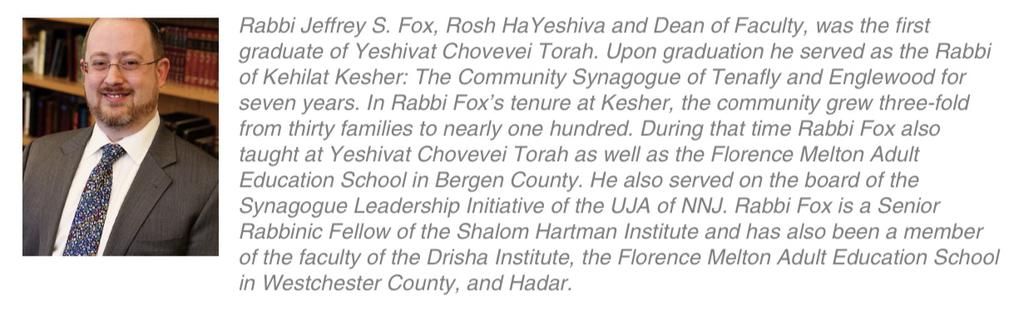
Rabbi Jeffrey Fox
Rosh HaYeshiva and Dean of Faculty
R' Eliezer and R' Yehoshua referred to our ancestors with words that have a standard meaning. When we see the word, “אבותינו forefathers" we tend to associate that with Abraham, Isaak and Jacob. The word "אמותינו matriarchs" generally refers to Sarah, Rebecca, Rachel and Leah. However, Rashi interprets these not as pointing to the heroes of the book of Genesis, but rather to the book of Exodus:
Forefathers [became Jewish] through circumcision in the time of Moses when we left Egypt. [At that time] they left the category of Noachides to receive the Torah and to receive the face of the shechina. Foremothers - their [the men from the time of the Exodus] wives, who immersed...
Rashi understood that the core narrative for the laws of Conversion is not Genesis but Exodus. As we continue forward in the Talmudic sugya we will see why Rashi made that leap. However, he says something which may surprise some people. Rashi refers to the Jewish People before the time of Moses as "בני נח Noachides." It turns out that our Matriarchs and Patriarchs, in the classic sense of Abraham and Sarah and their families, were not Jewish!
Instead of thinking of Avraham as the first Jew we should understand that in fact Moses, together with those who stood at Sinai, were the first Jews. Avraham Avinu was not [fully] Jewish. He may have been on the right path, but per this passage in Rashi, he was still only a Noachide with an additional Mitzvah.
Meiri refers to the position of Rashi and then brings another approach:
ויש מפרשים ארבע אימהות והוא כשנכנס אברהם לברית שהטביל את שרה וכן בארבע אימהות ומכל מקום משנכנסו לברית האמונה והתורה ונתקבלה עלינו לדורות לא הוצרכנו לטבילה כללית לכניסת דת ואמונה.
And some explain that this refers to our four mothers. And this was when Avraham entered the covenant, he brought Sara to the Mikvah, and so too with the four mothers. And none the less once they entered the covenant of faith and the Torah and they accepted it upon us for generations, there was no longer an ongoing need for general immersion to enter the religion and the faith.
It is not clear to me how this position would read the remainder of the Talmudic sugya, but this approach indeed assumes that Avraham and Sarah were the first Jews. Though the Biblical text makes no reference to the Mikvah, there is an assertion that Avraham brought Sarah to the Mikvah to become Jewish.
At the end of last week's essay, we asked about the nature of the Jewish People– are we are race or a religion? Another way to think about this question is- are we a family or a nation? If the story begins with Genesis, then the first Jews were united by familial blood ties. On the other hand, if the first Jews were those who experienced the Exodus and the Revelation, then we are nation bound through law.
It is possible to join a nation through immigration and naturalization. It is also possible to leave a nation by relinquishing citizenship. If by family we refer to a blood line, that is much more difficult to join and difficult to leave. Perhaps the debate between Rashi and Meiri is not only about how to read these words, but reflects a bigger question. For Rashi, the Jewish People begins our story at Sinai, for Meiri the Jewish family begins in Canaan.