




 Save
Save Copy
Copy Add to Collection
 Export to Google Docs
 Share
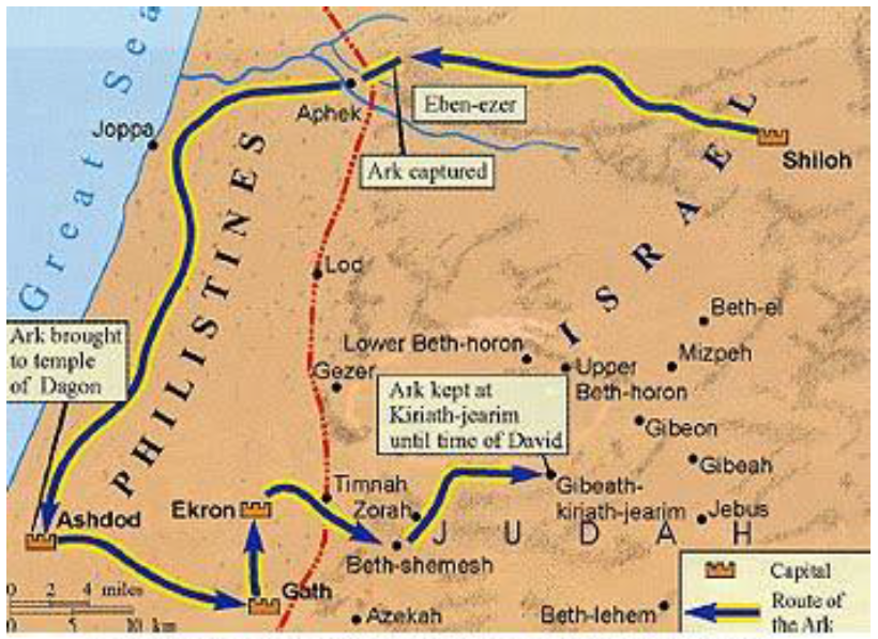
Share(ב) כֵּיוָן שֶׁנִּכְנְסוּ לָאָרֶץ הֶעֱמִידוּ הַמִּשְׁכָּן בַּגִּלְגָּל אַרְבַּע עֶשְׂרֵה שָׁנָה שֶׁכָּבְשׁוּ וְשֶׁחִלְּקוּ. וּמִשָּׁם בָּאוּ לְשִׁילֹה וּבָנוּ שָׁם בַּיִת שֶׁל אֲבָנִים וּפָרְשׂוּ יְרִיעוֹת הַמִּשְׁכָּן עָלָיו וְלֹא הָיְתָה שָׁם תִּקְרָה. וְשס''ט שָׁנָה עָמַד מִשְׁכַּן שִׁילֹה וּכְשֶׁמֵּת עֵלִי חָרַב וּבָאוּ לְנֹב וּבָנוּ שָׁם מִקְדָּשׁ. וּכְשֶׁמֵּת שְׁמוּאֵל חָרַב וּבָאוּ לְגִבְעוֹן וּבָנוּ שָׁם מִקְדָּשׁ. וּמִגִּבְעוֹן בָּאוּ לְבֵית הָעוֹלָמִים. וִימֵי נֹב וְגִבְעוֹן שֶׁבַע וַחֲמִשִּׁים שָׁנָה:
(2) After [the Jews] entered The Land [of Israel],10In the year 2488 after creation. they erected the Sanctuary in Gilgal during the fourteen years in which they conquered and divided [the land].11The conquest of the Land took seven years, and the division took another seven years (Zevachim 118b). From there, they came to Shiloh,12In the year 2502, built a house of stone and spread the curtains of the Sanctuary over it. It did not have a roof. The Talmud (ibid.) explains:
I Samuel 1:24 declares: "And she brought him to the House of God, Shiloh" implying that the Ark was enclosed with a permanent structure. Another verse (Psalms 78:60 states: "He has forsaken the tabernacle of Shiloh" from which it can be inferred that it was a tent-like structure resembling the Sanctuary in the desert. How can the two verses be reconciled?
There was no roof. Though there was a structure of stone, the curtains [of the Sanctuary] were spread over it.
built a house of stone, and spread the curtains of the Sanctuary over it. It did not have a roof. The sanctuary of Shiloh stood for 369 years. When Eli died, it was destroyed.13In the year 2871, when the Philistines captured the Holy Ark and slew Eli's two sons.
The Sanctuary of Shiloh had a greater degree of holiness than the structure which preceded it and those that followed immediately thereafter. The Sifri states that the verse (Deuteronomy 12:5 : "The place which God has chosen to cause His name to dwell there" refers to "Shiloh and the Temple."
The uniqueness of Shiloh is further emphasized by the fact that while it stood, the Jews were forbidden to offer sacrifices in any other place. While the Ark was in Gilgal, and similarly, in Nov and Givon, the Jews were allowed to bring their individual sacrifices wherever they desired. However, during all the years the Sanctuary was in Shiloh, no sacrifices could be offered in any other location.
[Afterwards,] they came to Nov14When the Philistines returned the ark after the seven months of its captivity, they brought it to Kiryat Yearim (I Samuel, Chapters 6-7). During this time, a Sanctuary was constructed in Nov and afterwards, in Givon, to provide the Jews with a place for centralized worship. However, the ark was not kept there out of fear that it might again be captured by the Philistines (Meiri, Megillah, 9b). and built a sanctuary.15Of stone. Though the Rambam in his commentary on the Mishnah (Zevachim, ibid.) states that the Jews erected the Sanctuary that had stood in the desert in Nov, here he appears to follow the view mentioned by Rashi (Pesachim 38 a,b) which states that a stone structure was erected there. Similarly, Sotah 9a states that the sanctuary's structure was entombed when the Jews entered Eretz Yisrael. The Sanctuary of Nov stood for 44 years (Seder HaDorot). When Samuel died, it was destroyed.16By King Saul. And they came to Givon17On the outskirts of Jerusalem (see II Samuel, ch. 6). The Sanctuary stood there for approximately 13 years. and built a sanctuary. From Givon, they came to the eternal structure [in Jerusalem].18In the year 2928, as described in the beginning of I Kings. The days [the sanctuary stood] in Nov and Givon were 57 years.
אֵלּוּ חֲמִשָּׁה דְּבָרִים שֶׁהָיוּ בֵּין מִקְדָּשׁ רִאשׁוֹן לְמִקְדָּשׁ שֵׁנִי, וְאֵלּוּ הֵן: אָרוֹן וְכַפּוֹרֶת וּכְרוּבִים, אֵשׁ, וּשְׁכִינָה, וְרוּחַ הַקּוֹדֶשׁ, וְאוּרִים וְתוּמִּים.
The Gemara asks: How is that possible? It is a wooden vessel designated to rest in a fixed place and not to be moved. And it was taught: Any wooden vessel designated to rest in a fixed place is not susceptible to ritual impurity, and it serves as a barrier before impurity, preventing its transmission. Rather, the fact that the table is described as pure teaches that the priests lift it in order to display the shewbread to the Festival pilgrims, and they say to them: See how beloved you are before the Omnipresent, as the bread is as hot at its removal on Shabbat, after a week on the table, as it was at its arrangement, as it is stated: “To put out hot bread on the day it was taken away” (I Samuel 21:7). Since the table was moved on occasion, it was not considered a wooden vessel designated to rest and was therefore susceptible to impurity. At the same time, it is clear that the miracle of the shewbread was a miracle performed outside the Sanctuary, as it was visible to all.The Gemara asks: And are there no more miracles performed in the Temple? But didn’t Rav Oshaya say: When Solomon built the Temple he planted all sorts of precious golden fruits there, and these brought forth their fruit in their appointed season like other trees, and when the wind blew them the fruit would fall, as it is stated: “May his fruits rustle like Lebanon” (Psalms 72:16). This indicates that fruits grew in Lebanon, which the Sages interpreted as a reference to the Temple, which was built with cedar trees from Lebanon. And when the gentiles entered the Sanctuary the golden tree withered, as it stated: “And the blossoms of Lebanon wither” (Nahum 1:4). And the Holy One, Blessed be He, will restore the miraculous trees to Israel in the future, as it is stated: “It shall blossom abundantly, it shall also rejoice and shout, the glory of Lebanon will be given to it” (Isaiah 35:2). Apparently, there were additional miracles in the Temple.The Gemara responds: The tannadoes not count perpetual miracles on the list. The Gemara comments: Now that you have arrived at this solution, it can resolve an earlier difficulty as well: The Ark and the cherubs are also not counted, since they too were perpetual miracles.§ The Master said in listing the miracles that even strong winds were unable to displace the smoke of the arrangement of wood. The Gemara asks: And did smoke rise from the arrangement of wood on the altar? But wasn’t it taught in a baraita: There were five matters stated with regard to the fire of the arrangement of wood: It crouched above the wood like a lion; and it was as clear as the light of the sun; and it had substance to the extent that it could be felt; it was powerful enough to consume wet wood like dry wood; and it did not raise smoke.The Gemara answers: When we said that the smoke was not displaced, indicating that the wood produced smoke, that was in reference to the fire brought by a person, as it was taught in a baraita: “And the sons of Aaron the priest shall put fire upon the altar” (Leviticus 1:7), indicating that even though fire descends from the heavens, still there is a special mitzva to bring fire by a person. The fire that the priests brought produced smoke, and the miracle related to that smoke.The Gemara asks: And was the altar’s fire crouched like a lion? But wasn’t it taught in a baraita: Rabbi Ḥanina, the deputy High Priest, said: I saw the fire in the Temple and it was crouched like a dog and not a lion? The Gemara answers: This is not difficult. Here, where the baraita stated that the fire resembled a lion, it refers to the fire in the First Temple; there, where Rabbi Ḥanina, the deputy High Priest, said that the fire resembled a dog, it refers to the fire in the Second Temple.The Gemara asks: And was there fire that descended from the heavens in the Second Temple? Didn’t Rav Shmuel bar Inya say: What is the meaning of that which is written with regard to the Second Temple: “Go up to the hills and get wood and build the house; and I will look on it favorably and I will be glorified [ve’ekkaved], said the Lord” (Haggai 1:8)? Even though it is written ve’ekkaved, we read it ve’ikkavda, with an added letter heh. The Gemara explains: What is different that the word is missing the letter heh? This represents five, the numerological value of heh, phenomena that constituted the difference between the First Temple and the Second Temple, in that they were not in the Second Temple. And these are: The Ark of the Covenant, and the Ark cover upon it, and the cherubs that were on the Ark cover; fire; and the Divine Presence; and the Divine Spirit; and the Urim VeTummim. Apparently, there was no fire from heaven in the Second Temple. The Sages say in response: Yes, there was fire from heaven in the Second Temple; however, it did not assist in burning the offerings but was merely visible above the wood.Apropos the fire on the altar, the Gemara cites a related baraita. The Sages taught that there are six kinds of fire: There is fire that consumes solids and does not consume liquids; and there is fire that consumes liquids and does not consume solids; and there is fire that consumes solids and consumes liquids; and there is fire that consumes wet objects like dry objects; and there is fire that repels other fire; and there is fire that consumes other fire.The Gemara elaborates: There is fire that consumes solids and does not consume liquids; that is our standard fire that consumes dry items but does not dry liquids.
Fire that consumes liquids and does not consume solids is the fever of the sick that dehydrates the body but does not consume the flesh.
Fire that consumes solids and consumes liquids is the fire of Elijah the Prophet, as it is written: “And fire fell from the sky and consumed the offering and the wood and the stones and the earth, and it licked up the water that was in the trench” (I Kings 18:38).
Fire that consumes wet objects like dry objects is the fire of the arrangement of wood.There is fire that repels other fire; that is the fire of the angel Gabriel. The book of Daniel relates that Gabriel was an angel of fire who descended to the fiery furnace, repelled the fire, and rescued Hananiah, Mishael, and Azariah, who had been cast inside.
And there is fire that consumes other fire; that is the fire of the Divine Presence, as the Master said in another context: The Holy One, Blessed be He, extended His finger between the angels, who are also made of fire, and burned them. The fire of the Divine Presence consumed the fire of the angels.§ The Gemara asks: And with regard to the smoke of the arrangement, is it so that even if all the winds in the world come and blow it, they do not move it from its place and it rises directly heavenward? Didn’t Rabbi Yitzḥak bar Avdimi say: At the conclusion of the final day of the festival of Sukkot, everyone looks to the smoke of the arrangement of wood; if the wind blew from the south and the smoke tends toward the north, the poor were glad and the homeowners were sad. This is because it was a sign that the year’s rains would be plentiful, producing an abundant crop on the one hand, but on the other hand, the fruit would rot due to the humidity, rendering it impossible to store the abundant harvest. This forced the landowners to sell quickly at a lower price. And if a northern wind caused the smoke to tend toward the south, the poor were sad and the homeowners were glad, because it was an indication that the year’s rains would be sparse. The yield would be low, and it would be easy to store the fruit and sell it at a higher price.If a western wind caused the smoke to tend to the east, that was an indication that there would be sufficient rainfall to ensure a substantial crop, and at the same time, it would be possible to store the fruit, and everyone was glad. If an eastern wind caused the smoke to tend to the west that was an indication that there would be a drought because eastern winds do not bring rain, and everyone was sad. Apparently, wind causes the smoke rising from the arrangement of wood to move. The Gemara responds: The smoke comes and goes like a palm tree, swaying in the wind, but it did not disperse.The Master said: If a western wind caused the pillar of smoke to tend to the east everyone is glad; if an eastern wind caused the smoke to tend to the west everyone was sad. And the Gemara raised a contradiction, as the Sages said: An eastern wind is always good; a western wind is always bad; a northern wind is good for wheat when it has reached one-third of its potential growth, and bad for olives when they are ripening; a southern wind is bad for wheat when it has reached one-third of its potential growth, and good for olives when they are ripening.And Rav Yosef said, and some say it was Mar Zutra who said it: And your mnemonic for which is good for wheat and which for olives is that in the Temple the table was in the north and the candelabrum was in the south of the Sanctuary. Bread made out of wheat was placed on the table, and oil made out of olives was burned in the candelabrum. The wind coming from this side, the north, increased its own component, wheat; and the wind coming from this side, the south, increased its own component, olives. In any event, there are contradictory opinions with regard to the effect of western and eastern winds.The Gemara responds: This is not difficult: This opinion that a wind from the east is good is for us, in Babylonia. Babylonia is a land whose water is plentiful, and a dry east wind will not harm the crop at all. This opinion that a wind from the east is harmful is for them, in Eretz Yisrael. That is a land where water is sparse, and the dry east wind will dry the land and ruin the crops.
(ד) וגם זאת נמצא כתוב, כי הגיד להם על פי ה', לשאת אתם את אוהל מועד ואת הארון.
(ה) ויהי בבואם ההרה אשר עלה עליו משה לראות את הארץ, וימצא ירמיהו שם מערה ויסתר בה את האוהל ואת הארון ואת מזבח הקטורת, ויסתום את פיה.
(1) It was also written in the books, that Jeremiah the prophet commanded the exiles to take the fire and hide it like we said.
(2) [Jeremiah] also gave them the book of the Torah of The Lord so they should not forget it, and they should not be seduced in their hearts to turn from the path, when they see graven images of gold and silver with the pride of their glory.
(3) [Jeremiah] taught them many proven things, so that the Torah of The Lord would not leave their hearts.
(4) This was also written, that [Jeremiah] told them according to the mouth of The Lord, to take with them The Tent of Meeting and The Ark.
(5) It was when they came to the mountain that Moses ascended to see the land, Jeremiah found a cave there and he hid The Tent of Meeting, The Ark, and The Alter of Incense in it, and he closed [the cave's] opening.
(6) Some of the people that went with [Jeremiah] tried to make a sign [at the cave] for themselves, yet they became tired from looking for the cave.
(7) Jeremiah heard [about it] and he rebuked them and said. "No man will know the location [of the cave], until The Lord will gather his nation and grant them mercy.
(8) Then The Lord will reveal the location [of the cave], and the glory of The Lord will shine in a cloud, as it was in the days of Moses and Solomon when they begged The Lord to sanctify ?himself? (unclear pronoun)."
(9) Jeremiah told them about the wisdom of Solomon and about the sacrifices that [Solomon] offered [at] the time of the dedication of the alter, when he finished erecting the temple of The Lord.
(10) When Moses prayed, A fire left from the presence The Lord and consumed the burnt offering that was on the alter. In this manner Solomon's prayer was also answered.
(11) For a fire descended from the heavens and consumed the burnt offering and the sacrifices.
(12) And when Moses searched [?in the ashes for?] the ram of the sin offering, Behold! it was charred and no man ate of it. So did Solomon when he offered his sacrifices to The Lord [all] eight days.
(13) All these events can be found in The Chronicles that were written in the days of Nehemiah.
(14) When Nehemiah searched for the books of David, the kings, the prophets, and [anything] that had information about the sacrifices, he collected them into a collection.
(15) So did Judah, when he collected the books that were scattered and dispersed in the storm of the war throughout the land.
(16) They are being guarded in our hands, and if you are desiring of them, send to us and they will be sent to you.
(17) Now, we wrote for you all of these things, so that you will celebrate this festival with us according to what is fit for you.
(18) We are hoping of The Lord our God that he will redeem his nation, and return to us our portion, the kingdom, and the service of the priests that was promised in His holy Torah.
(19) So he should be merciful upon us and gather our dispersed from under the heavens, to bring them to our holy land, just like he has begun to remove us from our distant places, and he purified his temple.
(20) And the deeds of Judah Maccabeus, his brothers, the purification of the temple from its impurity, the dedication ceremony of the temple, and the wars against Antiochus the great and his son Aopater.
(21) And the heavenly signs that the strong and zealous saw for the congregation of Israel.
(22) How is it that my tiny battalion chased the massive legions of the nations? They pursued them and they disgraced their land.
(23) And the redemption of our holy city, and the construction of the house whose splendor covers the entire world.
(24) And when The Lord established upon us with kindness his rules and laws that had almost been dissolved throughout the land.
(25) All these words that Jesus the Cyrenean wrote on five scrolls, I tried to condense his words and deliver them on one scroll.
(26) For when I saw that the accounts of events were mixed up, and that its many words were burdensome to the reader.
(27) I decided to retell [the events] in their proper order, in order that the reader would run through them, and that it would be easy [for the reader] to understand them and remember them.
(28) I certainly knew that in my endeavor to abridge [the book of Jesus the Cyrenean] a great and heavy task befell me; the sweat of my brow and nights of hard work were prepared for me.
(29) Yet when a man will make a feast, the responsibilities of catering to the desires of his guests also fall upon him.
(30) Therefore I was not afraid to burden my shoulders with the work, [because it would] benefit all who would desire it.
(31) I left some of the stories in the format of the original author, my work was only to abridge his words.
(32) This is just like the work of a carpenter, when he builds a house he worries and thinks about the foundation and structure of the house, and he leaves the decoration and beautification[of the house] to another person. This is what I did.
(33) For the way of all historians is to search and investigate every incident and event, to collect everything in order and to organize [the events] according to his desire.
(34) But for one who abridges there is a given rule to lay out the main part of the events, and to display them before the reader in a brief manner.
(35) And after I began this, I turned my attention to the chronicles, ?in order that the key of the book would not grow from within his words? (translation uncertain)


Hill of Tara, Ireland 1899
״מִשֶּׁנִּגְנַז״ לָא קָתָנֵי, אֶלָּא ״מִשֶּׁנִּיטַּל״. תְּנַן כְּמַאן דְּאָמַר אָרוֹן גָּלָה לְבָבֶל. דְּתַנְיָא, רַבִּי אֱלִיעֶזֶר אוֹמֵר: אָרוֹן גָּלָה לְבָבֶל, שֶׁנֶּאֱמַר: ״וְלִתְשׁוּבַת הַשָּׁנָה שָׁלַח הַמֶּלֶךְ נְבוּכַדְנֶאצַּר וַיְבִיאֵהוּ בָבֶלָה עִם כְּלֵי חֶמְדַּת בֵּית ה׳״.רַבִּי שִׁמְעוֹן בֶּן יוֹחַאי אוֹמֵר: אָרוֹן גָּלָה לְבָבֶל, שֶׁנֶּאֱמַר: ״לֹא יִוָּתֵר דָּבָר אָמַר ה׳״ — אֵלּוּ עֲשֶׂרֶת הַדִּבְּרוֹת שֶׁבּוֹ.רַבִּי יְהוּדָה (בֶּן לָקִישׁ) אוֹמֵר: אָרוֹן בִּמְקוֹמוֹ נִגְנַז, שֶׁנֶּאֱמַר: ״וַיֵּרָאוּ רָאשֵׁי הַבַּדִּים מִן הַקֹּדֶשׁ עַל פְּנֵי הַדְּבִיר וְלֹא יֵרָאוּ הַחוּצָה וַיִּהְיוּ שָׁם עַד הַיּוֹם הַזֶּה״.
not to begin piling the incense in front of you, i.e., from the side closest to you, lest you be burned. If the priest were to place the incense on the side directly in front of him and then proceed to spread it toward the Ark, his hands would pass over the incense that is already burning and he might burn himself.§ The Sages taught in a baraita: “And he shall put the incense upon the fire before the Lord” (Leviticus 16:13); this means that he should not prepare by placing the incense outside, in the Sanctuary, and bring into the Holy of Holies a coal pan holding the burning incense. This was emphasized in order to exclude the opinion of the Sadducees, who say that he should prepare the incense outside and then bring it in.The Gemara asks: What did the Sadducees interpret; what verse do they cite as the basis for their opinion? The Gemara answers that it was the verse: “For I will appear in a cloud upon the Ark cover” (Leviticus 16:2), which the Sadducees say teaches that he should prepare it outside, so there would already be a cloud of incense, and only then should he bring it inside the Holy of Holies.The Sages said to them: Wasn’t it already stated explicitly: “And he shall put the incense upon the fire before the Lord” (Leviticus 16:13), which indicates that the High Priest should present the incense only when he stands before God in the Holy of Holies? If so, what is the meaning when the verse states: “For I will appear in a cloud upon the Ark cover” (Leviticus 16:2)? This verse does not mean that there should already be an incense cloud before he enters.Instead, this verse is referring to the shape of the incense cloud, and it teaches that he includes a smoke-raiser in its spices, a plant that causes the smoke to rise straight up like a staff. And from where is it derived that he includes a smoke-raiser in its spices? As it is stated: “And the incense cloud shall cover the Ark cover” (Leviticus 16:13). Therefore, if he did not include a smoke-raiser, or if he omitted any one of its spices, he is liable to receive the death penalty.The Gemara analyzes this last halakha: Why does one incur the death penalty for omitting one of the spices? And let the tannaderive the fact that he incurs the death penalty for a different action, as his entry into the Holy of Holies is for no purpose. It is prohibited to enter the Holy of Holies unless one is performing a mitzva. If the incense lacks an ingredient, the High Priest is not truly performing the mitzva, and therefore he has entered the Holy of Holies for no purpose. Consequently, he incurs the death penalty on account of his entry, even without burning the incense.Rav Sheshet said: With what are we dealing here? We are dealing with a case where he acted unwittingly with regard to the entry, i.e., he was unaware that entering for no reason renders him liable, or he did not mean to enter the Holy of Holies at all; and he acted intentionally with regard to the burning, knowing that one who burns incense that lacks an ingredient incurs the death penalty. In that case, he is liable to receive the death penalty only for burning incomplete incense.Rav Ashi said a different explanation: Even if you say that he acted intentionally with regard to both this and that, i.e., he knew full well that he would be liable to receive the death penalty both for burning incomplete incense and for entering the Holy of Holies for no purpose, it is nevertheless possible that he is not liable to receive the death penalty for his entry. And Rav Ashi explains that this is the halakha in a case where he brought two sets of incense into the Holy of Holies, one complete with all the spices and one incomplete, both of which he burned. For his entry to the Holy of Holies he is not liable to be put to death, as he brought in a coal pan with complete incense and thereby fulfilled the mitzva. However, for burning he is liable to receive the death penalty, as he burns incomplete incense.§ The Gemara analyzes the above baraita. The Master said in the baraita: And from where is it derived that he includes a smoke-raiser in its spices? The verse states: “And it shall cover” (Leviticus 16:13). The Gemara expresses surprise at this statement: One verse for another verse? The requirement of a smoke-raiser was already proven from the verse: “For I will appear in a cloud upon the Ark cover” (Leviticus 16:2); why cite a second verse in support of the first one?Rav Yosef said: This is what the baraitasaid; this is how to understand the matter: I have derived nothing other than the obligation to bring a leaf of a smoke-raising plant. From where is it derived that he must also bring a root of a smoke-raiser? The verse states: “And it shall cover,” which indicates the requirement for more of the smoke-raiser than might have been supposed from the other verse.Abaye said to Rav Yosef: Your interpretation indicates that the leaf of the smoke-raiser raises smoke better than its root, as the requirement for a root is merely considered an addition. But wasn’t the opposite taught in a baraita? As it was taught in a baraita: He put into the incense a root of a smoke-raiser, and the smoke would rise in a column like a staff until it reached the Temple ceiling. When it reached the ceiling there was nowhere for the smoke to exit the building, and therefore it slowly descended the walls until the entire House was filled with smoke, as it is stated: “And the House was filled with smoke” (Isaiah 6:4). This baraita indicates that the root of the smoke-raiser raises smoke better than its leaf.Rather, Abaye said that this is what the baraitasaid; this is how it should be understood: I have derived nothing other than the obligation to bring a root of a smoke-raising plant. From where is it derived that he must also bring a leaf of a smoke-raiser? The verse states: “And it shall cover.”Rav Sheshet said that the baraita means the following: I have derived nothing other than the inclusion of a smoke-raiser amongst the other spices in the Tent of Meeting that was in the wilderness; from where is it derived that this obligation extends to the Tabernacle at Shiloh and in the eternal Temple in Jerusalem? The verse states: “And it shall cover,” which indicates that wherever the High Priest enters the Holy of Holies to burn incense, he must include a smoke-raiser in its ingredients.The Gemara raises a difficulty with regard to this interpretation: Thishalakhais derived from the verse: “And so shall he do for the Tent of Meeting that dwells with them” (Leviticus 16:16). This verse teaches that this rite must be performed not only that first time in the wilderness, but wherever the Divine Presence dwells.Rather, this is what the baraitasaid: I have derived nothing other than the obligation to include a smoke-raiser in the spices of the incense offered on Yom Kippur in the Holy of Holies; from where is it derived that this obligation applies to the incense offered on the rest of the days of the year in the Sanctuary? The verse states: “And it shall cover,” to teach that every incense burned in the Temple must include a smoke-raiser.Rav Ashi said: One verse teaches us the mitzva itself, and one verse teaches that this requirement is indispensable, i.e., the rite is invalid if one omits this ingredient. Rava said: One verse teaches that the omission of the smoke-raiser renders one liable to receive the punishment of death, and one verse serves as a warning that it is prohibited to omit it, as the Torah does not require punishment without issuing a warning.§ It was taught in a baraita that Rabbi Eliezer says: “Speak to Aaron your brother that he should not come at all times into the sacred place within the curtain, before the Ark cover that is upon the Ark; that he not die” (Leviticus 16:2). This verse teaches the punishment for the omission of the smoke-raiser from the spices of the incense. With regard to the verse: “For I will appear in a cloud upon the Ark cover” (Leviticus 16:2); this is the warning that it is prohibited to omit the smoke-raiser, which causes the cloud to rise.One might have thought that both verses were said before the deaths of Aaron’s sons, who died upon entering the sacred place. Therefore, the verse states: “After the deaths of the two sons of Aaron” (Leviticus 16:1). One might have thought that both of them, the punishment and the warning, were said after the deaths of Aaron’s two sons. Therefore, the verse states: “For I will appear in a cloud upon the Ark cover.” How so; how should these verses be understood? The warning was said before the death of Aaron’s sons, and the punishment associated with it was stated after the death of his sons.The Gemara expresses puzzlement at Rabbi Eliezer’s statement: What is the biblical derivation? How does Rabbi Eliezer learn from the phrase “I will appear” that the warning was stated earlier? Rava said that the verse states: “For I will appear in a cloud”; the future tense indicates that the cloud over the Ark cover had not yet appeared, as the Tabernacle had not been built, which means that this command was issued before Aaron’s sons entered and died. The Gemara asks: Rather, what is the reason that Aaron’s sons were punished with death, if the punishment had not been stated? The Torah does not punish one who is unaware of the sin’s punishment.The Gemara answers: They were not punished for their entry into the sacred place but for a different reason, as it was taught in a baraita that Rabbi Eliezer says: Aaron’s sons died only because they taught a halakha before Moses their teacher; they should have asked him for his ruling, but they neglected to do so. The Gemara asks: What did they interpret from the verse that led them to enter the sacred place with fire? The verse states: “And the sons of Aaron the priest shall put fire upon the altar” (Leviticus 1:7), which indicates that although fire descends from the heavens, it is a mitzva to bring man-made fire. To fulfill this mitzva, Aaron’s sons entered and brought fire to the altar. Although their ruling was in accordance with the halakha, they incurred the death penalty for failing to ask Moses.§ The mishna teaches that the High Priest exits and comes out the way that he entered, i.e., he does not turn around, but walks backward with his face toward the Ark. The Gemara asks: From where are these matters derived; what is the source in the Torah for this halakha? Rabbi Shmuel bar Naḥmani said that Rabbi Yonatan said that the verse states: “And Solomon came to the high place that was at Gibeon, Jerusalem” (II Chronicles 1:13). Now, what does Gibeon have to do with Jerusalem? Either he came to Gibeon or to Jerusalem; these are two different places.Rather, the verse compares his exit from Gibeon to Jerusalem to his arrival from Jerusalem to Gibeon. Just as in the case of his arrival from Jerusalem to Gibeon his face was necessarily turned toward the high place, in the usual manner of a person’s arrival, so too, upon his exit from Gibeon to Jerusalem his face was still turned toward the high place, in the manner of his arrival. This teaches that one does not turn his face away from a sacred place; rather, he must walk backward.And likewise, with regard to priests in their service; and Levites on their platform in the Temple, where they recited songs; and Israelites at their watches, where they observed the sacrifice of the daily offering: When they departed from the sacred place, they would not turn their faces and walk but would turn their faces sideways and walk, so as not to turn their backs on the sacred place.And likewise, a student who takes leave of his teacher should not turn his face and walk but turn his face sideways and walk. This is in accordance with that practice of Rabbi Elazar when he took leave of his teacher, Rabbi Yoḥanan. When Rabbi Yoḥanan wanted to leave him, Rabbi Elazar would bend down and stand in his place as a sign of respect and humility, until Rabbi Yoḥanan disappeared from his sight; only then would Rabbi Elazar turn to leave.And when Rabbi Elazar wanted to leave, he would walk backward until he disappeared from Rabbi Yoḥanan’s sight, and only then would he walk normally, so as not to turn his back on his teacher. The Gemara further relates: When Rava took leave of Rav Yosef, he would walk backward, paying no attention to the obstacles in his path, until his legs were bruised and the threshold of Rav Yosef’s house was bloodied from Rava’s wounds.They said to Rav Yosef: This is what Rava does. Rav Yosef was blind and could not see for himself. Rav Yosef said to him: May it be God’s will that you lift your head over the entire city, in reward for honoring your teacher.§ Apropos the obligation of a student to walk backward when taking leave of his teacher, the Gemara discusses a similar topic. Rabbi Alexandri said that Rabbi Yehoshua ben Levi said: One who prays must take three steps backward upon concluding his prayer and then recite: Peace, in a manner befitting one who departs from before the Holy One, Blessed be He. Rav Mordekhai said to him: Since he has taken three steps backward, he should stand there and not return to his place immediately. This is analogous to a student who takes leave of his teacher. If he returns immediately to the place where was first standing, he is similar to a dog who returns to its vomit, and his previous action is spoiled.The Gemara comments that this was also taught in a baraita: One who prays must take three steps backward upon concluding his prayer and then recite: Peace. And if he did not do so, it is better for him not to have prayed, as his actions are disrespectful toward God. And they said in the name of Shemaya the Sage that when one recites: Peace, he first bows to the right and then to the left, as it is stated: “At His right hand was a fiery law to them” (Deuteronomy 33:2), and it says: “A thousand may fall at your side, and ten thousand at your right side” (Psalms 91:7).The Gemara asks: What is the reason for: And it says? Why is it necessary to cite another source? The Gemara explains: If you say that it is merely the usual manner to give an object with the right hand, but this bears no special significance, come and hear: “A thousand may fall at your side, and ten thousand at your right side,” which indicates that the right side is the more significant one.The Gemara relates that Rava saw Abaye reciting: Peace, by bowing at the end of his prayer to his right first. Rava said to him: Do you maintain that you should bow to your right? I say you should bow to your left first, as it is the right of the Holy One, Blessed be He, since He is opposite you face-to-face, as it were. Rav Ḥiyya, son of Rav Huna, said: I observed that Abaye and Rava both took those three steps all in one act of bowing, without standing upright in between, by way of submission to and acceptance of God’s authority.§ The mishna taught: And the High Priest recites a brief prayer in the outer chamber. The Gemara asks: What does he pray? Rava bar Rav Adda and Ravin bar Rav Adda both said in the name of Rav that this was his prayer: May it be your will, Lord our God, that this year shall be rainy and hot. The Gemara immediately expresses surprise at this request: Is heat a good matter? Why should he request that the year be hot? Rather, say and emend it as follows: If the upcoming year is hot, may it also be rainy, lest the heat harm the crops.Rav Aḥa, son of Rava, concluded the language of this prayer in the name of Rav Yehuda: May the rule of power not depart from the house of Judah; and may your nation Israel not depend on each other for sustenance, rather, they should be sustained from the produce of their land; and let not the prayer of travelers enter Your presence when they pray for the rain to stop on their travels.The Gemara relates: Rabbi Ḥanina ben Dosa was walking on the road when rain fell upon him. He said: Master of the Universe, the entire world is comfortable and Ḥanina is suffering. The rain stopped. When he came to his house he said: Master of the Universe, the entire world is suffering for lack of rain and Ḥanina is comfortable. The rain came back. Rav Yosef said: What effect does the prayer of the High Priest have with regard to Rabbi Ḥanina ben Dosa? Notwithstanding the prayer of the High Priest in the Holy of Holies, Rabbi Ḥanina ben Dosa’s sanctity is greater, as God fulfills his bidding.§ The mishna stated that the High Priest would not extend his prayer. The Sages taught in the Tosefta: There was an incident involving a certain High Priest who extended his prayer, and his fellow priests took a vote, counted, and decided to go in after him out of concern that he had died or fainted and required assistance. They began to enter and at that moment he emerged. They said to him: Why did you extend your prayer? He said to them: Why not? Does it trouble you that I prayed for you and for the Temple not to be destroyed? They said to him: Do not make a habit of doing so, as we learned: He would not extend his prayer, so as not to alarm the Jewish people, who might fear he had died.MISHNA:After the Ark was taken into exile, there was a rock in the Holy of Holies from the days of the early prophets, David and Samuel, who laid the groundwork for construction of the Temple, and this stone was called the foundation rock. It was three fingerbreadths higher than the ground, and the High Priest would place the incense on it. After the High Priest left the Holy of Holies, he took the blood of the bull sacrificed as a sin-offering from the one who was stirring it, so it would not coagulate. He entered into the place that he had previously entered, the Holy of Holies, and stood at the place where he had previously stood to offer the incense, between the staves. And he sprinkled from the blood, one time upward and seven times downward.And he would neither intend to sprinkle the blood upward nor to sprinkle it downward, but rather like one who whips, with the blood sprinkled in a single column, one drop below the other. And this is how he would count as he sprinkled, to avoid error: One; one and one; one and two; one and three; one and four; one and five; one and six; one and seven. The High Priest then emerged from there and placed the bowl with the remaining blood on the golden pedestal in the Sanctuary.They brought him the goat to be sacrificed as a sin-offering to God. He slaughtered it and received its blood in the bowl. He again entered into the place that he had previously entered, the Holy of Holies, and stood at the place that he previously stood, and sprinkled from the blood of the goat one time upward and seven times downward. And this is how he would count, just as he counted when sprinkling the blood of the bull: One; one and one; one and two; etc. The High Priest then emerged from the Holy of Holies and placed the bowl with the remaining blood on the second golden pedestal in the Sanctuary. Rabbi Yehuda says: There was only one pedestal there, and he took the blood of the bull from the pedestal and placed the blood of the goat in its place.And he sprinkled from the blood of the bull on the curtain opposite the Ark from outside the Holy of Holies, one time upward and seven times downward, and he would not intend, etc. And this is how he would count, etc. When he concluded, he took the blood of the goat from the pedestal and placed blood of the bull in its place on the pedestal. And he sprinkled from the goat’s blood on the curtain opposite the Ark from outside, just as he did with the blood of the bull, one time upward and seven times downward, etc. Afterward, he poured the blood of the bull into the blood of the goat and placed the blood from the full bowl into the empty bowl, so that the blood would be mixed well.GEMARA: The Gemara comments with regard to the wording of the mishna: It does not teach: After the Ark was buried, but: After it was taken. If so, we learned this mishna in accordance with the opinion of the one who said that the Ark was exiled to Babylonia and was not buried in its place, as it was taught in a baraita: Rabbi Eliezer says: The Ark was exiled to Babylonia, as it is stated: “And at the turn of the year King Nebuchadnezzar sent and brought him to Babylonia, along with the precious vessels of the House of the Lord” (II Chronicles 36:10). These precious vessels must include the Ark.Likewise, Rabbi Shimon ben Yoḥai says: The Ark was exiled to Babylonia, as it is stated: “Behold, the days come that all that is in your house, and that which your fathers have stored until this day, shall be carried to Babylonia; nothing [davar] shall be left, says the Lord” (Isaiah 39:6). These are the Ten Commandments [dibrot] that are inside it; they too shall not be left behind.Rabbi Yehuda ben Lakish says: The Ark was buried in its place, as it is stated: “And the ends of the staves were seen from the sacred place before the partition, but they could not be seen without; and they are there to this day” (I Kings 8:8). The expression “to this day” means forever, as the text might be read at any time. This teaches that the Ark is hidden in its place.The Gemara comments: And this opinion that the Ark was exiled to Babylonia disagrees with that of Ulla, as Ulla said: Rabbi Matya ben Ḥarash asked Rabbi Shimon ben Yoḥai in Rome: And since Rabbi Eliezer taught us once and twice, i.e., from two separate verses, that the Ark was exiled to Babylonia. The Gemara interrupts its citation of Rabbi Matya ben Ḥarash’s question to identify these two verses. The first verse is that which we said: “And brought him to Babylonia, along with the precious vessels of the House of the Lord.” What is the second verse? Rabbi Eliezer said: As it is written: “And gone from the daughter of Zion is
(א) אֶבֶן הָיְתָה בְּקֹדֶשׁ הַקָּדָשִׁים בְּמַעֲרָבוֹ שֶׁעָלֶיהָ הָיָה הָאָרוֹן מֻנָּח. וּלְפָנָיו צִנְצֶנֶת הַמָּן וּמַטֵּה אַהֲרֹן. וּבְעֵת שֶׁבָּנָה שְׁלֹמֹה אֶת הַבַּיִת וְיָדַע שֶׁסּוֹפוֹ לֵחָרֵב בָּנָה בּוֹ מָקוֹם לִגְנֹז בּוֹ הָאָרוֹן לְמַטָּה בְּמַטְמוֹנִיּוֹת עֲמֻקוֹת וַעֲקַלְקַלּוֹת וְיֹאשִׁיָּהוּ הַמֶּלֶךְ צִוָּה וּגְנָזוֹ בַּמָּקוֹם שֶׁבָּנָה שְׁלֹמֹה שֶׁנֶּאֱמַר (דברי הימים ב לה ג) "וַיֹּאמֶר לַלְוִיִּם הַמְּבִינִים לְכָל יִשְׂרָאֵל הַקְּדוֹשִׁים לַה' תְּנוּ אֶת אֲרוֹן הַקֹּדֶשׁ בַּבַּיִת אֲשֶׁר בָּנָה שְׁלֹמֹה בֶן דָּוִיד מֶלֶךְ יִשְׂרָאֵל אֵין לָכֶם מַשָּׂא בַּכָּתֵף עַתָּה עִבְדוּ אֶת ה' אֱלֹקֵיכֶם" וְגוֹ'. וְנִגְנַז עִמּוֹ מַטֵּה אַהֲרֹן וְהַצִּנְצֶנֶת וְשֶׁמֶן הַמִּשְׁחָה וְכָל אֵלּוּ לֹא חָזְרוּ בְּבַיִת שֵׁנִי. וְאַף אוּרִים וְתֻמִּים שֶׁהָיוּ בְּבַיִת שֵׁנִי לֹא הָיוּ מְשִׁיבִין בְּרוּחַ הַקֹּדֶשׁ. וְלֹא הָיוּ נִשְׁאָלִין בָּהֶן שֶׁנֶּאֱמַר (עזרא ב סג) (נחמיה ז סה) "עַד עֲמֹד כֹּהֵן לְאוּרִים וְתֻמִּים". וְלֹא הָיוּ עוֹשִׂין אוֹתָן אֶלָּא לְהַשְׁלִים שְׁמוֹנָה בְּגָדִים לְכֹהֵן גָּדוֹל כְּדֵי שֶׁלֹּא יְהֵא מְחֻסַּר בְּגָדִים:
(1) The Ark was placed on a stone1Yoma 53b refers to that stone as the even hashtiah, "the foundation stone", and explains that it was given that name because it was the foundation upon which God fashioned the world. According to certain views, the Dome of the Rock Mosque is located on the Temple site and the stone around which it is built is the same even hashtiah. Other Rabbinical sources, however, do not accept this claim. in the western portion of the Holy of Holies.2There is a slight difficulty in the Rambam's statements. The Jerusalem Talmud (Bava Batra 6:2) states that the Ark was placed in the center of the Holy of Holies. A similar statement is also found in the Midrash Tanchuma (Parshat Kedoshim, sec. 10). However, the latter source states that the Even HaShtiah was placed behind the Ark. Perhaps the resolution is that stone was large. It began in the center of the Holy of Holies, while the ark was placed in its western portion. The vial of manna3Exodus 16:33 commands: "Take a vial and fill it with an omer of manna. Place it before the Lord as a testimonial for your descendants. "
Commenting on that verse, Rashi relates that in the time of Jeremiah, the people rationalized the fact that they did not study Torah, because of the pressures they faced in earning a livelihood. Jeremiah took the vial of manna from before the Ark and exclaimed: "See how God sustained your ancestors for forty years! Do you doubt whether He can sustain you today?" and Aharon's staff4After Korach's revolt, God commanded all the princes of the tribes to place their staffs in the Sanctuary. Aharon's staff blossomed, and produced leaves and almonds. Then, He commanded that Aharon's staff be placed before the Ark "as a testimonial" (Numbers 17:21-25). were placed before it.
When Solomon built the Temple, he was aware that it would ultimately be destroyed. [Therefore,]5I.e., to preserve the Ark fashioned under the direction of Moses, he constructed a chamber, in which the ark could be entombed below [the Temple building] in deep, maze-like vaults.
King Josiah6The last of Judah's righteous kings. He witnessed the spiritual decline of the Jewish people and foresaw the inevitable destruction of the Temple. commanded that [the Ark] be entombed in the chamber built by Solomon, as it is said (II Chronicles 35:3 : "And he said to the Levites who would teach wisdom to all of Israel: 'Place the Holy Ark in the chamber built by Solomon, the son of David, King of Israel. You will no [longer] carry it on your shoulders. Now, serve the Lord, your God.'7The entombment of the Ark is the subject of a debate among the Sages in the Talmud (Yoma 53b) and the Tosafta (Sotah 13:2). Although some Sages agree that the Ark was entombed as explained above, others maintain that it was one of the sacred articles plundered by the Babylonian conquerors. A third opinion agrees that it was entombed, but argues that it was entombed under the Chamber of Wood in the Woman's Courtyard and not under the Holy of Holies.
When it was entombed, Aharon's staff, the vial of manna, and the oil used for anointing were entombed with it. All these [sacred articles] did not return in the Second Temple.
Similarly, the Urim V'Tumim that existed in the Second Temple did not answer with Ruach HaKodesh (Divine inspiration)8Yoma 73b and the commentaries (Nachmanides and Rabbenu Bachai on Numbers 28:21 explain that the Urim V'Tumim were consulted as oracles by the High Priest. They provided guidance on all important questions involving the people as a whole. See the conclusion of Hilchot K'lei HaMikdash for a discussion of this issue. and questions were not asked of them, as stated [in Ezra 2:63]: "until a priest will arise with the Urim V'Tumim."9Yoma 21b mentions the Urim V'Tumim as one of the five miraculous aspects of the First Temple service, which were lacking in the Second Temple. The Rambam quotes that statement in Hilchot K'lei HaMikdash 10:10.
Nevertheless, they were not completely lacking. Exodus 28:43 commands the priests to wear all of the garments prescribed for them during their service in the Sanctuary. If even one garment was lacking, they would be punished by death. Thus, the High Priest had to wear the breastplate with the stones, the Urim V'Tumim. Otherwise, he would lack one of the eight garments he was required to wear. The Rambam explains that although the stones were embedded in the breastplate in the Second Temple as well, they lacked the spiritual dimension that they had possessed in the First Temple. [In the Second Temple,] they only made them to fulfill the requirement of eight garments for the High Priest.10These garments are described in Exodus, Chapter 28, and in Hilchot K'lei HaMikdash, ch. 8. Thus, the High Priest would not lack one of the required garments.11The Ra'avad does not accept the Rambam's statements concerning the Urim V'Tumim. He interprets the Urim V'Tumim as being mystical names of God engraved on the breastplate, rather than the stones themselves.
In his Chiddushim, Rav Yaakov Emden questions the reason for including this Halachah: "On the surface, there is apparently no practical relevance to these matters in our behavior....The Rambam generally does not include aspects which have neither Halachic nor ethical significance in this text." Why then is it important for us to know whether or not the ark was entombed and where it was entombed?
Rav Emden then explains the question he posed, based on the Rambam's statements in Chapter 6. There, the Rambam stated that after the exile, the sanctity of Eretz Yisrael was nullified regarding the laws of the Sabbatical year, the tithes, and certain other agricultural rulings. However, the holiness of Jerusalem and the Temple Mount always remained intact because:
The holiness of the Temple and Jerusalem comes about because of the Shechinah, and the Shechinah can never be nullified. Behold, God declared (Leviticus 27:31 : "I shall destroy your Sanctuaries." and the Sages commented (Megillah 28a): "Even though they are destroyed, their holiness remains intact. "
The Shechinah's resting place was the Ark. Therefore, had the Ark not been "entombed...in deep, maze-like vaults," on the Temple Mount, the sanctity of that site would also have been nullified. See also Chatam Sofer, Chullin 7a.
Likkutei Sichot (Vol. 21, p. 156-160) also discusses the same question. It explains that the Ark is a fundamental element of the Temple and the Temple building cannot be complete without it.
Therefore, from the very beginning of the Temple's construction, the Ark had two locations:
a) the place for the ark in the Holy of Holies,
b) the hidden vault where the Ark would be kept in the event of the Temple's destruction.
On this basis, we can see the Sanctuary built by Moses, the two Temples in Jerusalem, and the Messianic Temple, as unified by one essential bond. Since the same Ark was present in all previous structures and they will be revealed again in the Messianic age, all four buildings share the same essence.
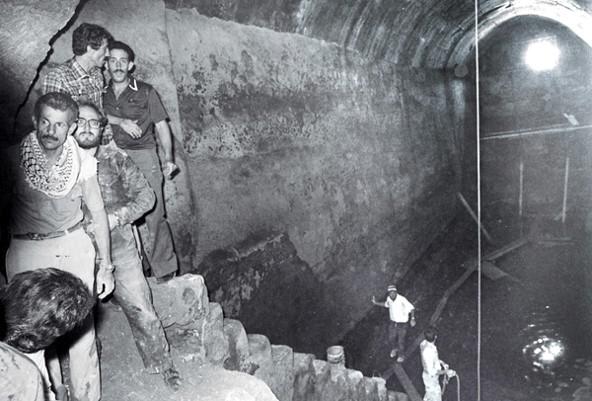
Warren Tunnel Project late 1970's early 1980"s
וַחֲכָמִים אוֹמְרִים: אָרוֹן בְּלִשְׁכַּת דִּיר הָעֵצִים הָיָה גָּנוּז. אָמַר רַב נַחְמָן בַּר יִצְחָק: אַף אֲנַן נָמֵי תְּנֵינָא: מַעֲשֶׂה בְּכֹהֵן אֶחָד שֶׁהָיָה מִתְעַסֵּק, וְרָאָה רִצְפָּה מְשׁוּנָּה מֵחַבְרוֹתֶיהָ, וּבָא וְהוֹדִיעַ אֶת חֲבֵירוֹ, וְלֹא הִסְפִּיק לִגְמוֹר אֶת הַדָּבָר עַד שֶׁיָּצְתָה נִשְׁמָתוֹ. וְיָדְעוּ בְּיִחוּד שֶׁשָּׁם אָרוֹן גָּנוּז.מַאי הֲוָה עָבֵיד? אָמַר רַבִּי חֶלְבּוֹ: מִתְעַסֵּק בְּקַרְדּוּמּוֹ הָיָה. תָּנָא דְּבֵי רַבִּי יִשְׁמָעֵאל: שְׁנֵי כֹהֲנִים בַּעֲלֵי מוּמִין הָיוּ מַתְלִיעִין בְּעֵצִים, וְנִשְׁמְטָה קַרְדּוּמּוֹ שֶׁל אֶחָד מֵהֶם וְנָפְלָה שָׁם, וְיָצְתָה אֵשׁ וַאֲכָלַתּוּ.
all her splendor” (Lamentations 1:6). What is the meaning of: “All her splendor [hadara]”? It means: Her chamber [ḥadra], i.e., something that was hidden within the innermost chambers, namely the Ark. You, Rabbi Shimon ben Yoḥai, what do you say in response to this? He said to him: As I say, the Ark was buried in its place and not exiled, as it is stated: “And the staves were so long that the ends of the staves were seen from the sacred place before the partition, but they could not be seen without; and they are there to this day” (I Kings 8:8).Rabba said to Ulla: From where in this verse may it be inferred that the Ark was buried in its place? Ulla replied that the source is as it is written: “And they are there to this day,” which is referring to any day when one might read this sentence, i.e., forever. Rabba objected to this explanation: And is it the case that anywhere that it is written “to this day” it means forever, as opposed to the time when the verse was written? But isn’t it written: “And the children of Benjamin did not drive out the Jebusites who inhabited Jerusalem; but the Jebusites dwelt with the children of Benjamin in Jerusalem, to this day” (Judges 1:21)? So too here, let us say that the Jebusites were not exiled from Jerusalem.But wasn’t it taught in a baraita that Rabbi Yehuda says: No person passed through the land of Judea for fifty-two years after the destruction of the Temple by Nebuchadnezzar, as it is stated: “I will raise crying and wailing for the mountains, and a lamentation for the pastures of the wilderness, for they have been burned, with no person passing through. And they do not hear the sound of the cattle; from the bird of the heavens to the beast [behema], all have fled and gone” (Jeremiah 9:9). Behema, spelled beit, heh, mem, heh, has a numerical value of fifty-two, alluding to the fact that no one passed through the land for fifty-two years.And it was taught in another baraita that Rabbi Yosei says: For seven years a curse of brimstone and salt endured in Eretz Yisrael, rendering it unfit for human habitation. And Rabbi Yoḥanan said: What is the rationale of Rabbi Yosei; from where does he learn this? It is derived from a verbal analogy between “covenant” and “covenant.” It is written here: “And he shall make a firm covenant with many for one week” (Daniel 9:27), i.e., seven years. And it is written there: “And that its entire land is brimstone and salt…They shall say: Because they forsook the covenant of the Lord, the God of their fathers” (Deuteronomy 29:22; 24). Evidently, the Jebusites must have been exiled from Jerusalem, which proves that the phrase “to this day” does not always mean forever.Ulla said to him: Here, with regard to the Ark, it is written: “And they are there”; whereas there, in the verse that deals with the Jebusites, it is not written. And anywhere that “there” is written with the phrase “to this day” it means forever. The Gemara raises an objection from the following verse: “And some of them, even of the sons of Simeon, five hundred men, went to Mount Seir having for their captains Pelatiah and Neariah and Rephaiah and Uzziel, the sons of Ishi. And they smote the remnant of the Amalekites who escaped, and dwelt there to this day” (I Chronicles 4:42–43).The Gemara explains its objection: But Sennacherib, king of Assyria, had already come, and through his policy of forced population transfer he had scrambled all the nations of the lands, as it is stated in reference to Sennacherib: “And I have removed the bounds of the peoples, and have robbed their treasures” (Isaiah 10:13). This indicates that the children of Simeon were also exiled, despite the fact that the verse states: “There to this day.” The Gemara concludes: Indeed, this is a conclusive refutation of Ulla’s statement.Rav Naḥman said that a Sage taught in the Tosefta: And the Rabbis say that the Ark of the Covenant was buried in the Chamber of the Woodshed. Rav Naḥman bar Yitzḥak said: We, too, have learned in a mishna: There was an incident involving a certain priest who was occupied with various matters, and he saw a floor tile in the woodshed that was different from the others. One of the marble floor tiles was higher than the rest, suggesting it had been lifted out and replaced. He came and informed his friend of the uneven tile, but was unable to finish his report and provide the exact location of the tile before his soul departed from his body. And consequently they knew definitively that the Ark was buried there, but its location was meant to be kept secret.The Gemara asks: What was he doing, that priest who noticed the misplaced tile? Rabbi Ḥelbo said: He was occupied with his axe, i.e., he was banging the floor with his axe. He thereby discovered an empty space under a tile, which he guessed was the opening of a tunnel. The school of Rabbi Yishmael taught: Two blemished priests were sorting wormy wood when the axe of one of them dropped and fell there, into the hole in the floor. Blemished priests were appointed to inspect the wood for worms, as these logs were unfit for use on the altar. And fire burst out and consumed that priest, so the exact location remains unknown.§ Rabbi Yehuda raised a contradiction. It is written: “The ends of the staves were seen,” and it is written in that same verse: “But they could not be seen without” (I Kings 8:8). How can one reconcile this contradiction? They were seen and yet not seen, i.e., the staves were partially visible. This was also taught in a baraita: “The ends of the staves were seen”; one might have thought that they did not move from their position and did not protrude at all. Therefore, the verse states: “And the staves were so long.” One might have thought that they ripped through the curtain and emerged on the other side; therefore, the verse states: “They could not be seen without.”How is this so? The staves of the Ark pushed and protruded and stuck out against the curtain toward the outside, and appeared like the two breasts of a woman pushing against her clothes. As it is stated: “My beloved is to me like a bundle of myrrh, that lies between my breasts” (Song of Songs 1:13). For this reason the Ark of the Covenant, where the Divine Presence rests, is positioned so that its staves protrude through the curtain, like the breasts of a woman.Continuing the previous discussion, Rav Ketina said: When the Jewish people would ascend for one of the pilgrimage Festivals, the priests would roll up the curtain for them and show them the cherubs, which were clinging to one another, and say to them: See how you are beloved before God, like the love of a male and female. The two cherubs symbolize the Holy One, Blessed be He, and the Jewish people.Rav Ḥisda raised an objection: How could the priests allow the people to see this? After all, it is stated with regard to the Tabernacle: “But they shall not go in to see the sacred objects as they are being covered, lest they die” (Numbers 4:20), and Rav Yehuda said that Rav said: When the vessels were put into their containers for transport, it was prohibited even for the Levites to look at them. The prohibition against viewing the vessels should be even more severe when they are fixed in their sacred place within the Temple. How could they be publicly displayed?Rav Naḥman said in answer: This is analogous to a bride; as long as she is engaged but still in her father’s house, she is modest in the presence of her husband. However, once she is married and comes to her father-in-law’s house to live with her husband, she is no longer modest in the presence of her husband. Likewise, in the wilderness, when the Divine Presence did not dwell in a permanent place, it was prohibited to see the sacred objects. By contrast, all were allowed to see the sacred objects in their permanent place in the Temple.Rav Ḥana bar Rav Ketina raised an objection from the aforementioned mishna: There was an incident involving a certain priest who was occupied and discovered the place where the Ark was hidden, and he subsequently died before he could reveal its location. Since he was prevented from seeing the Ark, it was evidently prohibited to see the sacred objects even after the Temple was built. Rav Naḥman said to him: This is not difficult, as you are speaking of when she was divorced. Since the Jewish people were exiled after the destruction of the First Temple, they are compared to a woman divorced from her husband, and when a woman is divorced she returns to her original beloved but reserved state. She is once again modest and does not reveal herself. Likewise, the Divine Presence will remain hidden until the glory of the First Temple is restored.The Gemara poses a question concerning Rav Ketina’s statement: With what are we dealing here; in what circumstance did the priests roll up the curtain to show everyone the cherubs? If we say this is referring to the First Temple, was there a curtain between the Sanctuary and the Holy of Holies? In the First Temple, there was a wall there. Rather, we will say this is referring to the Second Temple; but were there cherubs there? Since there was no Ark, it follows that there were no cherubs on it. The Gemara answers: Actually, Rav Ketina is referring to the First Temple, and what is the curtain that he mentioned? It is the curtain of the gates. For all of the Jewish people to be able to see, they had to raise the curtains hanging on all the gates.As Rabbi Zeira said that Rav said: There were thirteen curtains in the Second Temple: Seven opposite, i.e., on the inside of, seven gates; two additional ones within the Temple, one of which was at the entrance to the Sanctuary and the other one of which was at the entrance to the Entrance Hall. Two additional curtains were within the partition, in the Holy of Holies in place of the one-cubit partition, and two corresponding to them were above in the upper chamber. Above the Holy of Holies, there was another level in the same layout as the one below, and a curtain was affixed there, too, as no one climbed up to the higher chamber above the Holy of Holies without a pressing need. These curtains were most likely hanging in the First Temple as well.Rav Aḥa bar Ya’akov said: Actually, Rav Ketina’s statement is referring to the Second Temple: There was a curtain at the entrance of the Holy of Holies, and indeed there were images of cherubs there, i.e., drawn or engraved pictures of the cherubs on the walls. As it is written: “And he carved all the walls of the house round about with carved figures of cherubs and palm trees and open flowers, within and without” (I Kings 6:29), and it is further stated: “And he overlaid them with gold fitted upon the graven work” (I Kings 6:35), which teaches that in addition to the cherubs within the sacred place, other cherubs were drawn on the walls.And it is written: “According to the space of each with loyot” (I Kings 7:36). The Gemara asks: What is the meaning of: “According to the space of each with loyot”? Rabba bar Rav Sheila said:It means like a man joined and clinging to his livaya, his partner, i.e., his wife. In other words, the cherubs appeared to be embracing one another. Reish Lakish said: When gentiles destroyed the Second Temple and entered the Sanctuary, they saw these drawings of cherubs clinging to one another. They peeled them from the wall, took them out to the market, and said: These Jews, whose blessing is a blessing and whose curse is a curse, due to their great fear of God, should they be occupied with such matters, making images of this kind? They immediately debased and destroyed them, as it is stated: “All who honored her debase her because they have seen her nakedness” (Lamentations 1:8).§ The mishna taught that a stone sat in the Holy of Holies and it was called the foundation [shetiyya] rock. A Sage taught in the Tosefta: Why was it called shetiyya? It is because the world was created [hushtat] from it. The Gemara comments: We learned the mishna in accordance with the opinion of the one who said that the world was created from Zion. As it was taught in a baraita that Rabbi Eliezer says: The world was created from its center, as it is stated: “When the dust runs into a mass, and the clods cleave fast together” (Job 38:38). The world was created by adding matter to the center, like the formation of clumps of earth.Rabbi Yehoshua says: The world was created from the sides, as it is stated: “For He said to the snow: Become the earth, likewise to the shower of rain, and to the showers of His mighty rain” (Job 37:6). This verse indicates that the rains fell from all sides, which led to the creation of the earth. Rabbi Yitzḥak Nappaḥa said: The Holy One, Blessed be He, cast a stone into the sea, from which the world was created, as it is stated: “Upon what were its foundations fastened; or who laid its cornerstone?” (Job 38:6).And the Rabbis say: The world was created from Zion, as it is stated: “A Psalm of Asaph. God, the Lord God has spoken and called the earth, from the rising of the sun to its place of setting” (Psalms 50:1), and it states: “Out of Zion, the perfection of beauty, God has shined forth” (Psalms 50:2). The mishna is taught in accordance with this last opinion.It was taught in a baraita that Rabbi Eliezer the Great says: “These are the generations of the heaven and the earth when they were created, on the day that the Lord God made earth and heaven” (Genesis 2:4) means that the generations of the heavens, i.e., all things found in the heavens, were created from the heavens, while the generations of the earth were created from the earth.And the Rabbis say: Both these and those were created from Zion, as it is stated: “A Psalm of Asaph. God, the Lord God has spoken and called the earth, from the rising of the sun to its place of setting,” and it says: “Out of Zion, the perfection of beauty, God has shined forth,” i.e., from Zion the beauty of the world was perfected, which includes both the generations of the heavens and the generations of the earth.§ The mishna taught that the High Priest took the blood of the bull from the one who was stirring it so it would not coagulate, and he entered and sprinkled it like one who whips. The Gemara asks: What is the meaning of: Like one who whips? Rav Yehuda demonstrated the action with his hand,
