




 Save
Save Copy
Copy Add to Collection
 Export to Google Docs
 Share
ShareWhile Ezekiel’s description is the most detailed in the Hebrew Bible, others appear, in Isaiah 6 and Daniel 7. The New Testament Book of Revelation and the Quran also describe the Chariot, with significant differences, leading to much controversy.
Artistic treatments of the Chariot appear as early as the fourth century in Christian Europe, proliferating for twelve hundred years in Jewish and Christian Europe, and appearing also in Islamic art of the fifteenth and sixteenth century. Subsequently diminishing, the Chariot is represented by a mere handful of mainly Jewish artists of modern times.
(ה) וּמִ֨תּוֹכָ֔הּ דְּמ֖וּת אַרְבַּ֣ע חַיּ֑וֹת וְזֶה֙ מַרְאֵיהֶ֔ן דְּמ֥וּת אָדָ֖ם לָהֵֽנָּה׃ (ו) וְאַרְבָּעָ֥ה פָנִ֖ים לְאֶחָ֑ת וְאַרְבַּ֥ע כְּנָפַ֖יִם לְאַחַ֥ת לָהֶֽם׃ (ז) וְרַגְלֵיהֶ֖ם רֶ֣גֶל יְשָׁרָ֑ה וְכַ֣ף רַגְלֵיהֶ֗ם כְּכַף֙ רֶ֣גֶל עֵ֔גֶל וְנֹ֣צְצִ֔ים כְּעֵ֖ין נְחֹ֥שֶׁת קָלָֽל׃ (ח) (וידו) [וִידֵ֣י] אָדָ֗ם מִתַּ֙חַת֙ כַּנְפֵיהֶ֔ם עַ֖ל אַרְבַּ֣עַת רִבְעֵיהֶ֑ם וּפְנֵיהֶ֥ם וְכַנְפֵיהֶ֖ם לְאַרְבַּעְתָּֽם׃ (ט) חֹ֥בְרֹ֛ת אִשָּׁ֥ה אֶל־אֲחוֹתָ֖הּ כַּנְפֵיהֶ֑ם לֹא־יִסַּ֣בּוּ בְלֶכְתָּ֔ן אִ֛ישׁ אֶל־עֵ֥בֶר פָּנָ֖יו יֵלֵֽכוּ׃ (י) וּדְמ֣וּת פְּנֵיהֶם֮ פְּנֵ֣י אָדָם֒ וּפְנֵ֨י אַרְיֵ֤ה אֶל־הַיָּמִין֙ לְאַרְבַּעְתָּ֔ם וּפְנֵי־שׁ֥וֹר מֵהַשְּׂמֹ֖אול לְאַרְבַּעְתָּ֑ן וּפְנֵי־נֶ֖שֶׁר לְאַרְבַּעְתָּֽן׃
(5) In the center of it were also the figures of four creatures. And this was their appearance:They had the figures of human beings. (6) However, each had four faces, and each of them had four wings; (7) the legs of each were [fused into] a single rigid leg, and the feet of each were like a single calf’s hoof; and their sparkle was like the luster of burnished bronze. (8) They had human hands below their wings. The four of them had their faces and their wings on their four sides. (9) Each one’s wings touched those of the other. They did not turn when they moved; each could move in the direction of any of its faces. (10) Each of them had a human face [at the front]; each of the four had the face of a lion on the right; each of the four had the face of an ox on the left; and each of the four had the face of an eagle [at the back].
In a scholarly article, published in 1923, H. Schmidt sketches Ezekiel’s vision:
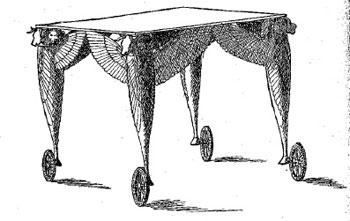
Schmidt succeeds in illustrating much of Ezekiel's bizarre vision. What prevented almost all artists from doing likewise?
A partial answer appears in one of the earliest Jewish sources on the Chariot - Mishnah Chagigah
(א) אֵין דּוֹרְשִׁין בַּעֲרָיוֹת בִּשְׁלֹשָׁה. וְלֹא בְמַעֲשֵׂה בְרֵאשִׁית בִּשְׁנַיִם. וְלֹא בַמֶּרְכָּבָה בְּיָחִיד, אֶלָּא אִם כֵּן הָיָה חָכָם וּמֵבִין מִדַּעְתּוֹ. כָּל הַמִּסְתַּכֵּל בְּאַרְבָּעָה דְּבָרִים, רָאוּי לוֹ כְּאִלּוּ לֹא בָּא לָעוֹלָם, מַה לְּמַעְלָה, מַה לְּמַטָּה, מַה לְּפָנִים, וּמַה לְּאָחוֹר. וְכָל שֶׁלֹּא חָס עַל כְּבוֹד קוֹנוֹ, רָאוּי לוֹ שֶׁלֹּא בָּא לָעוֹלָם:
(1)One may not expound the topic of forbidden sexual relations before three or more individuals; nor may one expound the act of Creation and the secrets of the beginning of the world before two or more individuals; nor may one expound by oneself the Design of the Divine Chariot, a mystical teaching with regard to the ways God conducts the world, unless he is wise and understands most matters on his own. The mishna continues in the same vein: Whoever looks at four matters, it would have been better for him had he never entered the world: Anyone who reflects upon what is above the firmament and what is below the earth, what was before Creation, and what will be after the end of the world. And anyone who has no concern for the honor of his Maker, who inquires into and deals with matters not permitted to him, deserves to have never come to the world.
Neither in this Mishnah nor in its expansion in the Talmud do we find a precise explanation. But clearly Ezekiel 1 is seen as a dangerous text, as exemplified in the Talmud:
וּמִי דָּרְשִׁינַן בְּחַשְׁמַל? וְהָא הָהוּא יָנוֹקָא דִּדְרַשׁ בְּחַשְׁמַל, וּנְפַקָא נוּרָא וַאֲכַלְתֵּיהּ! שָׁאנֵי יָנוֹקָא, דְּלָאו מָטֵי זִימְנֵיהּ.
The Gemara poses a question: And may one teach about the electrum of the Design of the Divine Chariot at all? But wasn’t there a certain youth who expounded the electrum, and fire came out and consumed him, showing that such study is highly dangerous? The Gemara answers: That youth was different, for his time to study such matters had not yet arrived. Therefore, he was punished.
(ד) לֹֽ֣א־תַֽעֲשֶׂ֨ה־לְךָ֥֣ פֶ֣֙סֶל֙ ׀ וְכׇל־תְּמוּנָ֔֡ה אֲשֶׁ֤֣ר בַּשָּׁמַ֣֙יִם֙ ׀ מִמַּ֔֡עַל וַֽאֲשֶׁ֥ר֩ בָּאָ֖֨רֶץ מִתָּ֑͏ַ֜חַת וַאֲשֶׁ֥ר בַּמַּ֖֣יִם ׀ מִתַּ֥֣חַת לָאָֽ֗רֶץ׃
(4) You shall not make for yourself a sculptured image, or any likeness of what is in the heavens above, or on the earth below, or in the waters under the earth.
(ה) לֹֽא־תִשְׁתַּחֲוֶ֥֣ה לָהֶ֖ם֮ וְלֹ֣א תׇעׇבְדֵ֑ם֒ כִּ֣י אָֽנֹכִ֞י יהוה אֱלֹהֶ֙יךָ֙ אֵ֣ל קַנָּ֔א פֹּ֠קֵ֠ד עֲוֺ֨ן אָבֹ֧ת עַל־בָּנִ֛ים עַל־שִׁלֵּשִׁ֥ים וְעַל־רִבֵּעִ֖ים לְשֹׂנְאָֽ֑י׃
(5) You shall not bow down to them or serve them. For I your God יהוה am an impassioned God, visiting the guilt of the parents upon the children, upon the third and upon the fourth generations of those who reject Me.
We will now examine a variety of artistic treatments of the Chariot, by Christians, Jews and Muslims to further explore how Ezekiel's account was understood and what prevented artists from portraying it fully.
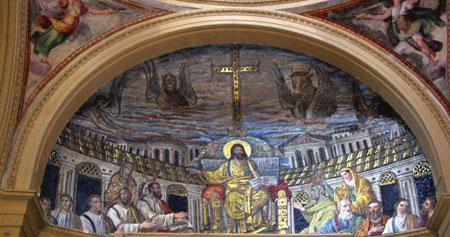

and in the middle of the throne, and round about the throne,
were four beasts full of eyes before and behind.7 And the first
beast was like a lion, and the second beast like a calf, and the
third beast had a face as a man, and the fourth beast was like a
flying eagle. 8 And the four beasts had each of them six wings
about him; and they were full of eyes within: and they rest not
day and night saying, Holy, holy, holy, Lord God Almighty,
which was, and is, and is to come.
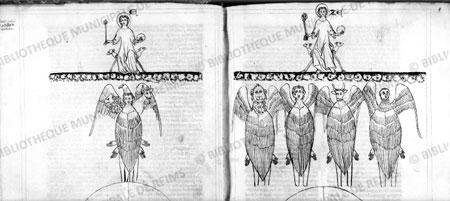
The Hebrew interpretation (Rashi, Karo and Beaugency) multiplies almost all of the components of the creatures, due to the idiosyncrasies of Ezekiel’s phrasing.
What Nicholas describes as the Jewish interpretation is actually a four-sided figure. We see, face forward, each of the four animals that compose the creatures; the faces of the other three animals are on its other sides but cannot be seen from our perspective. In addition, the Jewish scholars multiply the number of wings, concluding that there were four wings on each quarter of each creature.
R. Eliezer of Beaugency, a 12th century literalist, stresses that the legs and hands of the creatures were humanlike, thus each creature had two legs and two arms.
The Jewish commentators are mainly concerned with the details of the text and the vision, paying close attention to any textual oddities (e.g. ארבעתן and ארבעתם; does this refer to the 4 creatures or to the four sides or to the four faces?; also the word פנים – does it mean faces or face or side?); the Christian commentators, using the already simplified Vulgate, want only to visualize the text and their major concern is with the meaning of the vision for Jesus and Christianity. An essential difference between Judaism and Christianity is expressed here: for traditional Jewish commentators, Ezekiel is principally a commentary on the Torah and therefore the details of the text must be understood in all its minutiae. In Christianity, Ezekiel prefigures Jesus and the New Testament; thus, Jerome claims that the meaning of Ezekiel’s vision is that the four faces represent the four gospels.
In another manuscript of Nicholas' Postilla from 1430, wheels have been added both to the Christian (on the left) and to the Jewish (on the right) interpretations.
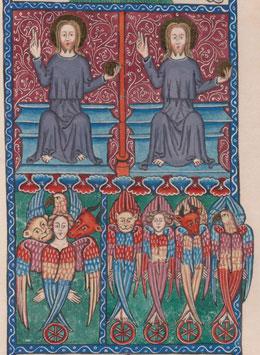
What do we learn from this comparison? In an attempt to present Ezekiel's ambiguous description in a coherent manner, Nicholas illustrated two readings of the biblical account, preferring what he saw as the literal interpretation, the Hebrew interpretation! Artists, however, continued to struggle with Ezekiel's fantastic vision, its idiosyncratic phrasing further complicated by translation, interpretation and conflation with Revelation 4.
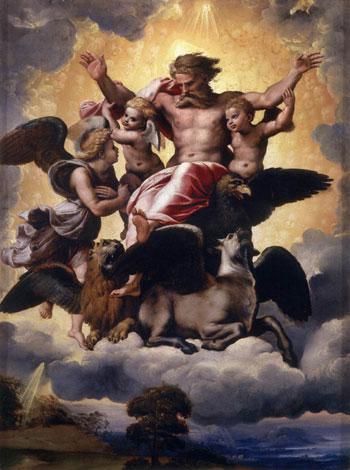

It is interesting to compare Raphael’s treatment with the relief on the façade of the cathedral of Chartres, from the 13th century.
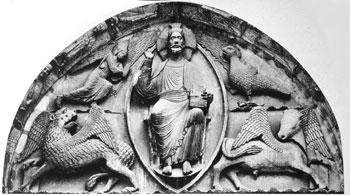

But while Chartres is contemplative and prayerful (Gothic, ritual, restrained), Raphael’s painting is naturalistic and lush. The central figure in Chartres is Christ enthroned, while Raphael paints a Michelangelo-like muscular God the Father. While Raphael’s creatures are very close to God, in Chartres they stand at a distance, stationed in a formal relation to the enclosed Christ. And finally, while the figures in the Chartres relief are without spatial context, Raphael's Divine "chariot" is seen in the clouds above an earthly landscape. Thus, while Raphael may have been using the same basic iconography as the creator of the Chartres relief, he has changed the serene/static image of the Divine/Pantocrator into a dynamic and powerful expression of God's presence in the world.
Joseph Campbell, a renowned historian of religions, suggests that the four beasts at Chartres represent human time and space. They flank the divine image in the center, eternal time and space. Raphael’s painting is a dramatic view of Ezekiel’s vision, unrelated to the symbolism that Campbell gives the Chartres sculpture.
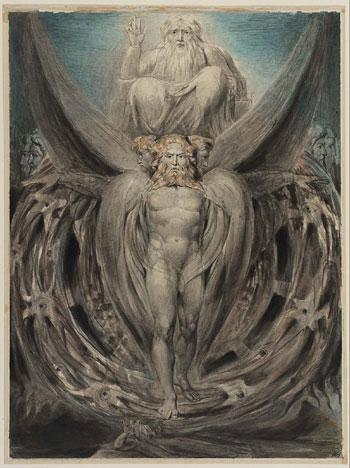
Physically, the Cherub's head, a single face of the four-faced creatures, is the focus of the painting. At the top God is seated on his throne, a secondary figure, both in Ezekiel's vision and in Blake's theology.
The Divine and Human merge in Blake's painting, with a disc enclosing the Divine, resting on the shoulders of the Cherub. The Cherub's head is, therefore, part of the divine sphere – they are one. Creativity is the divine connection.
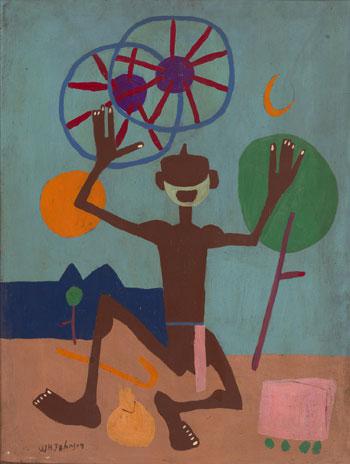
He, the artist, is Ezekiel; the American black, like Israel in exile, has no home and no hope, before the vision.
The painting is based on a Negro spiritual rather than on the verses from the book of Ezekiel.
Ezekiel saw the wheels;
Way up in the middle of the air.
Ezekiel saw the wheels;
Way up in the middle of the air.
Chorus
And the big wheel run by Faith, good Lord;
And the little wheel run by the Grace of God;
In the wheel in the wheel good Lord;
Way up in the middle of the air.
Scholars have suggested that the wheels were an important symbol of African religion from which Afro-Americans came, a symbol of the world.
Thus Johnson has significantly reinterpreted the meaning and the iconography of Ezekiel's vision, in accordance with this background and his needs.
This is a charming painting, not burdened by the complex theology of Ezekiel.
Perhaps the wheels represent the merkava, about to take off on its celestial voyage.
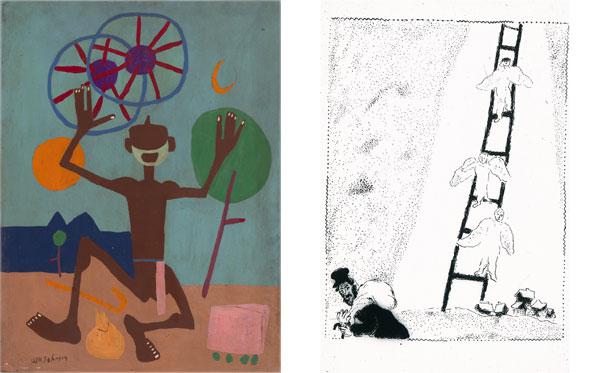
The two artists are roughly contemporary, from totally different cultural environments; but there is an intertextuality between their treatments of exile and revelation.
Chagall emerges from the shtetl of Eastern Europe, bearing the history of persecution and flight. His background is literary and historical. The background of Johnson as a black American is of non-literary content. His experience of the divine invites ecstasy, dance, pathos in music. This is not less significant than the literary background – just amazingly different.
Johnson's Ezekiel is a black man, emerging from slavery. Chagall's Jacob is a Jew going into Exile. Both are victims of persecution.
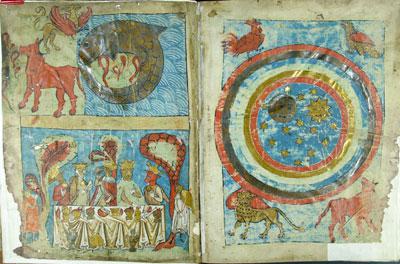
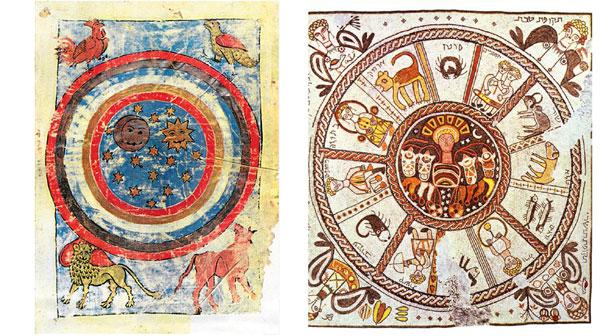
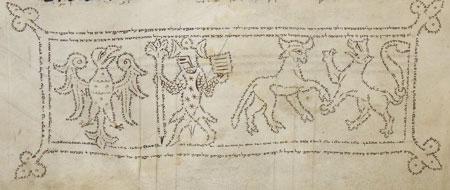
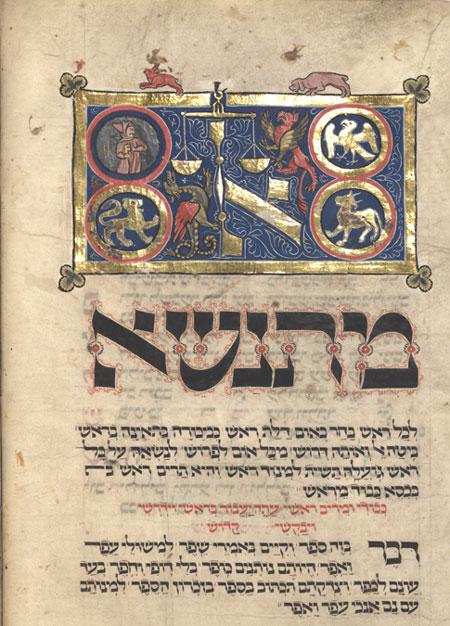
The right-hand page is dominated by a single image: the universe, multicircular heavens, centered on the astral bodies (sun, moon and 15 stars). The corners are populated by Ezekiel's beasts. But each creature is a single animal, as in the book of Revelation, rather than composites. An additional departure from Ezekiel’s account replaces the man with a rooster, likely avoiding the figurative depiction of a human, as in the Birds Head Haggadah, of the same period.
Scholars suggest that the three pictures are based on the apocalyptic Feast of the Righteous in the Alphabet of Rabbi Akiba. This feast is accompanied by the dancing of the sun, moon and stars, as well as the zodiac (here replaced by Ezekiel's creatures.)
And the heavens and the heavens of heavens open their doors and
shower on them [the Righteous] dewdrops of pure persimmon
whose scent reaches from one end of the World to the other, and
a thousand upon thousands of ministering angels stand before
them holding in their hands viols and harps and cymbals and all
manner of musical instruments and they entertain them during
the meal, and the Holy One, Blessed be He, stands Himself and
dances Himself at the meal, and the sun and moon and stars and
zodiac signs on his right and his left dance with Him before them.
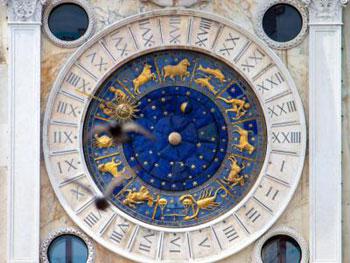
It is a huge leap from the Middle Ages to the 20th - 21st century, when we find our next Jewish treatments of the chariot.
The Vision of Ezekiel Sixty Paintings from the Bible,
1979 1992
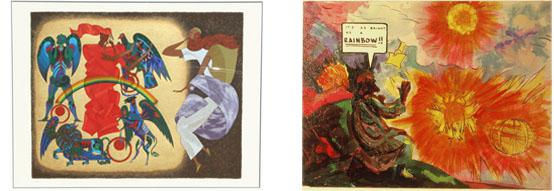
Shlomo Katz and Archie Rand are two modern, secular Jewish artists who deal with religious subjects. Katz, who grew up in Israel, adopts the traditional Christian format of the four creatures arranged in an unframed rectangle around the central Divine figure, belted by a rainbow. He also adds three wheels, as in Ezekiel's vision. The huge, red divine figure in the center and the rainbow are striking departures from any other rendition of the Chariot.
Similarly, Rand's painting is dominated by a fiery explosion, which the artist identifies as a rainbow. Within the red central area, the hybrid creatures appear amorphously beside the wheel within a wheel. As in Katz's painting, the prophet observes the vision from the side. Mirroring the lower explosion, is an upper world containing a vague image of the Divine and a celestial hand emerging from the clouds, holding a document or book. The presence of the speech balloon transforms this mystical painting into a comic.
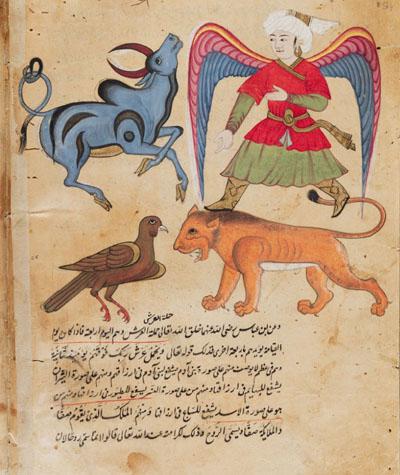
When a single blast is sounded on the trumpet…the heavens will be
torn apart…And the angels will be on the sides thereof, and eight
will uphold the Throne of thy Lord that day, above them.
In any event, as we have already seen with regard to Jewish and Christian art on the divine chariot, the text and the picture are not coordinated – text is very similar to Ezekiel, while the picture is more like Revelation.
The rectangular structure of angels is reminiscent of Chartres and others, but their order is different. The man and the eagle are winged, but the bull and lion are not. All four are in movement, as we would expect of the carriers of the divine chariot.
In some cases, biblical visions are accompanied by explanations of their meaning, as in Jeremiah 1 and Amos 7. In Jeremiah, the almond rod is interpreted by God as a sign of His immediacy, because of its early blossoming. In Amos 7, God explains that the plumb line is a symbol of judgment. In other cases, such as Jacob's vision of the "ladder" in Genesis 28 and Moses' vision of the burning bush in Exodus 3, no interpretation is given. Ezekiel 1 belongs to this second category. In all three cases, the vision is followed by Divine speech, that is seemingly unrelated to the vision. It is, therefore, up to the reader to explain the meaning of the vision and such explanations of all three visions abound.
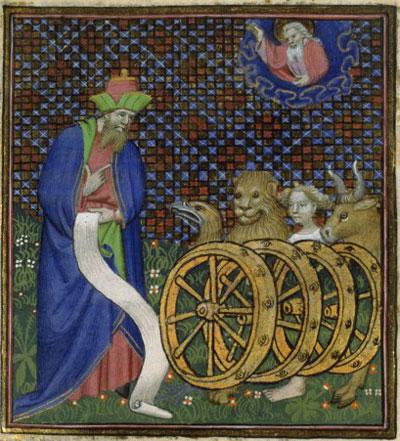
Early Christianity accepted the Hebrew Bible as canon, but interpreted it for its own needs and purposes. John of Patmos, the 2nd century author of Revelation, paraphrased Ezekiel's vision, changing various details. Since the account in Revelation is simpler than that of Ezekiel, but clearly describes the same vision, artists felt comfortable painting the vision of Ezekiel based on Revelation. In the course of time, Church doctrine understood the four beasts as the four evangelists. Nevertheless, we do find that there are significant differences in the ways in which the beasts are envisioned by Christian artists.
Medieval Jewish art had its own difficulties with Ezekiel. First, many communities were loath to create figurative images. Second, they were particularly reticent about making images of celestial beings. Third, widely different interpretations of Ezekiel 1 flourished. And fourth, the Divine Chariot became one of the major preoccupations of Jewish mysticism, a field limited to a select few. Intercultural communication in medieval Europe probably influenced the variety of Jewish visual interpretation.
Finally, Islam, too, adopted the motif of the Divine Throne; images of the Throne appear in several books and manuscripts in the late Middle Ages that bear remarkable similarity to Christian iconography, despite differences in interpretation.