




 Save
Save Copy
Copy Add to Collection
 Export to Google Docs
 Share
Shareוַיִּבְרָ֨א אֱלֹקִ֤ים ׀ אֶת־הָֽאָדָם֙ בְּצַלְמ֔וֹ בְּצֶ֥לֶם אֱלֹקִ֖ים בָּרָ֣א אֹת֑וֹ זָכָ֥ר וּנְקֵבָ֖ה בָּרָ֥א אֹתָֽם׃
And God created humankind in the divine image,
creating it in the image of God—
creating them male and female.
וְנִשְׁמַרְתֶּ֥ם מְאֹ֖ד לְנַפְשֹׁתֵיכֶ֑ם כִּ֣י לֹ֤א רְאִיתֶם֙ כׇּל־תְּמוּנָ֔ה בְּי֗וֹם דִּבֶּ֨ר ה׳ אֲלֵיכֶ֛ם בְּחֹרֵ֖ב מִתּ֥וֹךְ הָאֵֽשׁ׃
For your own sake, therefore, be most careful—since you saw no shape when ה׳ spoke to you at Horeb out of the fire—
"אסור לאדם לחבול בעצמו."
"It is forbidden for a person to injure himself."
(Bava Kama 91b)
אָסוּר לְאָדָם לַחֲבל בֵּין בְּעַצְמוֹ בֵּין בַּחֲבֵרוֹ. וְלֹא הַחוֹבֵל בִּלְבַד אֶלָּא כָּל הַמַּכֶּה אָדָם כָּשֵׁר מִיִּשְׂרָאֵל בֵּין קָטָן בֵּין גָּדוֹל בֵּין אִישׁ בֵּין אִשָּׁה דֶּרֶךְ נִצָּיוֹן הֲרֵי זֶה עוֹבֵר בְּלֹא תַּעֲשֶׂה שֶׁנֶּאֱמַר (דברים כה ג) "לֹא יֹסִיף" (דברים כה ג) "לְהַכֹּתוֹ". אִם הִזְהִירָה תּוֹרָה מִלְּהוֹסִיף בְּהַכָּאַת הַחוֹטֵא קַל וָחֹמֶר לְמַכֶּה אֶת הַצַּדִּיק:
It is forbidden for a person to injure anyone, neither his own self nor another person. Not only a person who causes an injury, but anyone who strikes in strife an upright Jewish person, whether a minor or an adult, whether a man or a woman, violates a negative commandment, as Deuteronomy 25:3 states: "Do not continue... to flog him." One may conclude that if the Torah adjures us against adding to the blows due a sinner, surely this prohibition applies with regard to striking a righteous person.
אסור להכות את חבירו אפילו הוא נותן לו רשות להכותו כי אין לאדם רשות על גופו כלל להכותו ולא לביישו ולא לצערו בשום צער אפילו במניעת איזה מאכל או משתה אלא אם כן עושה בדרך תשובה שצער זה טובה היא לו להציל נפשו משחת ולכן מותר להתענות לתשובה אפילו מי שאינו יכול להתענות ומי שיכול להתענות מותר אפילו שלא בדרך תשובה אלא כדי למרק נפשו לה׳ שאין טוב למעלה מטובה זו.
Rabbi Eliezer Waldenberg, (Ẓiz Eli'ezer, XI, no. 4, secs. 8–9), forcefully advances the argument against surgery which is purely cosmetic in nature.
In his opinion, the Torah’s statement, “He shall provide for his cure,” from which we learn that one may and must seek medical help, does not apply to ailments that are purely cosmetic.
He also adds a philosophical reasoning. One must believe that G‑d, the greatest artisan of all, formed him or her in the most fitting way, and one must not change this form. Changing one’s figure for beauty concerns alone is tantamount to insulting G‑d’s handiwork!
"מותר אם מטרתו להסיר פגם גדול."
"Permissible if its purpose is to remove a significant defect."
(Tzitz Eliezer 11:41)
Rabbi Yechiel Ya'akov Breish, Helkat Ya'akov, III, no. 11,
maintained that the prohibition of wounding oneself does not apply in a situation where the pain is intended to alleviate another, more excruciating, pain. He brought proofs from various places in the Talmud that the psychological pain associated with having abnormal features overrides the pain associated with the surgery. He therefore permitted this surgery when done to alleviate psychological distress. A similar explanation was offered by Rabbi Moshe Feinstein, the most recognized posek of the past generation (1895–1986), who explained that the Torah only prohibits self-affliction when done with malice, or in a degrading manner.
Rabbi Breisch also addressed the risks associated with surgery, and ruled that with the advancement of experience and expertise in this area of medicine, the risks involved have been greatly minimized, and therefore undergoing such a surgery cannot be reasonably considered a risk to life.
"אם הכאב אינו גדול ויש צורך לשידוך או לכבוד, יש מקום להקל."
"If the pain is not severe and it is necessary for marriage or dignity, there is room for leniency."
(Igrot Moshe, Yoreh De’ah II:65)
Many authorities have reached some sort of compromise—ruling that cosmetic surgery is permitted in order to remove an abnormality, if there is a grave psychological need, or to facilitate a happy marriage or decent livelihood; but prohibited if it is being done for beauty or convenience alone
(כח) וְשֶׂ֣רֶט לָנֶ֗פֶשׁ לֹ֤א תִתְּנוּ֙ בִּבְשַׂרְכֶ֔ם וּכְתֹ֣בֶת קַֽעֲקַ֔ע לֹ֥א תִתְּנ֖וּ בָּכֶ֑ם אֲנִ֖י ה׳׃
(28) Ye shall not make any cuttings in your flesh for the dead, nor imprint any marks upon you: I am the LORD.
"הכותב כתובת קעקע, בין בידו בין בשליחו—אם נכתבה ונחקקה בדיו, או בכחול, או בכל דבר הרושם—חייב."
"One who inscribes a tattoo, whether by himself or through another, if it is written and engraved with ink, kohl, or any marking substance, is liable."
(Mishneh Torah, Avodah Zarah 12:11)
"It is forbidden to inscribe a tattoo on one's body."
- שו"ת אגרות משה, יורה דעה ח"ב סי' ס"א"אם אינו מתקיים לעולם, אין בזה איסור גמור.""If it does not last permanently, it is not a full prohibition."(Igrot Moshe, Yoreh De’ah II:61)
- Since microblading fades within 1-3 years, some poskim argue it does not qualify as a full כתובת קעקע.
- שו"ת שבט הלוי ח' סימן קמ"ג"כל קעקוע שעתיד להימחק אינו בכלל האיסור.""Any tattoo that is destined to fade is not included in the prohibition."(Shevet HaLevi VIII:143)
- שו"ת ציץ אליעזר י"א:מ"א"היכן שאין ממש כתובת קעקע, אך דומה לזה – יש להימנע מחומרא.""Where there is no full-fledged tattoo but it resembles one, it is preferable to be stringent."(Tzitz Eliezer 11:41)
"וְרָצַע אֲדֹנָיו אֶת־אָזְנוֹ בַּמַּרְצֵעַ וַעֲבָדוֹ לְעֹלָם."
"His master shall pierce his ear with an awl, and he shall serve him forever."
(Exodus 21:6)
"רבי יוחנן אמר: אסור לנקוב את האוזן שלא לצורך."
"Rabbi Yochanan said: It is forbidden to pierce an ear without necessity."
(Bava Metzia 59b)
"אמר רבי יוחנן: מנהג בנות ישראל לנקב אוזניהם ונותנים בהם נזמים."
"Rabbi Yochanan said: It is the custom of Jewish women to pierce their ears and place earrings in them."
(Yerushalmi Shabbat 6:1)
"אין בזה איסור גמור, אבל מכל מקום אין זה ראוי."
"It is not strictly forbidden, but it is still improper."
(Igrot Moshe, Yoreh De’ah II:61)
"בנות ישראל נהגו לנקוב את אוזניהם לעדי ולא ראינו שמחו בהם."
"Jewish women have the custom to pierce their ears for earrings, and no one objected."
(Yabia Omer V)
"Women who have the custom of piercing their ears to wear earrings, this is not considered self-inflicted injury."
(Yabia Omer V, Yoreh De’ah 12)
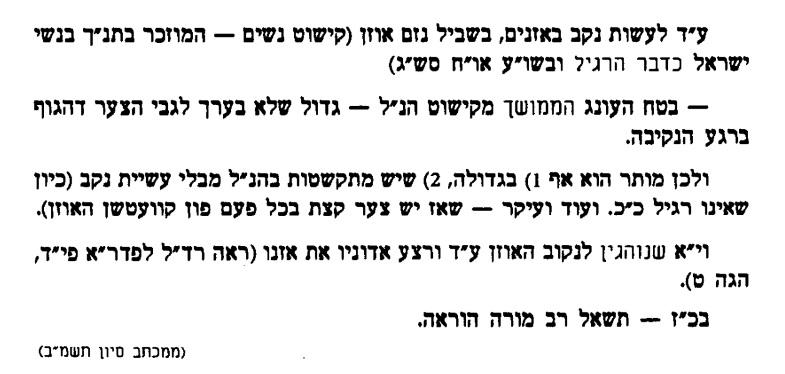
"נראה שאין זה דרך צניעות לנשים כשרות לרבות עגילים נוספים, והכל לפי המנהג."
"It seems that it is not the modest way for proper Jewish women to have multiple earrings, but everything follows the custom."
"If it is socially accepted that women wear multiple earrings, then there is no prohibition of self-injury or imitating non-Jewish customs."
(Shevet HaLevi VIII:143)
"Anything related to modesty and maintaining Jewish halachic standards should be avoided."
(Tzitz Eliezer 11:41)
שלא ללבוש כמלבושי עובדי כוכבים. ובו ג' סעיפים:
אין הולכין בחוקות העובדי כוכבים (ולא מדמין להם) (טור בשם הרמב"ם) ולא ילבש מלבוש המיוחד להם ולא יגדל ציצת ראשו כמו ציצת ראשם ולא יגלח מהצדדין ויניח השער באמצע ולא יגלח השער מכנגד פניו מאוזן לאוזן ויניח הפרע ולא יבנה מקומות כבנין היכלות של עבודת כוכבים כדי שיכנסו בהם רבים כמו שהם עושים : הגה אלא יהא מובדל מהם במלבושיו ובשאר מעשיו (שם) וכל זה אינו אסור אלא בדבר שנהגו בו העובדי כוכבים לשם פריצות כגון שנהגו ללבוש מלבושים אדומים והוא מלבוש שרים וכדומה לזה ממלבושי הפריצות או בדבר שנהגו למנהג ולחוק ואין טעם בדבר דאיכא למיחש ביה משום דרכי האמורי ושיש בו שמץ עבודת כוכבים מאבותיהם אבל דבר שנהגו לתועלת כגון שדרכן שכל מי שהוא רופא מומחה יש לו מלבוש מיוחד שניכר בו שהוא רופא אומן מותר ללובשו וכן שעושין משום כבוד או טעם אחר מותר (מהרי"ק שורש פ"ח)
1. Not To Dress Like A Non-Jew, 3 Seifim: One [i.e., a Jew] should not follow the customs of non-Jews (nor should one try to resemble them) (Tur in the name of the Rambam). One should not wear clothing that is particular to them [i.e., their culture]; one should not grow forelocks on one’s head like the forelocks on their heads; one should not shave the sides [of one’s head] and grow one’s hair in the middle of one’s head [like they do]; one should not shave the hair in front of one’s face from ear to ear and let one’s hair grow [in the back] [like they do]; one should not build places [i.e., buildings]—like the non-Jews’ temples—so that large groups of people will enter them, like [non-Jews] do. RAMA: Rather, one [i.e., a Jew] should be distinct from them [i.e., non-Jews] in one’s manner of dress and in all of one’s actions. But all of this [i.e., these restrictions] apply only to things that non-Jews do for the sake of licentiousness. For example, they are accustomed to wearing red clothing, which is official/princely clothing, and other clothing that is similarly immodest. [These restrictions also apply] to things that they are accustomed to doing because of a custom or rule that does not have a[ny underlying] reason, out of concern that [a Jew who does such things will follow the] “ways of the Amorites,” and that it has the blemish of [i.e., is tainted by] idol worship inherited from their ancestors. But things that they are accustomed to doing for a useful purpose—such as their custom for expert doctors to wear particular clothing so that the doctors will be recognized as specialists—one is permitted to wear [such clothing]. (Maharik Shoresh 88) Similarly, things that are done out of respect or another reason, it is permitted [for one to do such things].
