


Jonah, Intro to Bamidbar, Mitzvah of Sotah [G11S1Tmid]


 Save
Save Copy
Copy Add to Collection
 Export to Google Docs
 Share
ShareMixed and midterm review
MELACHIM
The world of מלכים is split into two kingdoms: the kingdom of ישראל, currently under the rule of the bad king ירעבם בן יואש, and the kingdom of יהודה. The kingdom of ישראל has 10/12 tribes, but they have had many bad kings and have turned away from Hashem, practicing idol worship. They will one day be attacked by the Assyrian Empire whereupon all the Jews will be exiled.
The kingdom of יהודה, which has remained steadfast to Jerusalem and the Beit HaMikdash, will exist for many more years after this. The kingdom of יהודה only has the tribes of יהודה and בינימין, along with some
Leviim, who were spread across both kingdoms.
The following takes place in the kingdom of ישראל, before its fall, under the rule of ירעבם בן יואש.
(כג) בִּשְׁנַת֙ חֲמֵשׁ־עֶשְׂרֵ֣ה שָׁנָ֔ה לַאֲמַצְיָ֥הוּ בֶן־יוֹאָ֖שׁ מֶ֣לֶךְ יְהוּדָ֑ה מָ֠לַ֠ךְ יָרׇבְעָ֨ם בֶּן־יוֹאָ֤שׁ מֶֽלֶךְ־יִשְׂרָאֵל֙ בְּשֹׁ֣מְר֔וֹן אַרְבָּעִ֥ים וְאַחַ֖ת שָׁנָֽה׃ (כד) וַיַּ֥עַשׂ הָרַ֖ע בְּעֵינֵ֣י יהוה לֹ֣א סָ֗ר מִכׇּל־חַטֹּאות֙ יָרׇבְעָ֣ם בֶּן־נְבָ֔ט אֲשֶׁ֥ר הֶחֱטִ֖יא אֶת־יִשְׂרָאֵֽל׃ (כה) ה֗וּא הֵשִׁיב֙ אֶת־גְּב֣וּל יִשְׂרָאֵ֔ל מִלְּב֥וֹא חֲמָ֖ת עַד־יָ֣ם הָעֲרָבָ֑ה כִּדְבַ֤ר יהוה אֱלֹהֵ֣י יִשְׂרָאֵ֔ל אֲשֶׁ֣ר דִּבֶּ֗ר בְּיַד־עַבְדּ֞וֹ יוֹנָ֤ה בֶן־אֲמִתַּי֙ הַנָּבִ֔יא אֲשֶׁ֖ר מִגַּ֥ת הַחֵֽפֶר׃ (כו) כִּי־רָאָ֧ה יהוה אֶת־עֳנִ֥י יִשְׂרָאֵ֖ל מֹרֶ֣ה מְאֹ֑ד וְאֶ֤פֶס עָצוּר֙ וְאֶ֣פֶס עָז֔וּב וְאֵ֥ין עֹזֵ֖ר לְיִשְׂרָאֵֽל׃
(23) In the fifteenth year of King Amaziah son of Joash of Judah, King Jeroboam son of Joash of Israel became king in Samaria—for forty-one years. (24) He did what was displeasing to GOD; he did not depart from all the sins that Jeroboam son of Nebat had caused Israel to commit. (25) It was he who restored the territory of Israel from Lebo-hamath to the sea of the Arabah, in accordance with the promise that the ETERNAL, the God of Israel, had made through God’s servant, the prophet Jonah son of Amittai from Gath-hepher. (26) For GOD saw the very bitter plight of Israel, with neither bond nor free left, and with none to help Israel.
In מלכים we see יונה working for Hashem in another place/setting. He helped ירעבם reconquer land for Israel. This shows that Hashem pitied The Kingdom of Israel and helped them, even though they didn't really deserve it because ירעבם was a bad king..
It also tells something about יונה: In addition to being a נביא, he was also a war general in restoring the kingdom's borders, which meant he was a PATRIOT to his county.
ELIYAHU
(יז) וַיְהִ֗י אַחַר֙ הַדְּבָרִ֣ים הָאֵ֔לֶּה חָלָ֕ה בֶּן־הָאִשָּׁ֖ה בַּעֲלַ֣ת הַבָּ֑יִת וַיְהִ֤י חׇלְיוֹ֙ חָזָ֣ק מְאֹ֔ד עַ֛ד אֲשֶׁ֥ר לֹא־נֽוֹתְרָה־בּ֖וֹ נְשָׁמָֽה׃ (יח) וַתֹּ֙אמֶר֙ אֶל־אֵ֣לִיָּ֔הוּ מַה־לִּ֥י וָלָ֖ךְ אִ֣ישׁ הָאֱלֹהִ֑ים בָּ֧אתָ אֵלַ֛י לְהַזְכִּ֥יר אֶת־עֲוֺנִ֖י וּלְהָמִ֥ית אֶת־בְּנִֽי׃ (יט) וַיֹּ֥אמֶר אֵלֶ֖יהָ תְּנִי־לִ֣י אֶת־בְּנֵ֑ךְ וַיִּקָּחֵ֣הוּ מֵחֵיקָ֗הּ וַֽיַּעֲלֵ֙הוּ֙ אֶל־הָעֲלִיָּ֗ה אֲשֶׁר־הוּא֙ יֹשֵׁ֣ב שָׁ֔ם וַיַּשְׁכִּבֵ֖הוּ עַל־מִטָּתֽוֹ׃ (כ) וַיִּקְרָ֥א אֶל־יהוה וַיֹּאמַ֑ר יהוה אֱלֹהָ֔י הֲ֠גַ֠ם עַֽל־הָאַלְמָנָ֞ה אֲשֶׁר־אֲנִ֨י מִתְגּוֹרֵ֥ר עִמָּ֛הּ הֲרֵע֖וֹתָ לְהָמִ֥ית אֶת־בְּנָֽהּ׃ (כא) וַיִּתְמֹדֵ֤ד עַל־הַיֶּ֙לֶד֙ שָׁלֹ֣שׁ פְּעָמִ֔ים וַיִּקְרָ֥א אֶל־יהוה וַיֹּאמַ֑ר יהוה אֱלֹהָ֔י תָּ֥שׇׁב נָ֛א נֶפֶשׁ־הַיֶּ֥לֶד הַזֶּ֖ה עַל־קִרְבּֽוֹ׃ (כב) וַיִּשְׁמַ֥ע יהוה בְּק֣וֹל אֵֽלִיָּ֑הוּ וַתָּ֧שׇׁב נֶֽפֶשׁ־הַיֶּ֛לֶד עַל־קִרְבּ֖וֹ וַיֶּֽחִי׃ (כג) וַיִּקַּ֨ח אֵלִיָּ֜הוּ אֶת־הַיֶּ֗לֶד וַיֹּרִדֵ֤הוּ מִן־הָֽעֲלִיָּה֙ הַבַּ֔יְתָה וַֽיִּתְּנֵ֖הוּ לְאִמּ֑וֹ וַיֹּ֙אמֶר֙ אֵ֣לִיָּ֔הוּ רְאִ֖י חַ֥י בְּנֵֽךְ׃ (כד) וַתֹּ֤אמֶר הָֽאִשָּׁה֙ אֶל־אֵ֣לִיָּ֔הוּ עַתָּה֙ זֶ֣ה יָדַ֔עְתִּי כִּ֛י אִ֥ישׁ אֱלֹהִ֖ים אָ֑תָּה וּדְבַר־יהוה בְּפִ֖יךָ אֱמֶֽת׃ {פ}
(17) After a while, the son of that woman—the owner of the house—fell sick, and his illness grew worse, until he had no breath left in him. (18) She said to Elijah, “What harm have I done you, O agent of God, that you should come here to recall my sin and cause the death of my son?” (19) “Give me the boy,” he said to her; and taking him from her arms, he carried him to the upper chamber where he was staying, and laid him down on his own bed. (20) He cried out to GOD and said, “My ETERNAL God, will You bring calamity upon this widow whose guest I am, and let her son die?” (21) Then he stretched out over the child three times, and cried out to GOD, saying, “My ETERNAL God, let this child’s life return to his body!” (22) GOD heard Elijah’s plea; the child’s life returned to his body, and he revived. (23) Elijah picked up the child and brought him down from the upper room into the main room, and gave him to his mother. “See,” said Elijah, “your son is alive.” (24) And the woman answered Elijah, “Now I know that you are an agent of God and that the word of GOD is truly in your mouth.”
Abarbanel: That the אלמנה/widow (the woman in the story) is actually יונה's mother.
Mechiltah: There are three Neviim who can be compared to each other (seen as one), and they differ in their Kavod Av and Ben.
פרק א׳
(א) וַֽיְהִי֙ דְּבַר־יְהֹוָ֔ה אֶל־יוֹנָ֥ה בֶן־אֲמִתַּ֖י לֵאמֹֽר׃ (ב) ק֠וּם לֵ֧ךְ אֶל־נִֽינְוֵ֛ה הָעִ֥יר הַגְּדוֹלָ֖ה וּקְרָ֣א עָלֶ֑יהָ כִּֽי־עָלְתָ֥ה רָעָתָ֖ם לְפָנָֽי׃ (ג) וַיָּ֤קׇם יוֹנָה֙ לִבְרֹ֣חַ תַּרְשִׁ֔ישָׁה מִלִּפְנֵ֖י יְהֹוָ֑ה וַיֵּ֨רֶד יָפ֜וֹ וַיִּמְצָ֥א אֳנִיָּ֣ה ׀ בָּאָ֣ה תַרְשִׁ֗ישׁ וַיִּתֵּ֨ן שְׂכָרָ֜הּ וַיֵּ֤רֶד בָּהּ֙ לָב֤וֹא עִמָּהֶם֙ תַּרְשִׁ֔ישָׁה מִלִּפְנֵ֖י יְהֹוָֽה׃ (ד) וַֽיהֹוָ֗ה הֵטִ֤יל רֽוּחַ־גְּדוֹלָה֙ אֶל־הַיָּ֔ם וַיְהִ֥י סַֽעַר־גָּד֖וֹל בַּיָּ֑ם וְהָ֣אֳנִיָּ֔ה חִשְּׁבָ֖ה לְהִשָּׁבֵֽר׃ (ה) וַיִּֽירְא֣וּ הַמַּלָּחִ֗ים וַֽיִּזְעֲקוּ֮ אִ֣ישׁ אֶל־אֱלֹהָיו֒ וַיָּטִ֨לוּ אֶת־הַכֵּלִ֜ים אֲשֶׁ֤ר בָּֽאֳנִיָּה֙ אֶל־הַיָּ֔ם לְהָקֵ֖ל מֵֽעֲלֵיהֶ֑ם וְיוֹנָ֗ה יָרַד֙ אֶל־יַרְכְּתֵ֣י הַסְּפִינָ֔ה וַיִּשְׁכַּ֖ב וַיֵּרָדַֽם׃ (ו) וַיִּקְרַ֤ב אֵלָיו֙ רַ֣ב הַחֹבֵ֔ל וַיֹּ֥אמֶר ל֖וֹ מַה־לְּךָ֣ נִרְדָּ֑ם ק֚וּם קְרָ֣א אֶל־אֱלֹהֶ֔יךָ אוּלַ֞י יִתְעַשֵּׁ֧ת הָאֱלֹהִ֛ים לָ֖נוּ וְלֹ֥א נֹאבֵֽד׃ (ז) וַיֹּאמְר֞וּ אִ֣ישׁ אֶל־רֵעֵ֗הוּ לְכוּ֙ וְנַפִּ֣ילָה גֽוֹרָל֔וֹת וְנֵ֣דְעָ֔ה בְּשֶׁלְּמִ֛י הָרָעָ֥ה הַזֹּ֖את לָ֑נוּ וַיַּפִּ֙לוּ֙ גּֽוֹרָל֔וֹת וַיִּפֹּ֥ל הַגּוֹרָ֖ל עַל־יוֹנָֽה׃ (ח) וַיֹּאמְר֣וּ אֵלָ֔יו הַגִּידָה־נָּ֣א לָ֔נוּ בַּאֲשֶׁ֛ר לְמִי־הָרָעָ֥ה הַזֹּ֖את לָ֑נוּ מַה־מְּלַאכְתְּךָ֙ וּמֵאַ֣יִן תָּב֔וֹא מָ֣ה אַרְצֶ֔ךָ וְאֵֽי־מִזֶּ֥ה עַ֖ם אָֽתָּה׃ (ט) וַיֹּ֥אמֶר אֲלֵיהֶ֖ם עִבְרִ֣י אָנֹ֑כִי וְאֶת־יְהֹוָ֞ה אֱלֹהֵ֤י הַשָּׁמַ֙יִם֙ אֲנִ֣י יָרֵ֔א אֲשֶׁר־עָשָׂ֥ה אֶת־הַיָּ֖ם וְאֶת־הַיַּבָּשָֽׁה׃ (י) וַיִּֽירְא֤וּ הָֽאֲנָשִׁים֙ יִרְאָ֣ה גְדוֹלָ֔ה וַיֹּאמְר֥וּ אֵלָ֖יו מַה־זֹּ֣את עָשִׂ֑יתָ כִּֽי־יָדְע֣וּ הָאֲנָשִׁ֗ים כִּֽי־מִלִּפְנֵ֤י יְהֹוָה֙ ה֣וּא בֹרֵ֔חַ כִּ֥י הִגִּ֖יד לָהֶֽם׃ (יא) וַיֹּאמְר֤וּ אֵלָיו֙ מַה־נַּ֣עֲשֶׂה לָּ֔ךְ וְיִשְׁתֹּ֥ק הַיָּ֖ם מֵֽעָלֵ֑ינוּ כִּ֥י הַיָּ֖ם הוֹלֵ֥ךְ וְסֹעֵֽר׃ (יב) וַיֹּ֣אמֶר אֲלֵיהֶ֗ם שָׂא֙וּנִי֙ וַהֲטִילֻ֣נִי אֶל־הַיָּ֔ם וְיִשְׁתֹּ֥ק הַיָּ֖ם מֵֽעֲלֵיכֶ֑ם כִּ֚י יוֹדֵ֣עַ אָ֔נִי כִּ֣י בְשֶׁלִּ֔י הַסַּ֧עַר הַגָּד֛וֹל הַזֶּ֖ה עֲלֵיכֶֽם׃ (יג) וַיַּחְתְּר֣וּ הָאֲנָשִׁ֗ים לְהָשִׁ֛יב אֶל־הַיַּבָּשָׁ֖ה וְלֹ֣א יָכֹ֑לוּ כִּ֣י הַיָּ֔ם הוֹלֵ֥ךְ וְסֹעֵ֖ר עֲלֵיהֶֽם׃ (יד) וַיִּקְרְא֨וּ אֶל־יְהֹוָ֜ה וַיֹּאמְר֗וּ אָנָּ֤ה יְהֹוָה֙ אַל־נָ֣א נֹאבְדָ֗ה בְּנֶ֙פֶשׁ֙ הָאִ֣ישׁ הַזֶּ֔ה וְאַל־תִּתֵּ֥ן עָלֵ֖ינוּ דָּ֣ם נָקִ֑יא כִּֽי־אַתָּ֣ה יְהֹוָ֔ה כַּאֲשֶׁ֥ר חָפַ֖צְתָּ עָשִֽׂיתָ׃ (טו) וַיִּשְׂאוּ֙ אֶת־יוֹנָ֔ה וַיְטִלֻ֖הוּ אֶל־הַיָּ֑ם וַיַּעֲמֹ֥ד הַיָּ֖ם מִזַּעְפּֽוֹ׃ (טז) וַיִּֽירְא֧וּ הָאֲנָשִׁ֛ים יִרְאָ֥ה גְדוֹלָ֖ה אֶת־יְהֹוָ֑ה וַיִּֽזְבְּחוּ־זֶ֙בַח֙ לַֽיהֹוָ֔ה וַֽיִּדְּר֖וּ נְדָרִֽים׃
(1) The word of GOD came to Jonah son of Amittai: (2) Go at once to Nineveh, that great city, and proclaim judgment upon it; for their wickedness has come before Me. (3) Jonah, however, started out to flee to Tarshish from GOD’s service. He went down to Joppa and found a ship going to Tarshish. He paid the fare and went aboard to sail with the others to Tarshish, away from GOD’s service. (4) But GOD cast a mighty wind upon the sea, and such a great tempest came upon the sea that the ship was in danger of breaking up. (5) In their fright, the sailors cried out, each to his own god; and they flung the ship’s cargo overboard to make it lighter for them. Jonah, meanwhile, had gone down into the hold of the vessel where he lay down and fell asleep. (6) The captain went over to him and cried out, “How can you be sleeping so soundly! Up, call upon your god! Perhaps the god will be kind to us and we will not perish.” (7) Those aboard said to one another, “Let us cast lots and find out on whose account this misfortune has come upon us.” They cast lots and the lot fell on Jonah. (8) They said to him, “Tell us, you who have brought this misfortune upon us, what is your business? Where have you come from? What is your country, and of what people are you?” (9) “I am a Hebrew,” he replied. “I worship the ETERNAL, the God of Heaven, who made both sea and land.” (10) The men were greatly terrified, and they asked him, “What have you done?” And when the men learned that he was fleeing from GOD’s service—for so he told them— (11) they said to him, “What must we do to you to make the sea calm around us?” For the sea was growing more and more stormy. (12) He answered, “Heave me overboard, and the sea will calm down for you; for I know that this terrible storm came upon you on my account.” (13) Nevertheless, the men rowed hard to regain the shore, but they could not, for the sea was growing more and more stormy about them. (14) Then they cried out to GOD: “Oh, please, ETERNAL One, do not let us perish on account of this man’s life. Do not hold us guilty of killing an innocent person! For You, O ETERNAL One, by Your will, have brought this about.” (15) And they heaved Jonah overboard, and the sea stopped raging. (16) The men feared GOD greatly; they offered a sacrifice to GOD and they made vows.
WHY יונה RUN
Opinion 1: Rashi - חילול ה׳ֿ
(א) לִבְרֹחַ תַּרְשִׁישָׁה. יָם שֶׁשְּׁמוֹ תַּרְשִׁישׁ, וְהוּא בְּחוּצָה לָאָרֶץ. אָמַר: אֶבְרַח לִי הַיָּם, שֶׁאֵין הַשְּׁכִינָה שׁוֹרָה בְּחוּץ לָאָרֶץ. אָמַר לוֹ הַקָּדוֹשׁ בָּרוּךְ הוּא: חַיֶּיךָ, יֵשׁ לִי שְׁלוּחִים כְּיוֹצֵא בְּךָ לִשְׁלוֹחַ אַחֲרֶיךָ וּלְהָבִיאֲךָ מִשָּׁם. מָשָׁל לְעֶבֶד כֹּהֵן שֶׁבָּרַח מִן רַבּוֹ וְנִכְנַס לְבֵית הַקְּבָרוֹת. אָמַר לוֹ רַבּוֹ: יֵשׁ לִי עֲבָדִים כַּיוֹצֵא בְּךָ לִשְׁלוֹחַ אַחֲרֶיךָ וּלְהָבִיאֲךָ מִשָּׁם. וּמָה רָאָה יוֹנָה שֶׁלֹּא רָצָה לֵילֵךְ אֶל נִינְוֵה? אָמַר: הָעַכּוּ״ם קְרוֹבֵי תְשׁוּבָה הֵם, אִם אוֹמַר לָהֶם וְיַעֲשׂוּ תְשׁוּבָה נִמְצֵאתִי מְחַיֵּב אֶת יִשְׂרָאֵל שֶׁאֵין שׁוֹמְעִים לְדִבְרֵי הַנְּבִיאִים:
(1) to flee to Tarshish—I.e, to a sea named Tarshish, which is outside the Holy Land. He said, “I will flee to the sea, for the Shechinah does not rest outside the Holy Land.” Said the Holy One, blessed be He, to him, “By your life, I have messengers like you to send after you and fetch you from there.” This is illustrated by an allegory of a priest’s slave who fled from his master and entered a cemetery [making it impossible for his master to retrieve him]. His master said to him, “I have slaves like you to send after you and fetch you from there.” Now what did Jonah see that he did not wish to go to Nineveh? He said, “The gentiles are quick to repent. Should I prophesy to them and they repent, I will be found condemning Israel, who do not heed the words of the prophets.” [from Mechilta, Exodus 12:1]
If יונה goes to Ninveh and they do Teshuva when only 1 Navi goes to them, it will look bad on the Jews who have hundreds of Neviim and still don't do Teshuva. This is therefore חילול יהוה since it looks bad on Jews.
This is a PATRIOTIC reason since he is defending the honor of his people.
Opinion 2: Abarbanel - Anti-Assyria
Yonah knows that Assyria (אשור) will come to destroy the Kingdom of Israel. Ninveh is the capital of Assyria and thus he doesn't want to save them.
This is a PATRIOTIC reason since he is defending the future of his kingdom.
Nafka Mina (נפקה מינה)/Practical difference between Opinion 1 and Opinion 2 -
They both have in common יונה's PATRIOTISM, which was also expressed when he was a general who defended the borders of the Kingdom of Israel.
A Nafka Mina, or a practical case where the two opinions disagree, would be if יהוה asks יונה to save a different non-Jewish nation.
Opinion 1 (Rashi) would say - No, יונה would still run because any non-Jewish nation doing Teshuva (תשובה) looks bad on the Jews. Opinion 2 (Abarbanel) would say - Yes, יונה would've listened to Hashem, because he only has qualms against Ashur/Assyria, nowhere else.
OPINION 3: Rashi - Navi Sheker
Yonah is worried that the people of Ninveh will consider him a false prophet (נביא שקר) and he will be attacked.
Thought process:
- Yonah goes to tell people of Ninveh that they will be destroyed in 40 days since they are bad in the eyes of Hashem.
- The people of Ninveh are afraid and do Teshuva (תשובה)
- Since they repent, Hashem has mercy and does not destroy them
- Then they accuse יונה of lying since they weren't actually destroyed.
This is a SELFISH motivation to run away, since he is afraid of his own self-image or and/or life.
OPINION 4: Dr. Uriel - Anti-Teshuva
שָׁאֲלוּ לַחָכְמָה. חוֹטֵא מָהוּ עוֹנְשׁוֹ. אָֽמְרָה לָהֶם. חַ֭טָּאִים תְּרַדֵּ֣ף רָעָ֑ה. שָׁאֲלוּ לַנְּבוּאָה. חוֹטֵא מָהוּ עוֹנְשׁוֹ. אָֽמְרָה לָהֶן. הַנֶּ֥פֶשׁ הַחוֹטֵאת הִ֥יא תָמֽוּת. שָׁאֲלו לְקוּדְשָׁא בְּרִיךְ הוּא. חוֹטֵא מָהוּ עוֹנְשׁוֹ. אָמַר לָהֶן. יַעֲשֶׂה תְשׁוּבָה וְיִתְכַּפֵּר לוֹ.
They asked Wisdom, what is the punishment of the sinner? She told them, evil will pursue sinners. They asked Prophecy, what is the punishment of the sinner? She told them, the sinning soul is the one which will die. They asked the Holy One, praise to Him, what is the punishment of the sinner? He said to them, let him repent and it will be atoned for him.
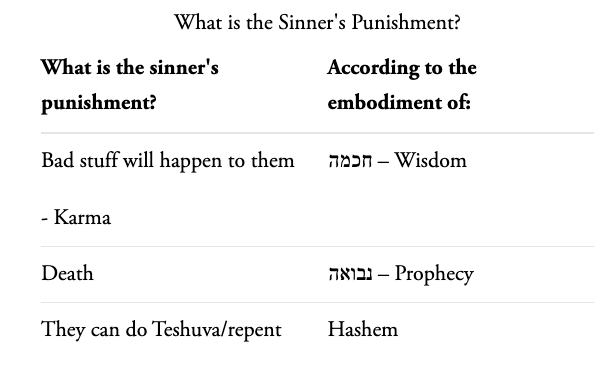
Dr. Uriel Simon:
The debate between Hashem and נבואה in the above Gemara is the debate between יונה and Hashem in our story. יונה is called בן אמיתי because he loves the truth and he loves justice. He loves truth so much that he is willing to criticise Hashem for not being truthful in His Judgement. This is seen when he lists Hashem's attributes of mercy in Perek 4 when he excludes אמת from this list. According to this opinion, יונה ran because he was anti-Teshuva in general, and felt that Hashem was not delivering true Justice by sparing them, and he thought they should have all been killed instead.
WHERE IS TARSHISH? WHY DOES יונה GO THERE?
- 1 - Rashi on Tarshish: Tarshish is not a city or a place, but rather any waters outside of Israel. יונה believed that since Hashem's שכינה (presence) was in Israel, Hashem couldn't chase him out of Israel. He still wants to be devoted to Hashem and he still believes in it, but he doesn't want to fulfill this order of Hashem, so he is running away so he doesn't here. Specifically, Tarshish is likely a part of the Mediterranean Sea. He's trying to get out of Hashem's שכינה range.
Motivation for running: He still believes in Hashem, but he doesn't want to have to do this thing that will help Ashur, which supports the PATRIOTIC perspective.
- 2 - Ibn Ezra on Tarshish: Tarshish is the port city of Tunis, Tunisia (originally called Carthage). At the time, Tunis was the wealthiest and main port city of the Mediterranean (in Africa).
How do we know? - There is a Pasuk in Melachim that references Tarshish as a super wealthy port city. (this proof is not given by the Ibn Ezra, but rather found in the Concordance.)
Motivation for running: This fits well with the SELFISH motivation (fits with the second Rashi in Opinion 3) that he doesn't want to be seen as a נביא שקר.
- 3 - Dr. Uriel Simone There is a place called Tarsis in Spain. This is Tarshish. Hashem told יונה to go to Ninveh, which is all the way in the East, so he runs to Tarsis, which is the farthest West you can go. Hashem tells him to get up and go to Ninveh, so he goes to the very bottom of the boat. יונה wants Hashem to do Justice and not Teshuva, so he runs away in Protest and sins intentionally, to make Hashem kill him and do דין and true justice, instead of Teshuva.
Motivation for running: He knows he can't run away from Hashem himself, so he is doing this as a PROTEST. יונה is saying that he so disagrees with the idea of Teshuva and repentance that he is going to the opposite place to make a point.
פרק ב׳
(א) וַיְמַ֤ן יְהֹוָה֙ דָּ֣ג גָּד֔וֹל לִבְלֹ֖עַ אֶת־יוֹנָ֑ה וַיְהִ֤י יוֹנָה֙ בִּמְעֵ֣י הַדָּ֔ג שְׁלֹשָׁ֥ה יָמִ֖ים וּשְׁלֹשָׁ֥ה לֵילֽוֹת׃ (ב) וַיִּתְפַּלֵּ֣ל יוֹנָ֔ה אֶל־יְהֹוָ֖ה אֱלֹהָ֑יו מִמְּעֵ֖י הַדָּגָֽה׃ (ג) וַיֹּ֗אמֶר קָ֠רָ֠אתִי מִצָּ֥רָה לִ֛י אֶל־יְהֹוָ֖ה וַֽיַּעֲנֵ֑נִי מִבֶּ֧טֶן שְׁא֛וֹל שִׁוַּ֖עְתִּי שָׁמַ֥עְתָּ קוֹלִֽי׃ (ד) וַתַּשְׁלִיכֵ֤נִי מְצוּלָה֙ בִּלְבַ֣ב יַמִּ֔ים וְנָהָ֖ר יְסֹבְבֵ֑נִי כׇּל־מִשְׁבָּרֶ֥יךָ וְגַלֶּ֖יךָ עָלַ֥י עָבָֽרוּ׃ (ה) וַאֲנִ֣י אָמַ֔רְתִּי נִגְרַ֖שְׁתִּי מִנֶּ֣גֶד עֵינֶ֑יךָ אַ֚ךְ אוֹסִ֣יף לְהַבִּ֔יט אֶל־הֵיכַ֖ל קׇדְשֶֽׁךָ׃ (ו) אֲפָפ֤וּנִי מַ֙יִם֙ עַד־נֶ֔פֶשׁ תְּה֖וֹם יְסֹבְבֵ֑נִי ס֖וּף חָב֥וּשׁ לְרֹאשִֽׁי׃ (ז) לְקִצְבֵ֤י הָרִים֙ יָרַ֔דְתִּי הָאָ֛רֶץ בְּרִחֶ֥יהָ בַעֲדִ֖י לְעוֹלָ֑ם וַתַּ֧עַל מִשַּׁ֛חַת חַיַּ֖י יְהֹוָ֥ה אֱלֹהָֽי׃ (ח) בְּהִתְעַטֵּ֤ף עָלַי֙ נַפְשִׁ֔י אֶת־יְהֹוָ֖ה זָכָ֑רְתִּי וַתָּב֤וֹא אֵלֶ֙יךָ֙ תְּפִלָּתִ֔י אֶל־הֵיכַ֖ל קׇדְשֶֽׁךָ׃ (ט) מְשַׁמְּרִ֖ים הַבְלֵי־שָׁ֑וְא חַסְדָּ֖ם יַעֲזֹֽבוּ׃ (י) וַאֲנִ֗י בְּק֤וֹל תּוֹדָה֙ אֶזְבְּחָה־לָּ֔ךְ אֲשֶׁ֥ר נָדַ֖רְתִּי אֲשַׁלֵּ֑מָה יְשׁוּעָ֖תָה לַיהֹוָֽה׃ {פ} (יא) וַיֹּ֥אמֶר יְהֹוָ֖ה לַדָּ֑ג וַיָּקֵ֥א אֶת־יוֹנָ֖ה אֶל־הַיַּבָּשָֽׁה׃ {ס}
(1) GOD provided a huge fish to swallow Jonah; and Jonah remained in the fish’s belly three days and three nights. (2) Jonah prayed to the ETERNAL his God from the belly of the fish. (3) He said: In my trouble I called to GOD, Who answered me; From the belly of Sheol I cried out, And You heard my voice. (4) You cast me into the depths, Into the heart of the sea, The floods engulfed me; All Your breakers and billows Swept over me. (5) I thought I was driven away Out of Your sight: Would I ever gaze again Upon Your holy temple? (6) The waters closed in over me, The deep engulfed me. Weeds twined around my head. (7) I sank to the base of the mountains; The bars of the earth closed upon me forever. Yet You brought my life up from the pit, My ETERNAL God! (8) When my life was ebbing away, I called GOD to mind; And my prayer came before You, Into Your holy temple. (9) They who cling to empty folly Forsake their own welfare, (10) But I, with loud thanksgiving, Will sacrifice to You; What I have vowed I will perform. Deliverance is GOD’s! (11) GOD commanded the fish, and it spewed Jonah out upon dry land.
FISH OR FISHET
Rashi - דג דגה
Question - Text starts out refering to the fish as a דג, bu later it switches to a דגה. What does this mean? Is the fish gender fluid?
Answer - Yonah started out in the belly of a male fish, but it didn't give Yonah desire to pray because the male fish was too comfy. So, Hashem told the male fish to spit Yonah out into the mouth of a female fish which was pregnant so it's stomach was filled with a fetus and was thus uncomfortable, so Yonah prayed.
Ibn Ezra - דגה
Question: same as Rashi, confused about changing between דג and דגה
Answer: a) The female fish swallowed the male fish
b) gramatically, דג/דגה are interchangeable and don't represent gender.
YONAH'S PRAYER
- You have sent me to the depths of the heart of the ocean, and the currents surround me and all the breaking of the waves pass over me
- I was banished/kicked out from your eyes, but I will continue to look towards your eyes. (Irony: he wasn't banished; he chose to leave. -->you forced my hand to flee but I still had faith for you)
- Those who guard empty promises, their kindness abates-->problem with Teshuva is it's an empty problem
- But I with a voice of gratitude will offer to you a thanksgiving korban. What I promised, I will fulfill. My saving is from Hashem (implying that the sailors won't fulfill their promises of Teshuva, while he will)
Point of Tefila:
Ibn Ezra -
Question: Why does Yonah say Hashem answered his prayers if it didn't happen yet?
Answer: Neviim can sometimes see the future and refer to it in the past tense.
Is Yonah doing Teshuva?
No, Yonah is merely asking for help, not saying sorry. He is saying thank you for helping me because he knew the future (according to Ibn Ezra) that Hashem was going to help him. this is NOT Teshuva, just saying "help me out of a tough spot." Yonah is not admitting he's wrong.
VOMITING YONAH
Dr. Erica Brown -
Question: Why did the text specifically choose the word ויקא and not another, milder word?
Answer: vomiting is a rejection of something bad because Hashem is not accepting Yonah's prayer.
Yaakov Rebei -
Question: Why did the text specifically choose the word ויקא and not another, milder word?
Answer: Vomiting is something done against your will. Yonah is forced to leave the fish's stomach and does not want to go to Ninveh. This is the second time around of this cycle, and no matter what, we see that Yonah cannot escape the command of Hashem.
פרק ג׳
(א) וַיְהִ֧י דְבַר־יְהֹוָ֛ה אֶל־יוֹנָ֖ה שֵׁנִ֥ית לֵאמֹֽר׃ (ב) ק֛וּם לֵ֥ךְ אֶל־נִֽינְוֵ֖ה הָעִ֣יר הַגְּדוֹלָ֑ה וּקְרָ֤א אֵלֶ֙יהָ֙ אֶת־הַקְּרִיאָ֔ה אֲשֶׁ֥ר אָנֹכִ֖י דֹּבֵ֥ר אֵלֶֽיךָ׃ (ג) וַיָּ֣קׇם יוֹנָ֗ה וַיֵּ֛לֶךְ אֶל־נִֽינְוֵ֖ה כִּדְבַ֣ר יְהֹוָ֑ה וְנִֽינְוֵ֗ה הָיְתָ֤ה עִיר־גְּדוֹלָה֙ לֵֽאלֹהִ֔ים מַהֲלַ֖ךְ שְׁלֹ֥שֶׁת יָמִֽים׃ (ד) וַיָּ֤חֶל יוֹנָה֙ לָב֣וֹא בָעִ֔יר מַהֲלַ֖ךְ י֣וֹם אֶחָ֑ד וַיִּקְרָא֙ וַיֹּאמַ֔ר ע֚וֹד אַרְבָּעִ֣ים י֔וֹם וְנִֽינְוֵ֖ה נֶהְפָּֽכֶת׃ (ה) וַֽיַּאֲמִ֛ינוּ אַנְשֵׁ֥י נִֽינְוֵ֖ה בֵּֽאלֹהִ֑ים וַיִּקְרְאוּ־צוֹם֙ וַיִּלְבְּשׁ֣וּ שַׂקִּ֔ים מִגְּדוֹלָ֖ם וְעַד־קְטַנָּֽם׃ (ו) וַיִּגַּ֤ע הַדָּבָר֙ אֶל־מֶ֣לֶךְ נִֽינְוֵ֔ה וַיָּ֙קׇם֙ מִכִּסְא֔וֹ וַיַּעֲבֵ֥ר אַדַּרְתּ֖וֹ מֵֽעָלָ֑יו וַיְכַ֣ס שַׂ֔ק וַיֵּ֖שֶׁב עַל־הָאֵֽפֶר׃ (ז) וַיַּזְעֵ֗ק וַיֹּ֙אמֶר֙ בְּנִֽינְוֵ֔ה מִטַּ֧עַם הַמֶּ֛לֶךְ וּגְדֹלָ֖יו לֵאמֹ֑ר הָאָדָ֨ם וְהַבְּהֵמָ֜ה הַבָּקָ֣ר וְהַצֹּ֗אן אַֽל־יִטְעֲמוּ֙ מְא֔וּמָה אַ֨ל־יִרְע֔וּ וּמַ֖יִם אַל־יִשְׁתּֽוּ׃ (ח) וְיִתְכַּסּ֣וּ שַׂקִּ֗ים הָֽאָדָם֙ וְהַבְּהֵמָ֔ה וְיִקְרְא֥וּ אֶל־אֱלֹהִ֖ים בְּחׇזְקָ֑ה וְיָשֻׁ֗בוּ אִ֚ישׁ מִדַּרְכּ֣וֹ הָֽרָעָ֔ה וּמִן־הֶחָמָ֖ס אֲשֶׁ֥ר בְּכַפֵּיהֶֽם׃ (ט) מִֽי־יוֹדֵ֣עַ יָשׁ֔וּב וְנִחַ֖ם הָאֱלֹהִ֑ים וְשָׁ֛ב מֵחֲר֥וֹן אַפּ֖וֹ וְלֹ֥א נֹאבֵֽד׃ (י) וַיַּ֤רְא הָֽאֱלֹהִים֙ אֶֽת־מַ֣עֲשֵׂיהֶ֔ם כִּי־שָׁ֖בוּ מִדַּרְכָּ֣ם הָרָעָ֑ה וַיִּנָּ֣חֶם הָאֱלֹהִ֗ים עַל־הָרָעָ֛ה אֲשֶׁר־דִּבֶּ֥ר לַעֲשׂוֹת־לָהֶ֖ם וְלֹ֥א עָשָֽׂה׃
(1) The word of GOD came to Jonah a second time: (2) “Go at once to Nineveh, that great city, and proclaim to it what I tell you.” (3) Jonah went at once to Nineveh in accordance with GOD’s command. Nineveh was an enormously large city a three days’ walk across. (4) Jonah started out and made his way into the city the distance of one day’s walk, and proclaimed: “Forty days more, and Nineveh shall be overthrown!” (5) The people of Nineveh believed God. They proclaimed a fast, and great and small alike put on sackcloth. (6) When the news reached the king of Nineveh, he rose from his throne, took off his robe, put on sackcloth, and sat in ashes. (7) And he had the word cried through Nineveh: “By decree of the king and his nobles: No human or animal—of flock or herd—shall taste anything! They shall not graze, and they shall not drink water! (8) They shall be covered with sackcloth—human and animal—and shall cry mightily to God. Let everyone turn back from their own evil ways and from the injustice of which they are guilty. (9) Who knows but that God may turn and relent? [God] may turn back from wrathfulness, so that we do not perish.” (10) God saw what they did, how they were turning back from their evil ways. And God renounced the punishment that had been planned for them, and did not carry it out.
- Repetition of "Go to Ninveh, the big city!" command by Hashem
- Yonah goes and tells them they are going to be destroyed in 40 days

Question: Why does Yonah go this time?
Answer #1: Alleviates fear of Navi Sheker
- Wordplay on נהפכת -
a) Flipped = earthquake]
b) flip = reversal of fortune (like Purim)
- The wordplay semantics made it so he can't be accused of being a Navi Sheker
Answer #2: unraveling of Yonah's ethos because Hashem gave Yonah a script and he thought it...
NINVEH'S TESHUVAH
- Question: Why do they listen to Yonah?
Answer: They used to be a God-fearing city (Ibn Ezra, לאלאהים); king's speech.
- Question: What is the purpose of the king's announcement?
Answer: The king is actually Pharaoh from Yetziat Mitzraim (Midrash). He said "I know what God's wrath is capable of if you don't listen and do Teshuva.
Fasting for Teshuva -
- We fast because of month's lack of rain on Monday, Thursday, then Monday again.
- For the first week, only rabbis fast
- Then, if it still hasn't rained, everyone fasts
- Rain is equated to how Hashem looks at us (favor or no). No rain means Hashem is unhappy with us.
- Fasting for rain thus represents Teshuva.
POSITIVE VIEW OF NINVEH:
Steps of Meaningful Fast (Mishna #1) -
- Take Aron Kodesh out into the town square
- Put ashes on the Aron
- Put ashes on the נשיא/leader
- Put ashes on the אב בית דין
- Put ashes on everyone
- Old Man's Advice - The oldest man then gives an inspirational speech.
Old Man's Qualifications -
Oldest person there who is
- Competent
- Prays regularly
- has an empty house (economically speaking)
...So that his heart is desperate for Teshuva -->most effective in tefillah
Old Man's Speech -
- It does not say about Ninveh that Hashem forgave them because he saw their fasting and sackcloths. Rather, it says that Hashem saw their deeds and that they had turned away from evil. Hashem forgave them because of their prayer and heartfelt Teshuva, not fasting or sacrifices.
- In Prophets it says to tear your hearts and not your garments
- Fast is a means to an end, not a magic cure-all. Fasting is not the end-goal. It is for the purpose of Teshuva.
So far, the Mishnah has had a POSITIVE view of Ninveh's Teshuvah.
NEGATIVE VIEW OF NINVEH:
The focus on animals (Mishna #2)
Question: Why is the text seemingly so focussed on animals?
Answer: Ninveh separated the mother sheep from its baby and said to Hashem: "if you don't have mercy on us, we won't have mercy on the animals.
¡¡¡¡¡¡¡¡Attempting to blackmail God!!!!!!!
This Mishna takes a NEGATIVE view of Ninveh's teshuvah, seeing as they tried to blackmail Hashem by threatening innocent baby animals separated from their mothers. Evil humans!
UNSUSTAINABLE VIEW OF NINVEH:
Violence in their hands (Mishna #3)
Question: What is the meaning of the phrase there was "violence in their hands?"
Answer: They tore. down entire buildings to return one stolen beam to its owner. They were willing to damage themselves and their homes for Teshuva. While this may initially seem great, it is unsustainable in the long run and no one will want to do Teshuva. (said Shmuel)
Process of Halacha:
- Halacha - give stolen objects back no matter what for teshuva
- Plays Out - Destroy whole buildings to return even one stolen beam for Teshuva (what Ninveh did; very extreme)
- Consequence - Not sustainable in the long run for Teshuva. What Ninveh did was a bad long-term modus operandi. This unsustainability of the Teshuva means its only a matter of time before they turn back to their old ways
- Takana - [Rabbis adapting Torah for modern society] Rabbis are worried that no one is going to do Teshuva because destroying you home to give back stolen materials is not practical. They modified the Halacha to be monetary. You have to pay back the monetary equivalent value of stolen property if unable to return the object.
Question: Why did the gemara jump to this conclusion?
Answer: It takes a long while to incorporate a stolen beam into your house. They've been doing this for a long time and it is integral to who they are.
- Sunk-cost fallacy - the phenomenon whereby a person is reluctant to abandon a strategy or course of action because they have invested heavily in it, even when it is clear that abandonment would be more beneficial.
- Overall, the two gemarot have Ninveh asking if it is worth it to tear down all our ways and change everything about who we are for the sake of Teshuva?
This approach to Teshuva by Ninveh was clearly an UNSUSTAINABLE method for the long-term since it makes people not want to do Teshuva
Note: R' Yochanan on "returned what was in their hand" says that they only returned what they stole that they had readily available but if they had already used it (to build) they didn't return it nor give back monetary value
פרק ד׳
(א) וַיֵּ֥רַע אֶל־יוֹנָ֖ה רָעָ֣ה גְדוֹלָ֑ה וַיִּ֖חַר לֽוֹ׃ (ב) וַיִּתְפַּלֵּ֨ל אֶל־יְהֹוָ֜ה וַיֹּאמַ֗ר אָנָּ֤ה יְהֹוָה֙ הֲלוֹא־זֶ֣ה דְבָרִ֗י עַד־הֱיוֹתִי֙ עַל־אַדְמָתִ֔י עַל־כֵּ֥ן קִדַּ֖מְתִּי לִבְרֹ֣חַ תַּרְשִׁ֑ישָׁה כִּ֣י יָדַ֗עְתִּי כִּ֤י אַתָּה֙ אֵֽל־חַנּ֣וּן וְרַח֔וּם אֶ֤רֶךְ אַפַּ֙יִם֙ וְרַב־חֶ֔סֶד וְנִחָ֖ם עַל־הָרָעָֽה׃ (ג) וְעַתָּ֣ה יְהֹוָ֔ה קַח־נָ֥א אֶת־נַפְשִׁ֖י מִמֶּ֑נִּי כִּ֛י ט֥וֹב מוֹתִ֖י מֵחַיָּֽי׃ {פ} (ד) וַיֹּ֣אמֶר יְהֹוָ֔ה הַהֵיטֵ֖ב חָ֥רָה לָֽךְ׃ (ה) וַיֵּצֵ֤א יוֹנָה֙ מִן־הָעִ֔יר וַיֵּ֖שֶׁב מִקֶּ֣דֶם לָעִ֑יר וַיַּ֩עַשׂ֩ ל֨וֹ שָׁ֜ם סֻכָּ֗ה וַיֵּ֤שֶׁב תַּחְתֶּ֙יהָ֙ בַּצֵּ֔ל עַ֚ד אֲשֶׁ֣ר יִרְאֶ֔ה מַה־יִּהְיֶ֖ה בָּעִֽיר׃ (ו) וַיְמַ֣ן יְהֹוָֽה־אֱ֠לֹהִ֠ים קִיקָי֞וֹן וַיַּ֣עַל ׀ מֵעַ֣ל לְיוֹנָ֗ה לִֽהְי֥וֹת צֵל֙ עַל־רֹאשׁ֔וֹ לְהַצִּ֥יל ל֖וֹ מֵרָֽעָת֑וֹ וַיִּשְׂמַ֥ח יוֹנָ֛ה עַל־הַקִּֽיקָי֖וֹן שִׂמְחָ֥ה גְדוֹלָֽה׃ (ז) וַיְמַ֤ן הָֽאֱלֹהִים֙ תּוֹלַ֔עַת בַּעֲל֥וֹת הַשַּׁ֖חַר לַֽמׇּחֳרָ֑ת וַתַּ֥ךְ אֶת־הַקִּֽיקָי֖וֹן וַיִּיבָֽשׁ׃ (ח) וַיְהִ֣י ׀ כִּזְרֹ֣חַ הַשֶּׁ֗מֶשׁ וַיְמַ֨ן אֱלֹהִ֜ים ר֤וּחַ קָדִים֙ חֲרִישִׁ֔ית וַתַּ֥ךְ הַשֶּׁ֛מֶשׁ עַל־רֹ֥אשׁ יוֹנָ֖ה וַיִּתְעַלָּ֑ף וַיִּשְׁאַ֤ל אֶת־נַפְשׁוֹ֙ לָמ֔וּת וַיֹּ֕אמֶר ט֥וֹב מוֹתִ֖י מֵחַיָּֽי׃ (ט) וַיֹּ֤אמֶר אֱלֹהִים֙ אֶל־יוֹנָ֔ה הַהֵיטֵ֥ב חָרָֽה־לְךָ֖ עַל־הַקִּֽיקָי֑וֹן וַיֹּ֕אמֶר הֵיטֵ֥ב חָֽרָה־לִ֖י עַד־מָֽוֶת׃ (י) וַיֹּ֣אמֶר יְהֹוָ֔ה אַתָּ֥ה חַ֙סְתָּ֙ עַל־הַקִּ֣יקָי֔וֹן אֲשֶׁ֛ר לֹא־עָמַ֥לְתָּ בּ֖וֹ וְלֹ֣א גִדַּלְתּ֑וֹ שֶׁבִּן־לַ֥יְלָה הָיָ֖ה וּבִן־לַ֥יְלָה אָבָֽד׃ (יא) וַֽאֲנִי֙ לֹ֣א אָח֔וּס עַל־נִינְוֵ֖ה הָעִ֣יר הַגְּדוֹלָ֑ה אֲשֶׁ֣ר יֶשׁ־בָּ֡הּ הַרְבֵּה֩ מִֽשְׁתֵּים־עֶשְׂרֵ֨ה רִבּ֜וֹ אָדָ֗ם אֲשֶׁ֤ר לֹֽא־יָדַע֙ בֵּין־יְמִינ֣וֹ לִשְׂמֹאל֔וֹ וּבְהֵמָ֖ה רַבָּֽה׃
(1) This displeased Jonah greatly, and he was grieved. (2) He prayed to GOD, saying, “O ETERNAL One! Isn’t this just what I said when I was still in my own country? That is why I fled beforehand to Tarshish. For I know that You are a compassionate and gracious God, slow to anger, abounding in kindness, renouncing punishment. (3) Please, ETERNAL One, take my life, for I would rather die than live.” (4) GOD replied, “Are you that deeply grieved?” (5) Now Jonah had left the city and found a place east of the city. He made a booth there and sat under it in the shade, until he should see what happened to the city. (6) The ETERNAL God provided a ricinus plant, which grew up over Jonah, to provide shade for his head and save him from discomfort. Jonah was very happy about the plant. (7) But the next day at dawn God provided a worm, which attacked the plant so that it withered. (8) And when the sun rose, God provided a sultry east wind; the sun beat down on Jonah’s head, and he became faint. He begged for death, saying, “I would rather die than live.” (9) Then God said to Jonah, “Are you so deeply grieved about the plant?” “Yes,” he replied, “so deeply that I want to die.” (10) Then GOD said: “You cared about the plant, which you did not work for and which you did not grow, which appeared overnight and perished overnight. (11) And should not I care about Nineveh, that great city, in which there are more than a hundred and twenty thousand persons who do not yet know their right hand from their left, and many animals as well!”
(כא) וַיִּגַּ֨שׁ אֵלִיָּ֜הוּ אֶל־כׇּל־הָעָ֗ם וַיֹּ֙אמֶר֙ עַד־מָתַ֞י אַתֶּ֣ם פֹּסְחִים֮ עַל־שְׁתֵּ֣י הַסְּעִפִּים֒ אִם־יְהֹוָ֤ה הָאֱלֹהִים֙ לְכ֣וּ אַחֲרָ֔יו וְאִם־הַבַּ֖עַל לְכ֣וּ אַחֲרָ֑יו וְלֹא־עָנ֥וּ הָעָ֛ם אֹת֖וֹ דָּבָֽר׃
(21) Elijah approached all the people and said, “How long will you keep hopping between two opinions? If the ETERNAL is God, then follow [the ETERNAL]; and if Baal, follow [Baal]!” But the people answered him not a word.
Eliyahu gives them the choice, but tells them to stop being hypocritical and just choose one, because he like אמת. Hypocrisy is the bigger problem than Avodah Zarah. It is better to choose only Avodah Zarah then to lie and do both.
The people do Teshuva for Eliyahu then go right back to sinning. They didn't keep their promises.
Why is Yonah so mad at Hashem
- Yonah learned from Eliyahu's mistakes that Teshuva doesn't work, just like he knew the sailors were going to go back.
- Both Yonah and Eliyahu have black and white mindsets--> all good or all bad,
- Hashem, on the other hand, thinks that a mix of grey is still better than all bad.
(א) וַיַּגֵּ֤ד אַחְאָב֙ לְאִיזֶ֔בֶל אֵ֛ת כׇּל־אֲשֶׁ֥ר עָשָׂ֖ה אֵלִיָּ֑הוּ וְאֵ֨ת כׇּל־אֲשֶׁ֥ר הָרַ֛ג אֶת־כׇּל־הַנְּבִיאִ֖ים בֶּחָֽרֶב׃ (ב) וַתִּשְׁלַ֤ח אִיזֶ֙בֶל֙ מַלְאָ֔ךְ אֶל־אֵלִיָּ֖הוּ לֵאמֹ֑ר כֹּֽה־יַעֲשׂ֤וּן אֱלֹהִים֙ וְכֹ֣ה יֽוֹסִפ֔וּן כִּֽי־כָעֵ֤ת מָחָר֙ אָשִׂ֣ים אֶֽת־נַפְשְׁךָ֔ כְּנֶ֖פֶשׁ אַחַ֥ד מֵהֶֽם׃ (ד) וְהֽוּא־הָלַ֤ךְ בַּמִּדְבָּר֙ דֶּ֣רֶךְ י֔וֹם וַיָּבֹ֕א וַיֵּ֕שֶׁב תַּ֖חַת רֹ֣תֶם (אחת) [אֶחָ֑ד] וַיִּשְׁאַ֤ל אֶת־נַפְשׁוֹ֙ לָמ֔וּת וַיֹּ֣אמֶר ׀ רַ֗ב עַתָּ֤ה יהוה קַ֣ח נַפְשִׁ֔י כִּֽי־לֹא־ט֥וֹב אָנֹכִ֖י מֵאֲבֹתָֽי׃ (ה) וַיִּשְׁכַּב֙ וַיִּישַׁ֔ן תַּ֖חַת רֹ֣תֶם אֶחָ֑ד וְהִנֵּה־זֶ֤ה מַלְאָךְ֙ נֹגֵ֣עַ בּ֔וֹ וַיֹּ֥אמֶר ל֖וֹ ק֥וּם אֱכֽוֹל׃ (ו) וַיַּבֵּ֕ט וְהִנֵּ֧ה מְרַאֲשֹׁתָ֛יו עֻגַ֥ת רְצָפִ֖ים וְצַפַּ֣חַת מָ֑יִם וַיֹּ֣אכַל וַיֵּ֔שְׁתְּ וַיָּ֖שׇׁב וַיִּשְׁכָּֽב׃ (ז) וַיָּ֩שׇׁב֩ מַלְאַ֨ךְ יהוה ׀ שֵׁנִית֙ וַיִּגַּע־בּ֔וֹ וַיֹּ֖אמֶר ק֣וּם אֱכֹ֑ל כִּ֛י רַ֥ב מִמְּךָ֖ הַדָּֽרֶךְ׃ (ח) וַיָּ֖קׇם וַיֹּ֣אכַל וַיִּשְׁתֶּ֑ה וַיֵּ֜לֶךְ בְּכֹ֣חַ ׀ הָאֲכִילָ֣ה הַהִ֗יא אַרְבָּעִ֥ים יוֹם֙ וְאַרְבָּעִ֣ים לַ֔יְלָה עַ֛ד הַ֥ר הָאֱלֹהִ֖ים חֹרֵֽב׃... מַה־לְּךָ֥ פֹ֖ה אֵלִיָּֽהוּ׃ (י) וַיֹּ֩אמֶר֩ קַנֹּ֨א קִנֵּ֜אתִי לַיהוה ׀ אֱלֹהֵ֣י צְבָא֗וֹת כִּֽי־עָזְב֤וּ בְרִֽיתְךָ֙ בְּנֵ֣י יִשְׂרָאֵ֔ל אֶת־מִזְבְּחֹתֶ֣יךָ הָרָ֔סוּ וְאֶת־נְבִיאֶ֖יךָ הָרְג֣וּ בֶחָ֑רֶב וָאִוָּתֵ֤ר אֲנִי֙ לְבַדִּ֔י וַיְבַקְשׁ֥וּ אֶת־נַפְשִׁ֖י לְקַחְתָּֽהּ׃ (יא) וַיֹּ֗אמֶר צֵ֣א וְעָמַדְתָּ֣ בָהָר֮ לִפְנֵ֣י יהוה וְהִנֵּ֧ה יהוה עֹבֵ֗ר וְר֣וּחַ גְּדוֹלָ֡ה וְחָזָ֞ק מְפָרֵק֩ הָרִ֨ים וּמְשַׁבֵּ֤ר סְלָעִים֙ לִפְנֵ֣י יהוה לֹ֥א בָר֖וּחַ יהוה וְאַחַ֤ר הָר֙וּחַ֙ רַ֔עַשׁ לֹ֥א בָרַ֖עַשׁ יהוה׃ (יב) וְאַחַ֤ר הָרַ֙עַשׁ֙ אֵ֔שׁ לֹ֥א בָאֵ֖שׁ יהוה וְאַחַ֣ר הָאֵ֔שׁ ק֖וֹל דְּמָמָ֥ה דַקָּֽה׃ (יג) וַיְהִ֣י ׀ כִּשְׁמֹ֣עַ אֵלִיָּ֗הוּ וַיָּ֤לֶט פָּנָיו֙ בְּאַדַּרְתּ֔וֹ וַיֵּצֵ֕א וַֽיַּעֲמֹ֖ד פֶּ֣תַח הַמְּעָרָ֑ה וְהִנֵּ֤ה אֵלָיו֙ ק֔וֹל וַיֹּ֕אמֶר מַה־לְּךָ֥ פֹ֖ה אֵֽלִיָּֽהוּ׃ (יד) וַיֹּ֩אמֶר֩ קַנֹּ֨א קִנֵּ֜אתִי לַיהוה ׀ אֱלֹהֵ֣י צְבָא֗וֹת כִּֽי־עָזְב֤וּ בְרִֽיתְךָ֙ בְּנֵ֣י יִשְׂרָאֵ֔ל אֶת־מִזְבְּחֹתֶ֣יךָ הָרָ֔סוּ וְאֶת־נְבִיאֶ֖יךָ הָרְג֣וּ בֶחָ֑רֶב וָאִוָּתֵ֤ר אֲנִי֙ לְבַדִּ֔י וַיְבַקְשׁ֥וּ אֶת־נַפְשִׁ֖י לְקַחְתָּֽהּ׃
(1) When Ahab told Jezebel all that Elijah had done and how he had put all the prophets to the sword, (2) Jezebel sent a messenger to Elijah, saying, “Thus and more may the gods do if by this time tomorrow I have not made you like one of them.” He came to Beer-sheba, which is in Judah, and left his servant there; (4) ... He came to a broom bush and sat down under it, and prayed that he might die. “Enough!” he cried. “Now, O ETERNAL One, take my life, for I am no better than my predecessors.” (5) He lay down and fell asleep under a broom bush. Suddenly an angel touched him and said to him, “Arise and eat.” (6) He looked about; and there, beside his head, was a cake baked on hot stones and a jar of water! He ate and drank, and lay down again. (7) The angel of GOD came a second time and touched him and said, “Arise and eat, or the journey will be too much for you.” (8) He arose and ate and drank; and with the strength from that meal he walked forty days and forty nights as far as the mountain of God at Horeb. (9) There he went into a cave, and there he spent the night. Then the word of GOD came to him: “Why are you here, Elijah?” (10) He replied, “I am moved by zeal for the ETERNAL, the God of Hosts, for the Israelites have forsaken Your covenant, torn down Your altars, and put Your prophets to the sword. I alone am left, and they are out to take my life.” (11) “Come out,” He called, “and stand on the mountain before GOD.” And lo, GOD passed by. There was a great and mighty wind, splitting mountains and shattering rocks by GOD’s power; but GOD was not in the wind. After the wind—an earthquake; but GOD was not in the earthquake. (12) After the earthquake—fire; but GOD was not in the fire. And after the fire—a soft murmuring sound. (13) When Elijah heard it, he wrapped his mantle about his face and went out and stood at the entrance of the cave. Then a voice addressed him: “Why are you here, Elijah?” (14) He answered, “I am moved by zeal for the ETERNAL, the God of Hosts; for the Israelites have forsaken Your covenant, torn down Your altars, and have put Your prophets to the sword. I alone am left, and they are out to take my life.”
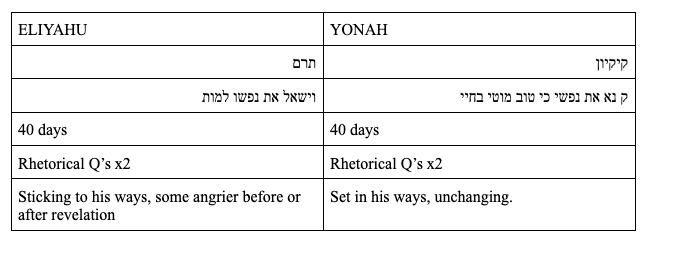
RABBI FOHRMAN
- Yonah was super upset because of the lack of justice, that is, people not facing the consequences of their actions.
- Justice makes people feel secure and happy
Kikayon (gourd plant for shade)
- Din is looking at a person's past (merits + sins)
- Rachamim is looking at a person's future. (Rechem = womb-->baby is born to live up to future potential)
- Yonah liked the קיקיון because of its potential. As it was just created, it has no merits to its name, and so by Din, since it did nothing deserving of life, it should die. Hashem's trick proved to Yonah that a world with only Din and no Rachamim is awful and inside he doesn't really want that.
- Just like you wanted to spare the Kikayon, so too shouldn't Hashem spare Ninveh based on their future potential after Teshuva.
Kushya on Analogy: The Kikayon may not have done anything good, but it also has done nothing bad to merit destruction. So either it's neutral like a fetus in a womb or good because it did give Yonah shade.
Ninveh, on the other hand, did bad stuff before, and the world needs consequence in order for their to be justice.
Teirutz for Problem: Ninveh is actually seen as good by Hashem because Hashem counts sins as merits for future after you do Teshuva.
GEMARA OF R' YOCHANAN & REISH LAKISH
Meeting:
...we all know the story (R' looks like a beautiful woman and Lakish swims out to get "her")...
R' Yochanan offers Reish Lakish his sister in exchange for learning Torah (i.e. do Teshuva for being a robber)
Breakup:
- Fight about Halacha of weapons
- R' Yochanan gets mad and says "a bandit knows his banditry"
- Reish Lakish responds "then I was a master, now I am a master
Rashi - Then and now I was a master
- I was a master of bandits before and now I am a master of Torah
Tosfot - Now and then I was a master
- I was a great rabbi before I was a bandit, and now I am a great rabbi again. (I was actually a great rabbi first before you, booyah!)
Our Gemara:
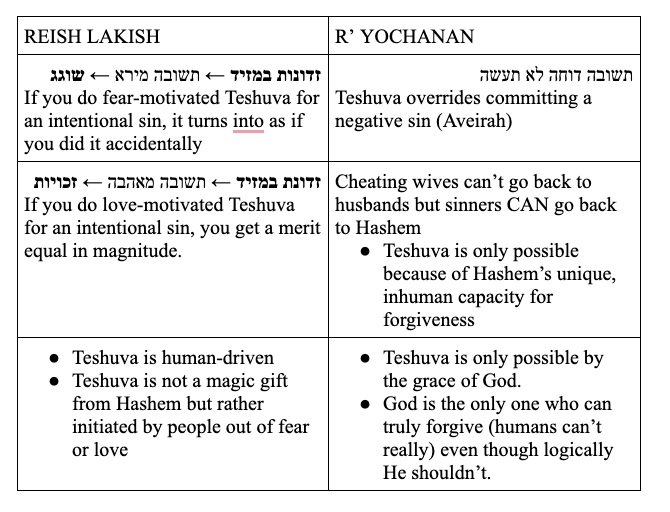
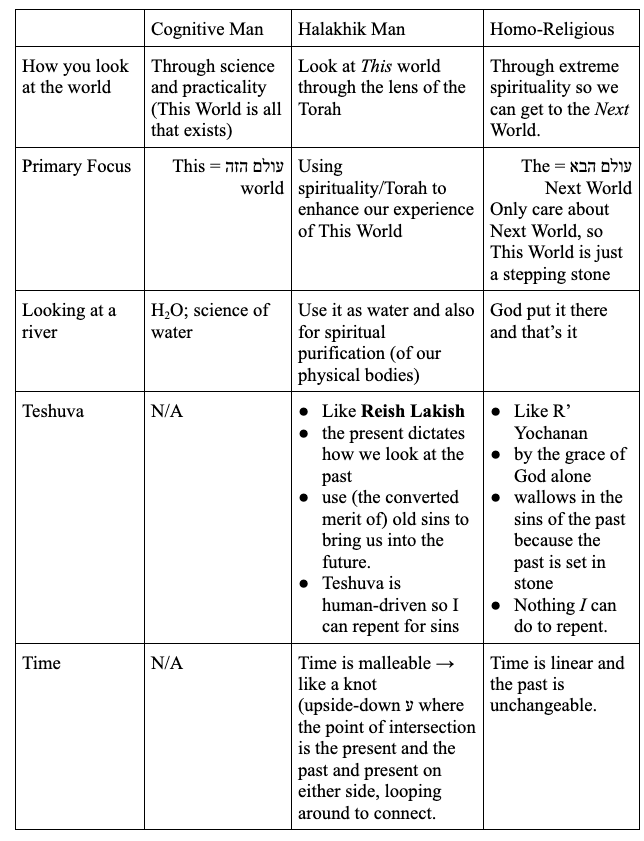
RAV SOLOVEITCHIK
Three types of people and how they view the world/Teshuva according to the above gemara.
VILNA GAON
All of יונה is a משל/parable for what happens to a soul when they die and go through גלגול נמשר

SUMMARY OF יונה PERAKIM 1-4
By Jake Gindi
Chapter 1:
- God's Command: God instructs Jonah to go to Nineveh, a major city known for its wickedness, and call them to repentance.
- Jonah's Rebellion: Instead of obeying, Jonah attempts to escape to Tarshish, heading in the opposite direction. This shows his unwillingness to fulfill God’s command.
- The Ship's Departure: Jonah pays for his fare and boards a ship, hoping to flee from God’s presence (a reflection of his desire to avoid his prophetic mission).
- The Storm: God sends a powerful storm that threatens to break the ship apart, illustrating His control over nature.
- Sailors’ Fear: The sailors, terrified, each cry out to their gods and throw cargo overboard to lighten the ship. This highlights their desperation.
- Casting Lots: The sailors cast lots to determine who is responsible for the calamity, and the lot falls on Jonah, emphasizing his guilt.
- Jonah's Confession: Jonah admits he is the cause of the storm and tells them to throw him into the sea, demonstrating his acceptance of responsibility.
- Reluctant Action: The sailors initially try to row back to land to save Jonah but ultimately throw him overboard as the storm worsens.
- Calm After the Storm: Once Jonah is thrown into the sea, the storm ceases, leading the sailors to fear and worship the God of Israel, recognizing His power.
- The Great Fish: God appoints a large fish to swallow Jonah, and he remains in its belly for three days and three nights, marking the beginning of Jonah’s transformative journey.
Chapter 2:
- Jonah's Prayer from the Fish: In the belly of the fish, Jonah prays to God, recalling his desperate situation as he sank into the depths.
- Themes of Distress: Jonah describes being engulfed by the waters and feeling abandoned, highlighting his despair.
- Recognition of God’s Sovereignty: He acknowledges God’s sovereignty and His ability to save, reflecting Jonah’s realization of God’s power even in his dire situation.
- Vow of Thanksgiving: Jonah vows to offer sacrifices and fulfill his promises to God, indicating a change in his attitude toward obedience.
- Divine Response: God hears Jonah’s prayer and commands the fish to vomit Jonah onto dry land, demonstrating God's willingness to listen and restore.
Chapter 3:
- God’s Second Command: God again instructs Jonah to go to Nineveh, showing His persistence in giving Jonah another chance.
- Jonah's Obedience: This time, Jonah obeys and travels to Nineveh, a city described as “very large” (three days' journey in extent).
- Jonah’s Message: He proclaims that Nineveh will be overthrown in 40 days, a message of impending judgment.
- The Response of Nineveh: The people of Nineveh believe Jonah’s warning and demonstrate genuine repentance by fasting and wearing sackcloth.
- King's Decree: The king of Nineveh issues a proclamation calling for a city-wide fast, urging everyone to turn from their evil ways and violence, emphasizing the collective response to Jonah’s message.
- God’s Mercy: Seeing their repentance, God relents from bringing destruction upon the city, highlighting His compassion and willingness to forgive.
Chapter 4:
- Jonah's Displeasure: Jonah is exceedingly angry and frustrated that God spared Nineveh, reflecting his narrow view of justice and expectations.
- Jonah's Exclamation: He expresses his discontent, stating that this is why he fled to Tarshish, as he knew God was merciful and would forgive the Ninevites.
- Seeking an Outcome: Jonah goes outside the city, builds a shelter, and waits to see what will happen, illustrating his hope that God might still destroy Nineveh.
- The Plant: God provides a plant to give Jonah shade and comfort, signifying divine care for Jonah even in his anger.
- God's Lesson: When God appoints a worm to destroy the plant, Jonah becomes angry about its loss. God questions Jonah about his anger for the plant, which he did not grow.
- God's Compassion Explained: God contrasts Jonah’s concern for the plant with His compassion for the people of Nineveh, emphasizing that if Jonah cares for a mere plant, how much more should God care for the lives of thousands in Nineveh.
INTRO TO BAMIDBAR
Netziv -
In this book, the rabbis focus the most on the two censuses even over other important events such as מרגלים or Bilaam.
This is because the main part of Bamidbar is the transition from living directly under Hashem and being spoonfed from Hahsem to taking care of ourselves.
תפארת (אור) ← במדבר ← טבע (טבע)
In a world of Tipheret or Light, Hashem is clear and obvious to everyone. However, in a world of Teva or Darkness, Hashem retreats a little and is more obsure and hidden from our plain sight.
This is the change from living directly under the cloud of Hashem in the desert, literally being fed from raining food and guided by a pillar of fire, to Hashem eventually leading us towards Eretz Yisrael where we have to take care of ourselves and become farmers and grow our own food.
This change starts taking place in Parshat חקה. Whereas in Egypt Hashem fought our wars for us with mighty miracles, when we are attacked here, we have to fight our own wars (even though we still have Hashem's help)
Signs of טבע include
- fight our own wars
- Moshe's staff of miracles is no longer a constant, automatic sucess but needs to be held up and supported by human arms
- אור לחושך
The two פקודים/censuses are fundamentally different in Tipheret and Teva. They are the benchmarks of the ספר.
Ramban on Shemot:
Both have 10 Commandments Luchot HaBrit
Both have same structure around center which is God
We see from this that Mishkan is our portable manifestation of the holiest thing in history (Har Sinai) and we carry it in the same order as seen from Camp Makeup. We really see how this is the peak of תפארת, and we must ask: How do we come down from this to טבע.
Like kid going to college and transitioning from parental care to independence.
We see that traveling with Mishkan in the desert is thus the epitome of Tipheret.
Three Books in One (Online Netziv)
What we call Bamidbar, Chazal[2] called Chumash ha-Pekudim, or the chumash of countings. Indeed, one of the distinguishing features of this chumash is its inclusion of not one but two census-takings. Upon further reflection, however, we puzzle over why those countings should give this chumash its name, rather than more dramatic events, like the sending of the spies and Bilam’s blessings. Bamidbar, in fact, is rich in striking narratives. Why makes the countings more prominent than all those other episodes?
The answer is that it is not the countings per se that are so important. Rather, two different sets of rules presided over all the dramatic events that befell Hashem’s people between the covers of this book, and they are reflected in those two countings. The manner in which the people who left Egypt were treated differs markedly from the way those who entered the Land lived their lives. The central theme that predominates in this chumash is the transition between those two different lifestyles.
Yeshaya describes the way in which a triumphant Bnei Yisrael lived through the first chapters of their life as a nation. “Who caused His splendrous arm to go at Moshe’s right side[3]?” Simply put, this allowed Bnei Yisrael to live outside the dictates of ordinary natural law. They ate the food of the Heavens, while other needs were provided for miraculously.
Arriving in Eretz Yisrael, their lives could not have been more different. Manna no longer descended from Heaven; they had to toil to coax food from a reluctant earth. They were governed by the same restraints and requirements of all other peoples, differing from them in only one all-important regard. The success of their endeavors was assisted by special Divine providence, assuring their success, but generally in a less dramatic fashion.
The change did not take place in an instant. HKBH saw to it that they were eased into the new way of living. While still travelling through the wilderness in the last of the forty years, Hashem began to wean them away from a completely miraculous existence[4].
The transition manifested itself in several ways. While Hashem had miraculously protected them from all enemies in the years that preceded, in the fortieth year the Bnei Yisrael were called upon to wage war – using conventional methods – against several enemies including Sichon. It can be shown that Moshe’s staff, the iconic representation of miraculous leadership, was no longer routinely taken by Moshe. He used it sparingly, only taking it in hand upon occasions of special need[5]. (This is the true meaning of Chazal’s comment[6] that the “Hashem divided between the light and the darkness” refers to Sefer Bamidbar. The “light” is the life suffused with open miracles. While in the wilderness, the Bnei Yisrael basked in the radiance of Hashem’s Presence, which was open and manifest. The darkness means living according to the fixity of nature. Once they entered the Land, His Presence became obscured. Only by peering very intently could one make out its contours, or catch a glimpse now and then when the night was illuminated by a brief lightning flash of His miraculous intervention.)
Within the two countings from which Chumash ha-Pekudim takes its name, we find this same contrast. Here, too, subtle differences in the way the countings took place manifest the difference between the “light” of brilliant manifestation of Hashem’s Presence and the “darkness” of its hiddenness behind veils of natural law.
The early counting, at the beginning of the chumash, reflects the glory of Hashem’s Presence. The shevatim travelled, according to Chazal, in a pattern and order that reflected their role as the entourage of the Shechinah. The counting follows the order of their encampment around the mishkan. Ephraim precedes Menashe, because Ephraim’s spiritual contribution to a miraculous existence was greater. Leaders could only arise from within the shevet to which they belonged, reflecting the sublime spiritual nuance that distinguished one shevet from another.
The second, later, counting matches the changed circumstances of the last year of their travels through the wilderness. Some of the leaders mentioned actually came from shevatim other than the ones they presided over[7]. Menashe supplants Ephraim in the role of leader. Pragmatic considerations became more important than spiritual roots, as Klal Yisrael shifted more of its gaze to the apparent realities of a lawful and predictable world.
We can localize the precise place where the text moves us from one orientation to the other. It comes at vayehi binso’a ha-aron[8]. Immediately after this short parshah, we hear how the people complained without cause, and how swift and harsh was Hashem’s reaction. The nation understood that living on miracles raised the stakes concerning their behavior. The Divine Presence that, as it were, waited upon them and supplied them with their every need was also close by to quickly move against their inadequacies and indiscretions. They came to fear such a relationship, thinking it impossible to survive such scrutiny. The decision to spy out the Land was a natural outgrowth of this attitude. Their preference for a game plan predicated upon their own activity, rather than relying entirely on Hashem’s providential oversight, led to Hashem complying. He began to replace their previous mode of existence with one that was rooted firmly in the fixity of predictable natural law.
Thus, vayehi binso’a divides between the earlier mode of transcending natural law, and the events that ushered in the constraints with which we still live today. By viewing vayehi binso’a this way, we understand its pivotal importance. The term “sefer” need not mean an entire book; even a single episode can be so important that the Torah will call it a sefer. It thus becomes clear why Chazal[9] call Bamidbar a sefer to itself.

And that is why the ויהי בנסוע הארון in the L...נ is in its own sefer according to Chazal, because it divides the Chumash of Bamidbar into two parts.
Part 1 - before and is about תפארת
Part 2 - after and about טבע
IBN EZRA ON CAMP:

Merkava:
The 4 דגלים represent the 4-faced cheruvim that carry Hashem's Chariot (from Yechezkel) of lighting and fire.
The camp represents the traveling Chariot of Hashem and we are Hashem's emmissaries.
Just like the Cheruvim carry the Merkava (chariot), so too does Bnei Yisrael carry the Mishkan.
This is the epitome of the Netziv's תפארת sta
SOTAH
Sotah - Procedure that happens in Mishkan where woman accused of adultery by her husband must drink a special water to see if she was guilty (innards implode; thigh falls off) or innocent (nothing happens)
Happens if a man is suspicious of his wife of secretly sleeping with another man but there are no witnesses and she won't confess.
Non-Sotah Cheating Scenarios -
- Witnesses - Death
- Confession - a) אסור לבועל=must divorce husband; אסור לבעל=can't marry partner b) No Ketuvah/Alimony money received
Sotah Steps:

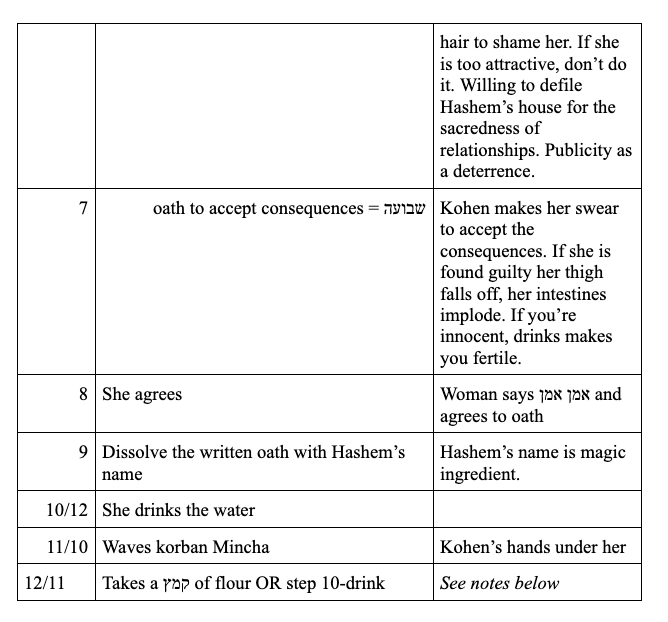
Gemara on 10/12:
- There is a contradiction in the order where the drinking is repeated as steps 10 and 12.
- The real order is...9,11,12,10 --> drinking is last
- Question: Why out of order?
- Answer: To teach that dissolving Hashem's name in water is the Point of No Return when she can no longer confess and must drink
Hammurabi vs. Sotah:

