




 Save
Save Copy
Copy Add to Collection
 Export to Google Docs
 Share
Share
- The Torah is part of the birthright of the Jewish people and requires the voices of all Jews.
- Torah study is transformative and helps us to be the best version of ourselves.
- Torah is for every person who wishes to learn it – there is no hierarchy of who can learn Torah.
- Torah study invites us in to be interpreters, and when we interpret, we can make the world better.
Morasha - Inheritance/Legacy/Heritage (Deuteronomy 33:4)
Deuteronomy 33:4 appears in the section of the Torah that contains Moses’ final blessing to the Jewish people. The surrounding verses recall the revelation at Sinai.
This verse is considered a core statement of the Jewish people’s identity and covenant. It anchors the idea that Torah belongs to all Jews across generations and is widely used liturgically (chanted when the Torah is taken out of the ark) and educationally (often among children’s first verses).
(ד) תּוֹרָ֥ה צִוָּה־לָ֖נוּ מֹשֶׁ֑ה מוֹרָשָׁ֖ה קְהִלַּ֥ת יַעֲקֹֽב׃
(4) Moses commanded us Torah, the morasha (inheritance/legacy/heritage) of the congregation of Jacob.
1) Read the texts several times, and then ask yourself:
a. What is a word or phrase that stands out to you?
b. What is something surprising to you about this text?
c. What are you wondering about regarding this text?
a. What are YOUR big ideas about this text?
b. What is meaningful to you about this text?
Who is Torah For? (Midrash Sifrei Devarim 345:1)
This text comes from Midrash Sifrei Devarim a midrash from the Land of Israel (late 2nd–3rd c.) on Deuteronomy.
Here the Midrash focuses on the word “lanu” (“for us”) in Deuteronomy 33:4 to assert that the Torah’s command is really to benefit those who follow the Torah, and not simply a top-down meaningless set of laws that we obey blindly.
(א) (ד) תורה צוה לנו משה, ציווי זה אינו אלא לנו אינו אלא בעבורנו.
(1) (Deuteronomy 33:4) "Torah was commanded lanu by Moses": This command is only "lanu," only for our sake.
1) Read the text several times, and then ask yourself:
a. What is a word or phrase that Stands out to you?
b. What is something surprising to you about this text?
c. What are you wondering about regarding this text?
a. What are YOUR big ideas about this text?
b. What is meaningful to you about this text?
"Spirituality of Texts," Dr. Michael Fishbane
This essay is by Dr. Michael Fishbane—one of the foremost scholars of Jewish biblical interpretation and theology. Fishbane believes that study and interpretation become disciplined practices that that turn Torah into a lived, renewing source of meaning. Pedagogically, this frames text study as something that refines character, community, and spiritual awareness.

1) Read the text several times, and then ask yourself:
a. What is a word or phrase that Stands out to you?
b. What is something surprising to you about this text?
c. What are you wondering about regarding this text?
a. What are YOUR big ideas about this text?
b. What is meaningful to you about this text?
"Taking the Crown of Torah" - Maimonides on Mishnah Avot 4:13
This text comes from Maimonides’s Commentary on the Mishnah written in 12th century Egypt.
Here Maimonides explains Avot 4:13—“There are three crowns: Torah, priesthood, and kingship; but the crown of a good name rises above them.”
Maimonides uses this Mishnah to teach us that while priesthood and kingship are inherited – the Crown of Torah is actually earned by any person who wishes to partake in learning Torah.
(א) אלו השלש מעלות טובות נתנו לאומה זו בתחלת נתינת התורה והן הכהונה והמלכות והתורה כהונה זכה בו אהרן מלכות זכה בו דוד וכתר תורה מונח לכל מי שירצה להתעטר בו
(1) These three good merits were given to the Jewish nation at the beginning of the giving of the Torah. And they are priesthood, monarchy and Torah. Aharon merited [to take] priesthood, David merited [to take] monarchy, but the crown of Torah remains for anyone who wants to be crowned with it.
1) Read the texts several times, and then ask yourself:
a. What is a word or phrase that Stands out to you?
b. What is something surprising to you about this text?
c. What are you wondering about regarding this text?
a. What are YOUR big ideas about this text?
b. What is meaningful to you about this text?
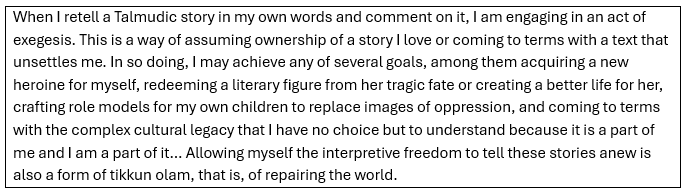
Torah Study is Tikkun Olam - A Bride for One Night, Dr. Ruth Calderon
This text comes from the introduction of “A Bride for One Night” by Dr. Ruth Calderon—an Israeli Talmud scholar and educator and founder of Alma, the secular Yeshiva. The book is a collection of her interpretation and creative retelling of Talmudic stories.
Here she asserts that all Jews have interpretive ownership – that when we interpret the text we actually take ownership over the texts, and thus to repair the world. She invites readers to add their voices to the ongoing conversation of Torah.
1) Read the texts several times, and then ask yourself:
a. What is a word or phrase that stands out to you?
b. What is something surprising to you about this text?
c. What are you wondering about regarding this text?
a. What are YOUR big ideas about this text?
b. What is meaningful to you about this text
