


Deep Rich Jewish Content: Demonstrating Authenticity and Vulnerability


 Save
Save Copy
Copy Add to Collection
 Export to Google Docs
 Share
ShareDemonstrating authenticity and vulnerability in a learning environment allows for genuine questions and struggles, and honest engagement with tradition. This is part of The Jewish Education Project's "Deep Rich Jewish Content" Toolkit.

This material is part of the Deep Rich Jewish Content (DRJC) e-course. Learn more about the DRJC Toolkit.
Let's explore ideas about demonstrating authenticity and vulnerability through some deep rich Jewish text study. Below, you'll encounter three different texts - some modern and some ancient - considering their meaning and application to your life and your work.
When unpacking each text, we'll use a strategy called "Looking Out, Looking In." These two categories of questions take you through a process of first understanding and analyzing the text, and then reflecting individually on your own self and practice.
The Heart of a Teacher
Background context:
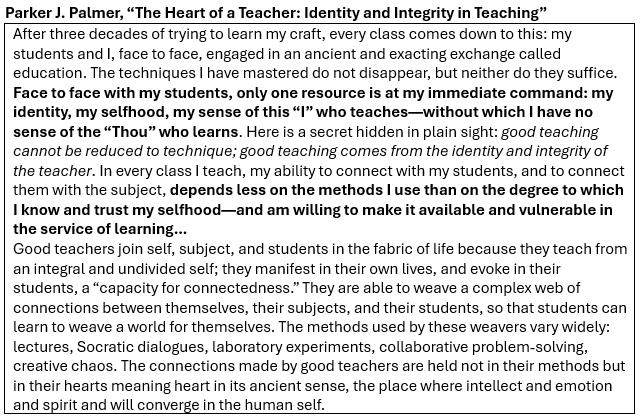
This text comes from an essay by Parker J. Palmer, a prominent educator who wrote extensively on issues in education, community, leadership, spirituality and social change. His transformative book “The Courage to Teach” (from which much of this essay is adapted) builds on a simple premise: good teaching can never be reduced to technique. Good teaching comes from the identity and integrity of the teacher, that core of self where intellect, emotion, and spirit converge.
The full essay, from Change Magazine, Vol. 29, Issue #6, pp. 14-21, Nov/Dec 1997, can be viewed here.
This text comes from an essay by Parker J. Palmer, a prominent educator who wrote extensively on issues in education, community, leadership, spirituality and social change. His transformative book “The Courage to Teach” (from which much of this essay is adapted) builds on a simple premise: good teaching can never be reduced to technique. Good teaching comes from the identity and integrity of the teacher, that core of self where intellect, emotion, and spirit converge.
The full essay, from Change Magazine, Vol. 29, Issue #6, pp. 14-21, Nov/Dec 1997, can be viewed here.
Looking Out:
- What does this text teach us about how an educator should relate to their role in the classroom?
- How do you understand Palmer’s requirement of “an undivided self”?
- Are you able to bring your selfhood to your students? What are your strategies for showing up authentically when you teach?
- What gets in the way of showing up authentically and vulnerably?
Sincerity and Authenticity in Teaching
Background context:
Dr. Erica Brown is the Vice Provost for Values and Leadership at Yeshiva University and the founding director of its Rabbi Lord Jonathan Sacks/Herenstein Center for Values and Leadership. In this article she explores the issue of role modeling, and how a teacher can be a role model without losing their own authenticity, and without imposing their personal practice on their students. She bases much of her thinking on Martin Buber’s seminal essay “The Education of Character.”
Dr. Erica Brown is the Vice Provost for Values and Leadership at Yeshiva University and the founding director of its Rabbi Lord Jonathan Sacks/Herenstein Center for Values and Leadership. In this article she explores the issue of role modeling, and how a teacher can be a role model without losing their own authenticity, and without imposing their personal practice on their students. She bases much of her thinking on Martin Buber’s seminal essay “The Education of Character.”

Looking Out:
- What does Dr. Brown recommend to educators in order to allow their students to be their most authentic selves?
- Do you agree that a teacher needs to show their own humanity? Why or why not?
- Do you ever fall into the trap of oversharing? What practices would you want to adopt that allow you to share authentically without oversharing?
Insides and Outsides
Background context:
Tractate Yoma, from the Babylonian Talmud, deals with the laws and rituals of Yom Kippur. This particular section is found in the midst of a larger conversation about the garments of the priests who served in the Temple, and other Temple ritual objects. Here, we are discussing the Ark in the Tabernacle which was covered in gold both on the inside and the outside, and held the ten commandments.
Tractate Yoma, from the Babylonian Talmud, deals with the laws and rituals of Yom Kippur. This particular section is found in the midst of a larger conversation about the garments of the priests who served in the Temple, and other Temple ritual objects. Here, we are discussing the Ark in the Tabernacle which was covered in gold both on the inside and the outside, and held the ten commandments.
״מִבַּיִת וּמִחוּץ תְּצַפֶּנּוּ״. אָמַר רָבָא: כׇּל תַּלְמִיד חָכָם שֶׁאֵין תּוֹכוֹ כְּבָרוֹ — אֵינוֹ תַּלְמִיד חָכָם.
The verse states concerning the Holy Ark in the Tabernacle: “From within and from without you shall cover it” (Exodus 25:11). Rava said: This alludes to the idea that any Torah scholar whose inside is not like their outside, i.e., whose outward expression of righteousness is insincere, is not to be considered a Torah scholar.
Looking Out:
- What do you think it means that we compare a Torah scholar to the ark? What does this teach you about the role of an educator?
- Why do you think Rava requires consistency and authenticity in order to be considered a Torah scholar?
- Are there ways that you feel you can’t be your full self in the classroom? What actions can you take to allow “your outsides to match your insides” (i.e., to cultivate more authenticity)?
