


 Save
 Copy
 Add to Collection
 Export to Google Docs
 Share
SHUVAH DRASHA
Caveat Emptor:
An unfortunate misconception must be exposed and corrected.
Many mistakenly define ‘minhag’ as any action or abstention that is untethered to Torah or Rabbinical halacha; the unique familial/communal customs relating to Jewish life that are source-less in our legal cannon.
Nothing could be further from the truth!
Rather, all minhagim must have a real - although perhaps minority - halachic viewpoint that is being followed, or, be grounded in the words of chazal (see, e.g. shu”t Noda B’Yehudah, 2, evh’a, #79; see also Tzava Rav Yehudah Hachasid, Otzar HaPoskim edition where sources are sought for each his mysterious rules and ‘chumros’).
- To assume otherwise could give credence to such dangerous groups as ‘Lev Tabor’: "Why can’t our minhag be for women to wear garbage bags on their feet?!"
- If we were indeed allowed to invent actions simply because they ‘felt’ right, Yiddeshkeit, in time, may become unrecognizable, R”l.
- See, e.g., the words of the Rosh, (end of mes. rosh hashana) in the name of Rav Hai Gaon, who shares how just such invented ‘beautifications’ caused the true biblical ‘teruah’ to become, in time, forgotten, necessitating our present-day 30 blasts out of doubt, as opposed to the 9 of obligation.
No one is suggesting that we must seek to discover each-and-every minhag’s source before acting upon them. Rather, that our reverence for our rebbeim and ancestors allows us to be confident that such sources already exist, known to their originators.
A helpful illustration:
The Minhag To Fast For A Fallen Sefer Torah, R"l.
Many may be surprised to learn that such a reaction is NOT mentioned anywhere in chazal, nor is it recorded in our classic codes.
It may be tempting to nevertheless assume that since such a fasting response is self-evidently appropriate, no source is required.
This would be a mistake.
In 1969, Rav Yechezkel Grubner - famed rav of Detroit (d. 2009) - shared with Rav Moshe Feinstein (shu”t Igros Moshe oh’c 3:3) many of the proposed Talmudic sources put forward by in support of this fasting-response-minhag - as the need for a source was obvious to all, even for the most intuitive action being done in Judaism’s name.
Further, in his response, Rav Moshe proceeds to dissect these potential sources, showing how each one may differently affect this minhag's practice. He finally settles on the one chazal he felt was the most likely true source for the fasting response (see taanis 16a).
The above is not to diminish minhagim – on the contrary! We can now better appreciate just how serious, well-cosseted, precious, and sacred our approved minhagim really are!
Only now, with this in mind, can we begin to discuss the minhag of being machmir during aseres yimei teshuva, its source(s), possible limitations, and, if we are so lucky, how it could act as a vehicle toward spiritual growth and change.
--LET US NOW BEGIN-—
I. The Chumrah's Source
Yerushalmi, Shabbos 1:3
רִבִּי חִיָיה רוֹבָה מְפַקֵּד לְרַב. אִין אַתְּ יְכִיל מֵיכוּל כָּל שַׁתָּה חוּלִין בְּטָהֳרָה אֲכוֹל. וְאִם לָאו תְּהֵא אֲכִיל שִׁבְעָה יוֹמִין מִן שַׁתָּא:
"Rebbe Chiya would strongly urge Rav to eat in a state of ritual purity for seven days of the year"
This ambiguous Gemara and mysterious request is clarified with just a little background:
- Aside for Kohanim, there is no prohibition of being or remaining in a state of ritual impurity, e.g. coming into contact with the dead, etc.
- However, should a non-Kohein go to the Temple, or wish to eat certain sanctified foods, etc., then purification is necessary.
- Some non-Kohanim were strict on themselves (even those in Bavel, it seems) remain pure for any-and-all food consumption.
- Why? The possible reasons were many: 1) this may have been to be ready at all times to go to the Temple, or, 2) to stand in spirit with our brethren in Israel-especially the Kohanim, or, 3) to remind the Kohanim in Bavel to be pure before eating their holy foodstuff, etc. etc. etc.
- The process for anyone to become ritually pure concerned the ashes of the Red Heifer -Parah Adumah- along with a precise and complex set of procedures.
- SO THAT: Rav Chiya was urging Rav to be strict during one week out of the year, in that..…
- …although in Bavel, and although a non-Kohen, and although not even eating ritually sanctified food - nevertheless, at least for ‘these seven days’ of the year, Rav should still make sure to be pure before any-and-all eating.
Regarding Which Seven Days Of The Year Was Rav Chiya Referring?
The answer, according to most, is that they referred to the seven non-yom-Tov-days within the Aseres Yimei Teshuva -from Motzai Rosh Hashana through erev Yom Kippur.
This is the interpretation of the classic commentaries found on the page:
עכ"פ בשבע ימים בשנה דהיינו שבעה ימים שבין ר"ה לי"כ תהא זהיר בעצמך לאכול חולין בטהרה ועל ר"ה לא היה נריך להזהיר לאכול שפשיטא שיאכל בטהרה שחייב אדם לטהר את עצמו ברגל:
שבעה יומין מן שתא. והן הימים שבין ר"ה ליוה"כ:
_________________________
The above is the sole source for our current minhag:
This is stated outright by one of the forerunners to Shulchan-Aruch-practice:
The Rosh (13th century) states that this why we are strict regarding Pas Yisroel during this same time frame:
ר' חייא רבה מפקיד לרב אי את יכול למיכל כולה שתא בטהרה אכול ואי לא אכול שבעה ימים בשתא וכתב ראב"י העירי ז"ל קבלתי שאלו שבעה ימים הן שבין ראש השנה ליום הכפורים על כן נהגו באשכנז אף אותן שאין נזהרין מפת של נכרים כל השנה בעשרת ימי התשובה נזהרין:
A few centuries later, the Shulchan Aruch codifies this minhag:
(א) אף מי שאינו נזהר מפת של עכו"ם בעשר' ימי תשובה צריך ליזהר: הגה ויש לכל אדם לחפש ולפשפש במעשיו ולשוב מהם בי' ימי תשובה וספק עבירה צריך יותר תשובה מעבירה ודאי כי יותר מתחרט כשיודע שעשה משאינו יודע ולכן קרבן אשם תלוי הוצרך להיות יותר ביוקר מחטאת: (ד"ע ורבינו יונה ריש ברכות):
However, we are now left with several questions:
- How did halacha go from a source urging one to eat in a state of ritual purity to...Pas Yisroel?!
- Isn't Pas Yisroel a halacha and not a chumra?
- How is this whole enterprise not 'playing games with Gd', chalila?
- Adding to #3: would one be able to simply drop a stringency after Yom Kippur? What of neder?
- Does this minhag apply only to Pas Yisroel, or may one pick and choose other chumros during this time?
Many of These Questions Quickly Fall Away upon reading the words Rav Yosef Karo that predate his Shulchan Aruch- in his commentary to the Tur (as the Rosh's son, the Tur, before the Shulchan Aruch, also codified this custom).
(א) ירושלמי ר' חייא מפקיד לרב וכו' בפ"ק דשבת גמרא לא יאכל הזב עם הזבה:
(א) ומ"ש בשם אבי"ה עד סוף הסימן הם דברי הרא"ש בסוף מסכת ר"ה ודברי המרדכי בתחלתה ובתשב"ץ סי' ק"פ: וכתב בתשב"ץ על דברי אבי"ה וה"ר שמואל מבונבורק אומר דלא דק דדוקא חולין בטהרה דלית בהו איסור טוב הוא לטהר עצמו אבל פת של עו"ג דמשום איסורא הוא אי נהוג בהני י' יומין בכוליה שתא נמי לא מצי אכיל ע"כ. ואין זו טענה דכיון דאין איסורו ברור אלא תלוי במנהג מאחר שבשעה שהוא נזהר מלאכלו אין בדעתו ליזהר כ"א באותן הימים בלבד פשיטא שלא נאסר בשאר ימות השנה:
(א) בעשי"ת צריך ליזהר - היינו אפילו מפת פלטר של גוי... ומ"מ מי שהולך בדרך אם אין לפניו פת של ישראל עד יותר מארבעה מילין ממקום שהוא עומד בו ורוצה לאכול מותר לו לאכול פת פלטר של עכו"ם בעשי"ת כמו שמותר בשאר ימות השנה כמ"ש ביו"ד שם דלא קבילו עלייהו להחמיר ביו"ד ימים יותר ממי שנזהר כל השנה.. כתב הרא"ש שיקרא באלו הימים באגרת התשובה של רבינו יונה והאר"י ז"ל כתב שחיוב ללמוד בספרי מוסר כל השנה וכ"כ הגר"א במשלי בכ"מ ובמע"ר ועכ"פ באלו הימים יעשה כל אדם כדעת הזוהר שישוב קודם שישכב ויתאונן על חטאיו ויפשפש במעשיו...
In other words:
- The rule of only eating Pas Yisroel was initially to be included among the decrees of Bishul Akum, Chalav Akum, etc. (Those who eat Chalav Stam do so only because they believe that certain modern milk productions naturally fulfill the requirements for chalav Yisroel. Such dairy should never be referred to as ‘Chalav Akum’, which is never allowed! The reason we don’t call chalav stam ‘Chalav Yisroel’ is only so as not to confuse those who don’t agree that its production fulfills the decree, who could then mistakenly eat it)
- However, at some point chazal RESCINDED the Pas Yisroel decree, as it was too burdensome for the nation (today we spoil ourselves with 'low carb' diets, but back then bread was the cheapest and most accessible source of calories).
- The Pas Yisroel section of our codes, then, is where our poskim discuss a separate and accepted minhag of still abiding by certain elements of the initial-yet-rescinded Pas Yisroel decree. The debate only how far the minhag goes in mirroring chazal's initial intent.
With all this in mind we can easily answer many of the questions above, as follows:
- Rav Karo brings the Tashbeitz (14th century) who indeed was bothered by the subterfuge and neder issues that may arise from being machmir for just these ten days.
- However, Rav Karo explains that this is indeed why we chose specifically Pas Yisroel as our stringency of choice: just like eating mundane food whilst in a pure state is a non-halachic custom - as opposed to, say, having a minhag not to open bottle caps on Shabbos - Pas Yisroel nowadays has no clear germ of true halachic concern! It is a pure minhag! Therefore, we choose this as the best comparable minhag to eating in a a state of tahara!
- In addition, during these Ten Days, even when assuming the more strict minhag for Pas Yisroel (compared to one’s standard custom), one is not to go beyond that stricter view’s basic approach, as that would thereby be inventing new chumros, which we are not to do. (For example: since even the most strict view of this minhag would allow Pas Palter when Pas Yisroel is a journey away, so too during these Ten Days would such bread be allowed under those same circumstances)
What we've learned thus far is fascinating!
- OPEN bottlecaps on Shabbos! (If this is your practice the rest of the year)
- Chazal only teach to be strict regarding 'Inconsequential'-yet-established-minhagim! Otherwise, what was even the point of last week's Hataras Nedarim?!
- Pas Yisroel was chosen presicly because -like Rav Chiya's charge -it doesn't go near true halacha!!!
This explains the following issue of 'kavod' which has always bothered me.
That Question Goes Like This:
"You mean to tell me that in ‘honor’ of Aseres Yimei Teshuva...we should question our parents, our poskim, our rebbim?! To go 'rabbi-shopping'?! To suddenly, say, wear a gartel, or not rely on an otherwise reliable shechita?!"
Answer:
"Of course not! Rather, choose an innoucous matter, unrelated to true law"
While this answers most of our initial questions, we are introduced to a NEW one -a most perplexing issue:
"What then is the point of all this?
- Meaning, if this minhag is -DAFKA- not about halachah, to choose something innocuous, why then is it to be the focus of change during these days? As if we are being taught: "On Aseres Yimei Teshuva let us all work on...A HARMLESS MINHAG”?!
- Based on all of the above, it would seem that this minhag lacks any intuitive purpose!
In fact, and magfyung our questions, some had a version of this Gemarathat hasRav Chiya actually suggesting our exact minhag -of eating only Pas Yisroel during Aseres Yimei Teshuva!!:

Our goal tonight is not only be to answer these questions, but to share a new way of understanding the purpose of this minhag; demonstrating how it contains a secret tool for growth.
- (THIS APPROACH IS FOUND BELOW IN SECTION VI. ONE MAY CHOOSE TO JUMP DIRECTLY THERE) -
_________________________________________________________________
However, before that -and time allowing- I would be remiss not to share some fascinating history regarding this minhag:
II.
Through The Centuries
Some saw this source -and our minhag - as an exact copy of Rav Chiya and Rav! Meaning, still in the 16th century, some would avoid eating mundane food in a state of impurity!!!
“There are hasidim who eat their chullin in purity during the Ten Days of Repentance, and likewise on Passover.” And similarly in the list of practices written by R. Avraham HaLevi, the student of the Ramak: “There are among them those who eat chullin in purity twice: on the Shabbat before Passover, and during the Ten Days of Repentance.” An additional source from that same period also testifies to a group of select individuals who held this custom: “Some hasidim who are accustomed to eat chullin in purity during the seven days between Rosh Hashanah and Yom Kippur…”
“There is also purity in eating, and as the early ones were accustomed, that they would eat their chullin in purity. But it is a very difficult thing to fulfill since we are all impure… And the holy divine one, the Ari z”l, was accustomed thus from Rosh Hashanah until after Yom Kippur.”
“Let our master teach us whether it is possible in this time to practice any form of purity in any manner whatsoever. For I have seen some hasidim who are accustomed to eat chullin in purity during the seven days between Rosh Hashanah and Yom Kippur… and they rely on the language of the Jerusalem Talmud:…And to refute their proofs I say, according to my humble opinion, that (in the period of that event)” they still had the ashes of the red heifer, and therefore they were able to purify themselves and eat chullin in purity.
"...and there is in this a desecration of the Torah in the eyes of the nations, for they think it is two Toros. Therefore I went out before them to seek their favor and to find grace in their eyes: let them not be overly pious, and what the Torah forbade is enough for them... And because over the course of these stringencies there arose disputes at festive meals, and between a man and his wife...”
________________________________________________________________
III.
Different Readings/Different Girsoas
(Time Allowing)
On the flip-side of this 16th century example, we have those (again, a minority) who reject how even we today apply this source/Chazal.
- Some point to the fact that Rav Chiya said SEVEN DAYS, when we know that the Aseres Yimei Teshuva are just that -TEN!!
- Similarly, the Meshech Chochma understands Rav Chiya to be referring not to the Aseres Yimei Teshuva, but rather to the days of Yom Tov in the year (7):
... עיין רא"ש סוף רה"ש בשם אבי העזרי קבלתי כו'. ואם קבלה נקבל (!!) ונראה לפרש, דכונתו על שבעת ימים טובים, היינו פסח ב' ימים וסוכות ב' ימים, ועצרת יום אחד, ורה"ש לבד מקום הועד היו עושין שני ימים מספיקא, והוי שבעת יומין.
- Still others may accept our reading, yet posit that there is little application to our days:
- Still others read this Chazal as a quasi 'buyers' choice', that Rav Chiya was urging Rav to choose ANY seven days of the year! This would then have no bearing on the Yomim Noriam!:
ובפ”ק דשבת ירושלמי אמרינן: ר’ חייה...ופי’ רבינו ר’ נסים גאון זצ”ל: מיום ראשון דר”ה עד יו”כ, ויוה”כ בכלל, עשרה ימים; כד דלית מינייהו שני ימים של ר”ה ויוה”כ שאין בהם אכילה ושתייה, אשתייר שבעה ימים, ועליהם צוה ר’ חייא לרב...מידו הוא סובר שמותר להתענות בר”ה...מיהו אין לי ראיה משם, שאני יכול לומר דלא צוהו ר”ח לרב אלא על שבעה ימים בשנה, איזו שבעה שיהיו.
A final point: The reader should note that our source -this Yerushalmi - is already well-known, used as an allusion to other halachos/minhagim:
(ו) (ו) כדי שיעור חלה - היינו מלבד שהלישה והאפיה הוא מכלל כבוד שבת ויו"ט כמו שמסיים לבסוף עוד יש בזה טעם כדי לקיים מצות חלה לפי שאיבדה את אדה"ר שהיה חלתו של עולם שנברא בע"ש ועיין באחרונים דאפילו הנוהגין לאכול פת פלטר של א"י בחול מ"מ בשבת ויו"ט נכון ליזהר שלא לאכול כ"א מפת ישראל מפני כבוד השבת ויו"ט.
____________________________________________________________
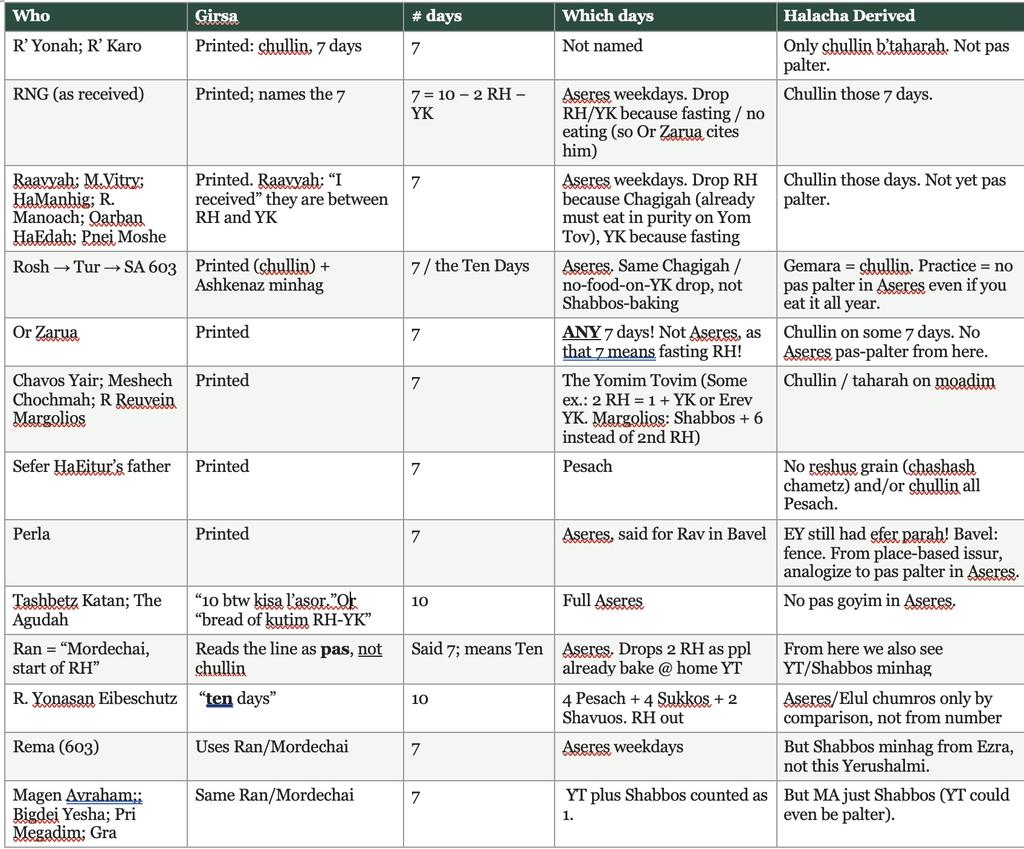
V. Explaining The Number Problem - Why 'Seven' & Not 'Ten'
(TIME ALLOWING)
{What follows is for the edification of the reader, and was not part of the Drasha proper}
- Yerushalmi says to eat b'taharah for seven days of the year.
- If we identify those days with Aseres, should it not instead say 10?!
- We can subtract YK, as there's no eating. That still leaves two days to account for.
- Almost everyonesimply subtracts the two days of RH as ppl anyway bake at home for the yom tov. So we have our Seven.
- However, what about the Shabbos that falls inside Aseres, when ppl also bake for themsleves? That leaves us with six, not seven!
- Rema’s Resolution: The Shabbos/Pas Yisroel minhag is a takanas Ezra, not this Yerushalmi (which did not subtract Shabbos)
- Magen Avraham’s Resolution (simaler to Gra): He subtracts Shabbos but posits that in those days they made RH one day (kiddush al pi ha-re’iyah)!
- Rema of Lishitz's Resolution: He subtracts both Shabbos and two-days-RH, but thene adds a day: the night after YK!
A CHART W/ ALL VIEWS, READINGS, & GIRSOAS:
___________________________________________________________
- The Heart of the Matter-
VI.
Subterfuge With Gd?!
Or
What is the Point of all this?:
First, we must share that some Poskim indeed say that our minhag is to be machmir by any and all halachos!
For example:


Rav Yisroel Salanter, naturally, even extends this chumra minhag of these Ten Days to middos:
.... כִּי הִנֵּה יָדוּעַ כִּי בַּעֲשֶׂרֶת יְמֵי תְּשׁוּבָה. צָרִיךְ הָאָדָם לְהֵישִׁיר דְּרָכָיו וּלְשַׁפֵּר מַעֲשָׂיו בְּיוֹתֵר. וְאַף מִדַּת חֲסִידוּת שֶׁאֵינוֹ רָגִיל לִהְיוֹת נִזְהָר בְּכָל הַשָּׁנָה. בְּכָל זֹאת צָרִיךְ לִהְיוֹת זָהִיר בַּעֲשֶׂרֶת יְמֵי תְּשׁוּבָה. וְכַמְבֹאָר בִּירוּשַׁלְמִי.... וְכָתַב הָרֹא"שׁ דְּעַל כֵּן נָהֲגוּ בְּאַשְׁכְּנַז שֶׁאַף אוֹתָן שֶׁאֵין נִזְהָרִין מִפַּת עוֹבֵד כּוֹכָבִים כָּל הַשָּׁנָה בַּעֲשֶׂרֶת יְמֵי תְּשׁוּבָה נִזְהָרִין עַיֵּן שָׁם. וְעַל כָּל פָּנִים כְּמוֹ כֵן בְּדַרְכֵי הַמִּדּוֹת בְּוַדַּאי צָרִיךְ לִהְיוֹת בַּיָּמִים הָאֵלּוּ עַל מִשְׁקַל הַחֲסִידוּת בְּיוֹתֵר...:
According to these opinions: what about the Beis Yosef and Tashbeitz concern for a Neder?
ועיין ביערות הדבש ח"א דרוש א' כי ז' ימים שבין ר"ה ליום הכפורים הם נגד ז' ימי שבוע ובכל יום יעשה תשובה על אותו יום ד"מ ביום ראשון יעשה תשובה על מה שחטא כל ימיו ביום ראשון וכן ביום ב' וכן כל ז' ימים:
__________________________________________________________________________
However, most disagree, asserting that this minhag concerns only inconsequential chumros.
This is the view with which we began this derasha, and with which we will now conclude.
According to this majority approach to the minhag, what is the point?
How can one possibly grow from this?
In fact, R' Shmuel Kamanetzky (Kovetz Halachos) explicitly limits this not only to 'inconsquential' minhagim but only to Pas Yisroel. He points to the following Chayay Adam that explains why the original Pas Yisroel Gezeira initially didn't take in the days of chazal (Chachmas Adam, 65:2):
Meaning precisely because of bread's central role in our lives was this decree too burdensome, and was rescinded.
THIS is explains why we use bread during Aseres as our 'inconsequential' chumra - utilizing humans' greatest and most central fuel source as a reminder how we are to be reliant on Gd for all things.
While this may answer why bread was chosen, it still does not explain the point of a minhag to be strict regarding a non-halachic-minhag-chumra - and at that, just for these ten days!
V. A New Approach
B'Chasdei Hashem...
I Would Like to Offer A New Way To Understand How This Seemingly Inconsequential Matter Can Help Us Grow:
This is based on a principle called:
'The Habit Discontinuity Hypothesis'
"Thinking of Changing Your Behavior? Try Moving First,"
San Antonio, Texas - 41% of Americans make New Year’s resolutions but only 9% feel they were successful in keeping their resolutions. The problem may be in the timing. According to research being presented at the SPSP Annual Convention the time for successful habit change isn’t based on the calendar, but on big changes to our everyday lives like moving to a new home.
“Changing your habits is very difficult,” says Bas Verplanken, professor of social psychology at the University of Bath, “including finding the right moment to make a change.”
Habits develop when we repeat behaviors, and they are reinforced the more everything around us stays the same.... Work from Verplanken and colleagues shows habits can be changed when you change the factors around the habit (location, context). Researchers call this the “discontinuity effect.”..Verplanken notes the New Year may be a nice moment to mark the start of a new phase, but the point of the discontinuity effect is that the change in behavior is embedded in other changes.
“In the case of moving to a new home for instance, people may need to find new solutions for how to do things in the new house, where and how to shop, commute, and so on. All of these aspects are absent when talking about New Year resolutions.”
Verplanken studied the behaviors of over 800 people, half of whom had recently moved and half of whom had been at the same home for several years...According to his research, people who received an intervention and had recently relocated reported more change eight weeks later on a composite of twenty-five environment-relevant behaviors compared to participants who had not recently relocated.
These results were consistent in spite of the strength of previous habits and views, and are consistent with research from others....
In other words:
Want to quit smoking? Try it when on vacation!
Want to make a big change in your life?
Start with a tiny-and-unrelated change or shift in your daily routine!
Changing our rhythm of life first-even the smallest element-can allow real change to more naturally follow!
We tend to think of teshuvah as requiring a major act of will.
But that’s not always how change begins.
There is where the concept of 'Habit Discontinuity Hypothesis' enters the picture.
- We drive the same routes,
- shop at the same places,
- follow the same routines,
-....and respond to our surroundings almost automatically.
And we then wonder why change is difficult?!
When we, for example, move, change a major environmental cue, then those other auto-cues disappear. Suddenly, the old routine does not flow as naturally.
This creates, or rather opens, a window of opportunity for behavioral change.
"During approximately the first three months after moving, people were more susceptible to establishing new habits. The move itself didn’t make them better people, rather it disrupted the automaticity of their old behavior. And once the old pattern was interrupted, there was an opening for something new."
Chazal Allude To This:
(ב) אֲנִ֥י יְשֵׁנָ֖ה וְלִבִּ֣י עֵ֑ר ק֣וֹל ׀ דּוֹדִ֣י דוֹפֵ֗ק פִּתְחִי־לִ֞י אֲחֹתִ֤י רַעְיָתִי֙ יוֹנָתִ֣י תַמָּתִ֔י שֶׁרֹּאשִׁי֙ נִמְלָא־טָ֔ל קְוֻצּוֹתַ֖י רְסִ֥יסֵי לָֽיְלָה׃
(2) I was asleep,But my heart was wakeful.Hark, my beloved knocks!“Let me in, my own,My darling, my faultless dove!For my head is drenched with dew,My locks with the damp of night.”
What Is The Meaning Of, 'LET ME IN!'?
The Midresh Pesikta D'Rav Kahana expounds:
... פתחי לי (שה"ש שם), א"ר יסא א' הקב"ה פתחי לי פתח כחרירה של מחט ואני פותח לכם פתח שיהו אהליות וכצוצטריות ניכנסין בו.
"Hashem says, 'Open up for me a little -like the eye of the needle -and I shall open for you a path big enough for chariots to pass through"
WOW!
“וְהִנֵּה הַסְּנֶה בֹּעֵר בָּאֵשׁ וְהַסְּנֶה אֵינֶנּוּ אֻכָּל.”
"Behold! The bush was burning with fire, yet the bush was not being consumed"
“אָסֻרָה נָּא וְאֶרְאֶה”
“Let me turn aside and see.”
“וַיַּרְא ה’ כִּי סָר לִרְאוֹת”
“Hashem saw that he had turned aside to see.”
“רבי יוחנן אמר: חמש פסיעות פסע משה באותה שעה… רבי שמעון בן לקיש אמר: הפך פניו והביט...כיון שהביט בו הקדוש ברוך הוא, אמר: נאה זה לרעות את ישראל”
Once Hashem saw Moshe do this, He said:
“This one is fit to shepherd Israel” !!
That’s extraordinary!
What did Moshe even do?!
He wasn't engaged in teshuvah!
He wasn’t looking for a spiritual experience!
Rather he simply breaks his routine!
Whether that is by taking five steps—ors merely turning his head.
And that tiny interruption may lead to a deeper disruption, one that may allow true life changes.
We tend to think teshuvah requires a dramatic decision.
But perhaps the first step is much smaller.
“אסורה נא” — I will step aside.
Change one thing.
Break one automatic routine.
Do something slightly differently.
Once the normal pattern has been interrupted, you’ve created room for something deeper to happen.
What psychologist calls it habit discontinuity, Chazal might call:
“ The Law Of:
"...אסורה נא”
- We spend most of our lives operating automatically.
- We don’t make a conscious decision every morning to be the person we’ve become.
- Our routines, surroundings, habits and patterns keep carrying us in the same direction.
- And sometimes the first thing we need isn’t a dramatic transformation.
- It’s a disruption.
- One small change.
- One different decision.
- One interruption of the automatic routine.
And perhaps that is what the Yamim Nora’im do for us.
- Rosh Hashanah isn’t our normal day.
- The shofar interrupts the ordinary sounds of life.
- Selichos interrupt the normal morning.
- The davening is different.
- Yom Kippur interrupts our ordinary eating, drinking and physical routine.
- Shabbos Shuvah itself is an interruption.
- For a few days, the normal rhythm of our lives is broken.
This may not be merely a consequence of the Yamim Nora’im but is part of their purpose.
But what about when we leave shul after Rosh hashana and begin to seek to come close to hashem for the next Seven Days?
IT CAN'T BE A HALACHA (FOR REASONS EXPLAINED), NOR SHOILD IT BE SOMETHING SILLY.
THUS THE HALACHICKLY-NON-CONSENQEUNTIAL MINHAG OF BEING STRICT REGARDING PAS YISROEL.
{As an added bonus, Pas, as the Chayay Adam/Rav Shmuel shared above, is seen - consciously or subconsciously -as integral to our lives}
More, the commonality of bread makes this same shift unavoidable, impossible not to notice
And then, perhaps, this shift, this break from the 'cruise control', the hamster wheel, of our daily auto-slumber will awaken a greater change - a more significant shift.
Hashem wants us to simply turn our head!.
That tiny act of breaking from the ordinary became the opening for an encounter with Hashem!
This is the Shabbos Shuvah challenge.
“What are my five steps?” "What is one small thing I can do differently?" "What is one automatic pattern I can interrupt?"
"What is one little “אסורה נא” I can introduce into my life?"
Real change doesn’t always begin with a revolution. Sometimes it begins with a deviation of five steps.
Let me conclude with how we began: Bread.
- No beginning and no end: A circle has no start or finish. This is a siman for long life, years without limit, and blessing “ad bli dai.”.
• The cycle of the year (ma’agal hashanah): The round shape mirrors the turning of the year itself.
• Crown (keser): We eat round loaves because the day’s main avodah is crowning Hashem (“veyitnu lecha keter malchuta”).
• Wheel of fortune / galgal hozer ba’olam: Parnassah and status go around.
• Completeness and no corners: A round loaf is whole, without edges or deviations, a siman that tefillos will be heard, and that the year’s cycle be without aveiros or stumbles.
• Peace and unity at the end of days: The circle alludes to future achdus
