


Envisioning Sefaria’s Future: Q&A With CEO Alex Luxenberg


 Save
 Copy
 Add to Collection
 Export to Google Docs
 Share
With a background in both innovation and Jewish learning, Sefaria’s new CEO has his sights set on expanding access and engagement with Jewish texts.
November 18, 2026
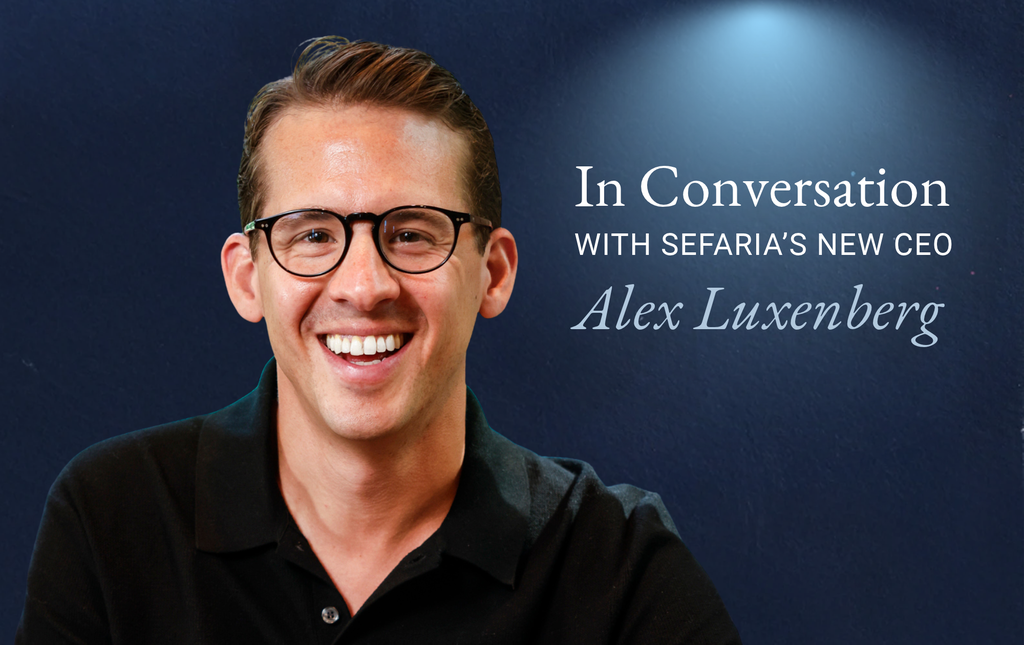
Earlier this fall, we welcomed Alex Luxenberg as Sefaria’s new CEO. Alex brings years of experience working at high-impact companies at times of technological transformation, and he’s a longtime Sefaria user with a deep background in Jewish texts.
Since taking the helm, Alex has set an exciting course for Sefaria — one of expanded access and deepened engagement with Jewish texts.
We sat down to ask him a few questions about tech, texts, the future he envisions for Sefaria, and the Jewish wisdom that inspires him in his new role.
Let’s start with the fun stuff. Favorite ice cream flavor, favorite TV show, your ideal superpower… go!
I am obsessed with açai bowls with Nutella. Try stumping me on Seinfeld trivia. Super power? The ability to make more time.
I am obsessed with açai bowls with Nutella. Try stumping me on Seinfeld trivia. Super power? The ability to make more time.
Share a bit of your background. What brought you to Sefaria?
Sefaria brings together two parts of my life that, for a long time, seemed pretty distinct.
Sefaria brings together two parts of my life that, for a long time, seemed pretty distinct.
Professionally, I’ve been fortunate to work at some extraordinary technology companies at moments of tremendous change. I’ve learned that anticipating change is far more interesting (and generally more rewarding) than reacting to it.
Personally, I grew up immersed in Jewish learning, spent time studying in yeshiva in Israel, and acquired some admittedly niche skills, like reading Aramaic and knowing where to put a question mark in a page of Gemara.
I’ve always felt incredibly fortunate to have that background, but I don’t think it should be a prerequisite for engaging deeply with Jewish wisdom. What excites me about Sefaria is the opportunity to bring these two parts of my life together and leverage technology to make thousands of years of Jewish wisdom accessible to more people, in more ways than ever before.
I’ve always felt incredibly fortunate to have that background, but I don’t think it should be a prerequisite for engaging deeply with Jewish wisdom. What excites me about Sefaria is the opportunity to bring these two parts of my life together and leverage technology to make thousands of years of Jewish wisdom accessible to more people, in more ways than ever before.
Before you became the CEO, you were a Sefaria user. How did you engage with the Sefaria Library, and what did you learn from that?
I was a pretty avid Sefaria user long before I had any idea I’d be its CEO. My most consistent use was studying the weekly parashah, but Sefaria also became an integral part of how I think and write.
I was a pretty avid Sefaria user long before I had any idea I’d be its CEO. My most consistent use was studying the weekly parashah, but Sefaria also became an integral part of how I think and write.
I’ve always enjoyed exploring contemporary ideas through the lens of Jewish thought. Often, I’d have what I thought was a particularly original insight, only to discover that someone had articulated it far more eloquently 800 years ago. There’s something both humbling and wonderful about that. It’s a reminder that we’re participants in a conversation that has been unfolding for thousands of years.
I’m also a bit of a tinkerer. At one point, I used Sefaria’s API to build a little app to personalize my own Jewish learning. I got to experience firsthand what’s possible when you make Jewish texts not only accessible to readers but also available to builders. That’s an aspect of Sefaria that I’m particularly excited to build upon.
What’s your vision for the future of Sefaria?
Building for the scholar and the first-time learner, the rabbi preparing a sermon and the teenager asking a question on their phone. I want Sefaria to be equally extraordinary for someone encountering a Jewish text for the first time and someone discovering something new in a text they’ve studied a hundred times.
Building for the scholar and the first-time learner, the rabbi preparing a sermon and the teenager asking a question on their phone. I want Sefaria to be equally extraordinary for someone encountering a Jewish text for the first time and someone discovering something new in a text they’ve studied a hundred times.
We’re also at a fascinating moment in the history of Jewish learning. The way we access and engage with Jewish texts has evolved over thousands of years, from scrolls to the printing press to the digital library. We’re living through the next chapter of that evolution, and Sefaria is uniquely positioned to lead it. I think we have both an extraordinary opportunity and a responsibility to do so.
Ultimately, our mission is to ensure that Jewish wisdom endures. The best way to do that is to make it more accessible to more people, in more ways than ever before, and to create opportunities for deeper, more meaningful engagement with it.
I want more people not only to discover Jewish wisdom but to develop a lifelong relationship with it.
Can you give any sneak peeks of what users might see soon?
Our incredible team has a lot in the works right now. One of the areas I’m really excited about are features we’re building to help people personalize their learning experience. For example, soon you’ll be able to customize your siddur nusach or preferred translations, and we’re working on ways for the platform to remember your favorite commentators or learning preferences.
Our incredible team has a lot in the works right now. One of the areas I’m really excited about are features we’re building to help people personalize their learning experience. For example, soon you’ll be able to customize your siddur nusach or preferred translations, and we’re working on ways for the platform to remember your favorite commentators or learning preferences.
This matters because more than 800,000 people use Sefaria each month. That’s thousands of people with different interests, different learning styles, different Jewish backgrounds. We want every user to experience Jewish texts in a way that’s meaningful and impactful for them, and that might not look the same for everyone.
In addition to that, we’re continuing to build the core library with texts and translations that people have been asking for — things like Sefardic siddurim and machzorim and more English translations of talmudic commentaries.
Since you’re a longtime Sefaria user yourself, what’s your top Sefaria tip that you think more users should know about?
The Library Assistant, our AI-powered chat experience, is an incredible tool for the newcomer and expert. It’s transformed my learning and has pulled me way deeper into the Library than ever before.
The Library Assistant, our AI-powered chat experience, is an incredible tool for the newcomer and expert. It’s transformed my learning and has pulled me way deeper into the Library than ever before.
What’s a piece of Torah that you find particularly inspiring when looking ahead to Sefaria’s future?
There’s a wonderful story in the Talmud (Berakhot 28a) about the day Rabbi Elazar ben Azariah removed the guard from the entrance to the beit midrash, the Jewish house of study. The Gemara records a debate over whether 400 or 700 additional benches were needed to accommodate the influx of new learners.
There’s a wonderful story in the Talmud (Berakhot 28a) about the day Rabbi Elazar ben Azariah removed the guard from the entrance to the beit midrash, the Jewish house of study. The Gemara records a debate over whether 400 or 700 additional benches were needed to accommodate the influx of new learners.
What I love about this story is that the appetite for Torah was already there. What needed to change was access.
Today, technology affords us the opportunity to open the doors of the beit midrash on a scale that those rabbis could never have imagined. We can welcome millions of people into a conversation that has been unfolding for thousands of years.
And fortunately for us, we don’t need to worry about running out of benches.
