Save
 Copy
 Add to Collection
 Export to Google Docs
 Share

14 Cheshvan 5775 | November 7, 2014
Parshat Vayera
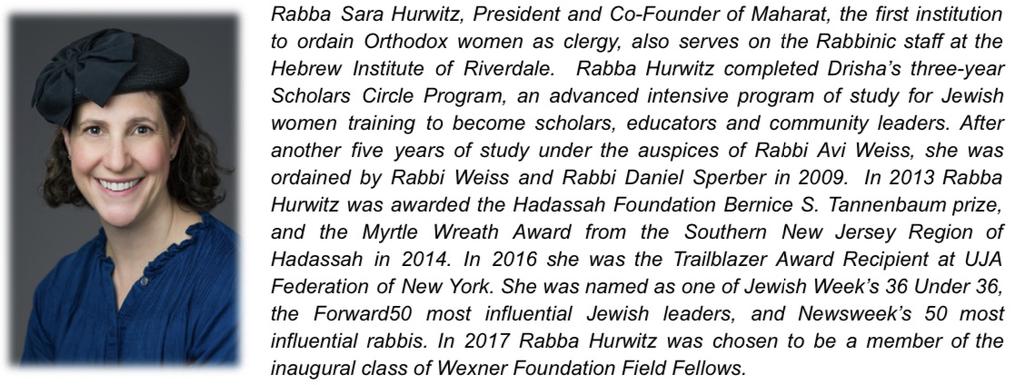
Rabba Sara Hurwitz
President and Co-Founder
This is the parsha of laughter.
Generally, we don’t think of laughter as a religious ethic. We don’t strive to respond to challenges with laughter in the same way that we try to strive to respond with humility, justice or morality. In fact, most uses of the word z ch k (laughter) in rabbinic literature and in Tanach are meant to imply ridicule. But laughter, when used appropriately, is actually a deeply religious and profoundly useful response, especially in our world today.
In these parshiot, Sarah laughs twice. First, when the Angels appeared at Sarah and Abraham’s tent to tell them of the pending birth of Yitzchak, the Torah narrates:
(יב) וַתִּצְחַ֥ק שָׂרָ֖ה בְּקִרְבָּ֣הּ
And Sarah laughed at herself.
In disbelief, Sarah laughs, “b’kirbah” (within herself). She looked at herself, at the limitations of her own body, and she laughed. It was in that laugh that she contracted (tzimtzum) and made space for the impossible; she created a void b’kirbah. It is in that void, in her womb, that Yitzchak was created. This is the laughter of creation.
And then, Sarah laughs again. This time, it is a laughter that inspires others to laugh as well. God remembers Sara and she gives birth to Isaac.
Sarah says, “God has made laughter for me; whoever hears will laugh with me.”
The Midrash in Bereishit Rabba (53:8) says when Sarah laughed, she caused laughter and by doing so, she caused others to heal. When she gave birth, those who were barren gave birth. Many deaf gained their hearing; many blind had their eyes opened. Sarah’s joy inspired laughter and joy in others because she modeled the idea that laughing leads to healing. In the void that is created by laughter, the pain of the world is diminished, we make room for the possibility that suffering can be transformed to health and well being. Through the newly created space, through that pain, God can be found.
There is a chassidic teaching, based on the ideas of the Baal Shem Tov, that God created the world with simcha, ahava, and zchok, through joy, love and laughter. To create something from nothing, the primary ingredient is simcha. The Baal Shem Tov goes on to explain that when a king laughs, his kavod, dignity and kingship is diminished. And it is in this state, that anyone can approach the king. Normally, you have to go through the secretary or the guards before you can petition the king. But when he is in a cheerful state, when his dignity is diminished, even the lowly servants can approach and greet him. So too, when God created the world, God’s joy caused God to become diminished. God withdrew from the world, engaged in tzimzum, contraction. And that tzimzum, created a void. It is within that void that the world was created. In that space where God’s laughter appeared, the world emerged.
Here’s the amazing part of this teaching. In order for us to find God, we have to do the same thing. We have to contract, create a void and fill it with laughter. We withdraw from the parts of the world that are hurtful and tragic and painful and depressing and through filling that space with joy, we reach through the void and reconnect with God. And by doing so, we diminish the suffering and the hardships in our world. It is within that creation, that we reach back and find God.
Sarah’s laughter represents two phases of coming closer to God. Her first laugh gave her the strength to pull back, contract and in that space, in that darkness, she saw the possibility of new creation. And then she laughs again. This is the laugh of healing of finding her way to happiness, love and ultimately to God.
Rabba Sara's Overarching Theme:
Feeling God’s presence, shouldn’t be that difficult. “You shall walk after the Lord your God,”(Devarim 12:5) we are told; seek out God’s presence. And yet, astonished, R. Hama son of R. Hanina (Talmud Bavli, Sotah 14a) asks, how is it possible to walk with the Shechina? Rav Hama quotes an early pasuk from Devarim that describes “... the Lord your God as a devouring Fire.”(Devarim 4:24). How is it possible to get close to God without being scorched? R. Hama answers his own question: We must walk after the midot, after the attributes of God, not his immediate presence.
In Hebrew, good attributes, midot, are translated as “good measures.” Rabbi Adin Steinsaltz in The Thirteen Petalled Rose, suggests that a quality is determined by its proportion. In other words our midot are the balance of our varied characteristic traits. To act Godly is to put our best spiritual essence forward, while trying to keep in check the inevitability of negative attributes. We are at once both good and bad, compassionate and injurious.
At Yeshivat Maharat, our students are ordained with the ability to lead, pasken, and teach. But, they must also be finely attuned to the nuances of the human condition. Spiritual leaders are most effective when they have confronted and understand their own midot, their own balance of human traits. Our Torah narratives bring to bare the multi-layers of the characteristic traits that individuals must learn to balance within themselves.
And so, I offer this weekly parsha column as a model of Yeshivat Maharat’s Pastoral Torah curriculum, where we will explore the rich and varies layers of the human condition.