




 Save
Save Copy
Copy Add to Collection
 Export to Google Docs
 Share
ShareSpotify | Apple Podcasts | YouTube
Link to Substack post: Here
The brave Maccabees against the oppressive Greeks.
The miracle of oil that lasted eight days.
בחנוכה:בִּימֵי מַתִּתְיָֽהוּ בֶּן יוֹחָנָן כֹּהֵן גָּדוֹל חַשְׁמוֹנָאִי וּבָנָיו כְּשֶׁעָמְ֒דָה מַלְכוּת יָוָן הָרְ֒שָׁעָה עַל־עַמְּ֒ךָ יִשְׂרָאֵל לְהַשְׁכִּיחָם תּוֹרָתֶֽךָ וּלְהַעֲבִירָם מֵחֻקֵּי רְצוֹנֶֽךָ, וְאַתָּה בְּרַחֲמֶֽיךָ הָרַבִּים עָמַֽדְתָּ לָהֶם בְּעֵת צָרָתָם רַֽבְתָּ אֶת־רִיבָם דַּֽנְתָּ אֶת־דִּינָם נָקַֽמְתָּ אֶת־נִקְמָתָם מָסַֽרְתָּ גִבּוֹרִים בְּיַד חַלָּשִׁים וְרַבִּים בְּיַד מְעַטִּים וּטְמֵאִים בְּיַד טְהוֹרִים וּרְשָׁעִים בְּיַד צַדִּיקִים וְזֵדִים בְּיַד עוֹסְ֒קֵי תוֹרָתֶֽךָ
In the days of Matisyahu, son of Yochanan the High Priest, the Hasmonean and his sons, when the evil Greek kingdom rose up against Your people Israel to make them forget Your Torah and to turn them away from the statutes of Your will— You, in Your abundant mercy, stood by them in their time of distress, You defended their cause, You judged their grievances, You avenged them. You delivered the mighty into the hands of the weak, many into the hands of the few, defiled people into the hands of the undefiled, the wicked into the hands of the righteous, and insolent [sinners] into the hands of diligent students of Your Torah.
שֶׁכְּשֶׁנִּכְנְסוּ יְוָוֽנִים לַהֵיכָל טִמְּאוּ כׇּל הַשְּׁמָנִים שֶׁבַּהֵיכָל. וּכְשֶׁגָּבְרָה מַלְכוּת בֵּית חַשְׁמוֹנַאי וְנִצְּחוּם, בָּדְקוּ וְלֹא מָצְאוּ אֶלָּא פַּךְ אֶחָד שֶׁל שֶׁמֶן שֶׁהָיָה מוּנָּח בְּחוֹתָמוֹ שֶׁל כֹּהֵן גָּדוֹל, וְלֹא הָיָה בּוֹ אֶלָּא לְהַדְלִיק יוֹם אֶחָד. נַעֲשָׂה בּוֹ נֵס וְהִדְלִיקוּ מִמֶּנּוּ שְׁמוֹנָה יָמִים. לְשָׁנָה אַחֶרֶת קְבָעוּם וַעֲשָׂאוּם יָמִים טוֹבִים בְּהַלֵּל וְהוֹדָאָה.
On the twenty-fifth of Kislev, the days of Hanukkah are eight. One may not eulogize on them and one may not fast on them. What is the reason? When the Greeks entered the Sanctuary they defiled all the oils that were in the Sanctuary by touching them. And when the Hasmonean monarchy overcame them and emerged victorious over them, they searched and found only one cruse of oil that was placed with the seal of the High Priest, undisturbed by the Greeks. And there was sufficient oil there to light the candelabrum for only one day. A miracle occurred and they lit the candelabrum from it eight days. The next year the Sages instituted those days and made them holidays with recitation of hallel and special thanksgiving in prayer and blessings.
What if Hanukkah was never really a war against the Greeks… but a Jewish civil war that we chose not to remember?
(14) In those days went there out of Israel wicked men, who persuaded many, saying,
(15) “Let us go and make a covenant with the heathen that are round about us: for since we departed from them we have had much sorrow.”
(16) So this device pleased them well. Then certain of the people were so forward herein, that they went to the king, who gave them a license to do after the ordinances of the heathen,
(17) whereupon they built a place of exercise at Jerusalem according to the customs of the heathen and made themselves uncircumcised, and forsook the holy covenant, and joined themselves to the heathen, and were sold to do mischief.
(18) Now when the kingdom was established before Antiochus, he thought to reign over Egypt that he might have the dominion of two realms.
(19) Wherefore he entered into Egypt with a great multitude, with chariots, and elephants, and horsemen, and a great navy,
(20) and made war against Ptolemee king of Egypt: but Ptolemee was afraid of him, and fled; and many were wounded to death.
(21) Thus they got the strong cities in the land of Egypt and he took the spoils thereof.
(22) And after that Antiochus had smitten Egypt, he returned again in the hundred forty and third year, and went up against Israel and Jerusalem with a great multitude,
They describe something far messier:
They were the Tobiads — wealthy Judean landowners, politically aligned with the Seleucid empire because it benefited them economically.
It was a battle between factions inside Judea over which foreign empire to align with... Syria or Egypt?
The question wasn’t “Should we become Greek?”
It was “Should we stay with the Egyptian Ptolemies or switch allegiance to the Syrian Seleucids?”
Hanukkah begins not with Antiochus, but with Jews attacking other Jews.
He did it because his family represented one faction, the Tobiads represented another, and the Tobiads had the king’s ear.
It is a story of political opportunism, betrayal, and intra-Jewish violence.
It celebrates a victory, not a military victory only; but a victory also of the spirit over things material; not a victory only over
external enemies, the Greeks; but a victory also over more dangerous internal enemies, the Sadducees; a victory of the many over the ease-loving, safety-playing, privileged, powerful few, who in their pliancy would have betrayed the best interests of
the people; a victory of democracy over aristocracy.
a struggle of the Jews today, as well as of those of 2,000 years ago. It is a struggle of America as well as of Palestine. It is a struggle in which all Americans, non-Jews as well as Jews, should be vitally interested because they are vitally affected.
One a traditionalist soldier, the other a secular modernist—yet both charismatic insurgents breaking the status quo.
Outstandingly they are alike in that the one man was no more
a statesman when the suffering of the Jews awakened his sympathy than the other was a soldier when called upon to lead his people in war. Of the differences between them, the most important is that they came from opposing sides, in that Maccabeus took up the struggle to save traditional Judaism while
Herzl came from what today corresponds to the Hellenistic party of the earlier times.
But both leaders were unprepared for their tasks and both achieved success through the force of native genius and the power of their magnetic personalities. (The Maccabean Spirit in Zionism - Hortense Levy Amram in Hanukkah- The Feast of Lights Emily Solis-Cohen ed 1937 JPS.
The only thing everyone agrees on is that their enemies were not really us.
A civil war is not something you celebrate with sufganiyot.
So the Rabbis redirected the holiday toward:
Factionalism is shameful.
And maybe the Rabbis believed the Jewish people couldn’t survive if Hanukkah remained a memory of how we tear ourselves apart.
בֵּית שַׁמַּאי אוֹמְרִים: יוֹם רִאשׁוֹן מַדְלִיק שְׁמֹנָה, מִכָּאן וְאֵילָךְ פּוֹחֵת וְהוֹלֵךְ. וּבֵית הִלֵּל אוֹמְרִים: יוֹם רִאשׁוֹן מַדְלִיק אַחַת, מִכָּאן וְאֵילָךְ מוֹסִיף וְהוֹלֵךְ.
Beit Shammai say: On the first day one kindles eight lights and, from there on, gradually decreases the number of lights until, on the last day of Hanukkah, he kindles one light. And Beit Hillel say: On the first day one kindles one light, and from there on, gradually increases the number of lights until, on the last day, he kindles eight lights.
A disagreement that multiplies light, not darkness.
Perhaps the Rabbis were trying to say:
We’re not building gymnasiums in Jerusalem.
But we do live in a moment where Israeli society feels dangerously close to tearing itself apart.
Left vs. right.
Diaspora vs. homeland.
Judicial reform vs. democracy activists.
Communal trauma vs. political absolutism.
Factional infighting, not foreign armies, is what nearly destroyed us.
The servant.
The helper.
The enabler of others’ light.
Aspire to be the shamash.
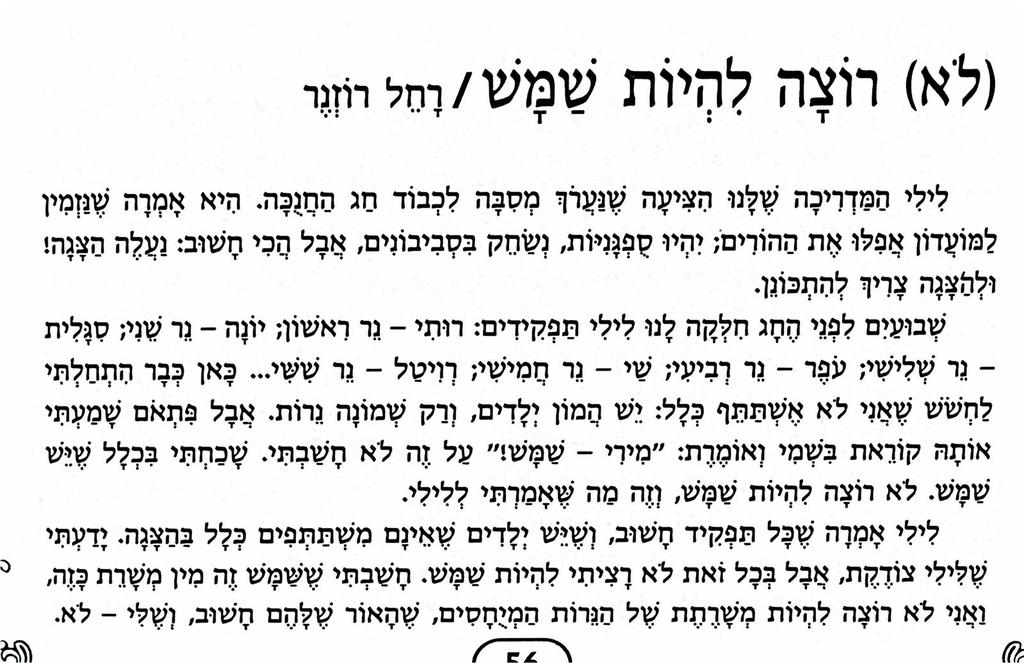
She said that the parents would even come to the clubhouse;
there would be refreshments, we would play with dreidels,
but most important of all: we would put on a play!
And for a play you need costumes.
Ruti — first candle;
Yonah — second;
Saglit — third;
Ofer — fourth;
Shai — fifth;
Revital — sixth…
At this point I already began to worry that I wouldn’t be in the show at all.
There are so many children, there are only eight candles,
but suddenly I heard her call my name and say:
“Miri — shamash.”
and I did not want to be the shamash.
And that’s exactly what I told Lily.
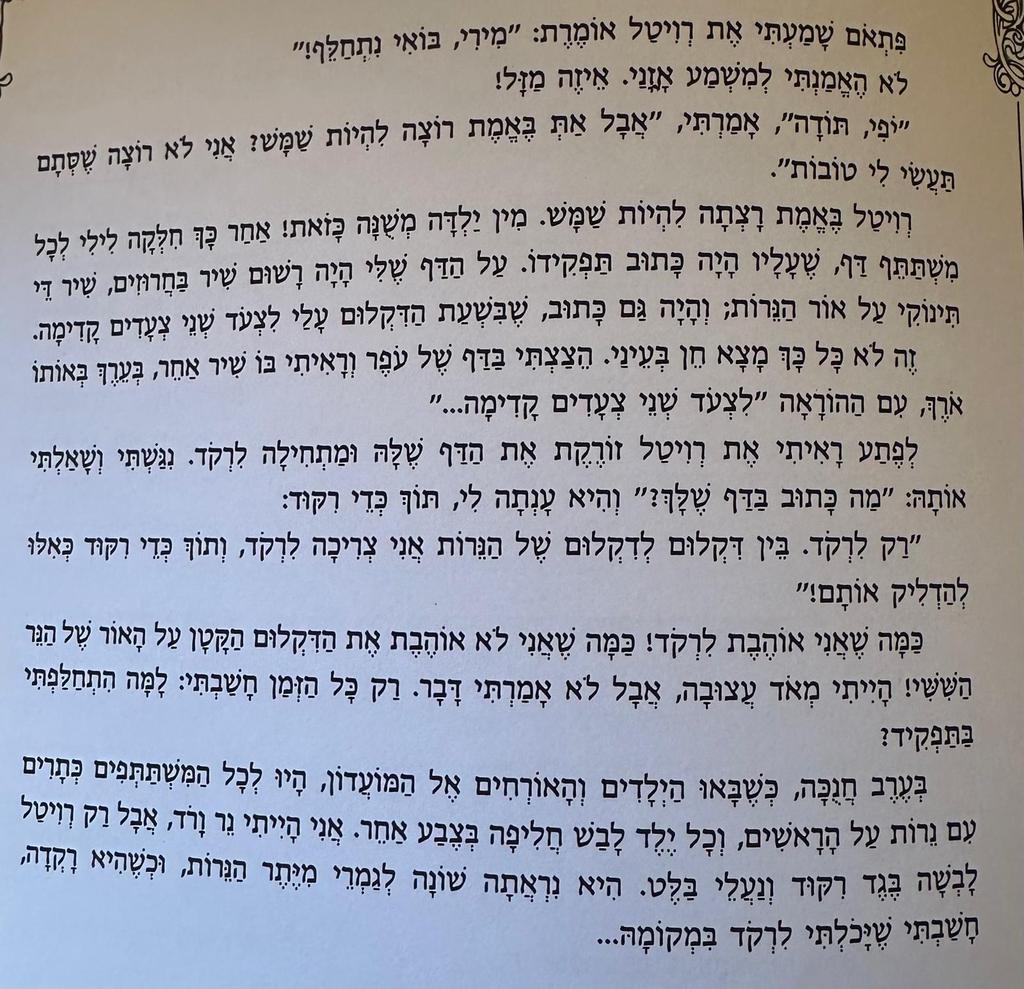
and that there are children who don’t participate in Hanukkah events at all.
I knew she was right,
but it didn’t matter to me that the shamash is important
or that it’s a good role.
I simply didn’t want to be one of the “helpers,”
the one whose light is for others, and not for me.
Suddenly I heard Revital say:
“Miri, come — let’s switch places!”
“With you? Well… maybe.
It’s very kind of you,” I said,
“but do you really want to be the shamash?
I don’t want you to do me a favor just because your name fits.”
She was that kind of girl — a serious one.
And for her, the role actually made things easier:
she knew a beautiful song about all the candles,
and in her view, you absolutely had to know that
none of the candles can be lit without the shamash.
I, on the other hand, still didn’t want it.
I peeked at Ofer’s script and saw a lovely song in honor of the shamash —
what luck!
He even did the hora step “to the side” that I never manage to do…
She was placing the little “flame hat” on her head and bowing.
I breathed in and said:
“Oh… how lovely this part is, this bowing!”
She was helping everyone, dancing as she went.
Between the candles she needed only to bow —
and during the dance,
to light them!
I held the little flame over the third candle’s light.
It always gave me a special glow.
And yet all the while I kept thinking:
Why did I switch roles?
Revital… and the others… laughed.
when all the children and guests came to the clubhouse,
everyone took their places.
We each held a candle of a different color.
I watched Ofer sing, and I held my own candle.
and I saw Ofer again — holding his,
and suddenly I understood:
she was the one who started the lighting of all the different candles —
and I realized:
I could now say, “Miri,
it was good that you switched places and danced in her role.”
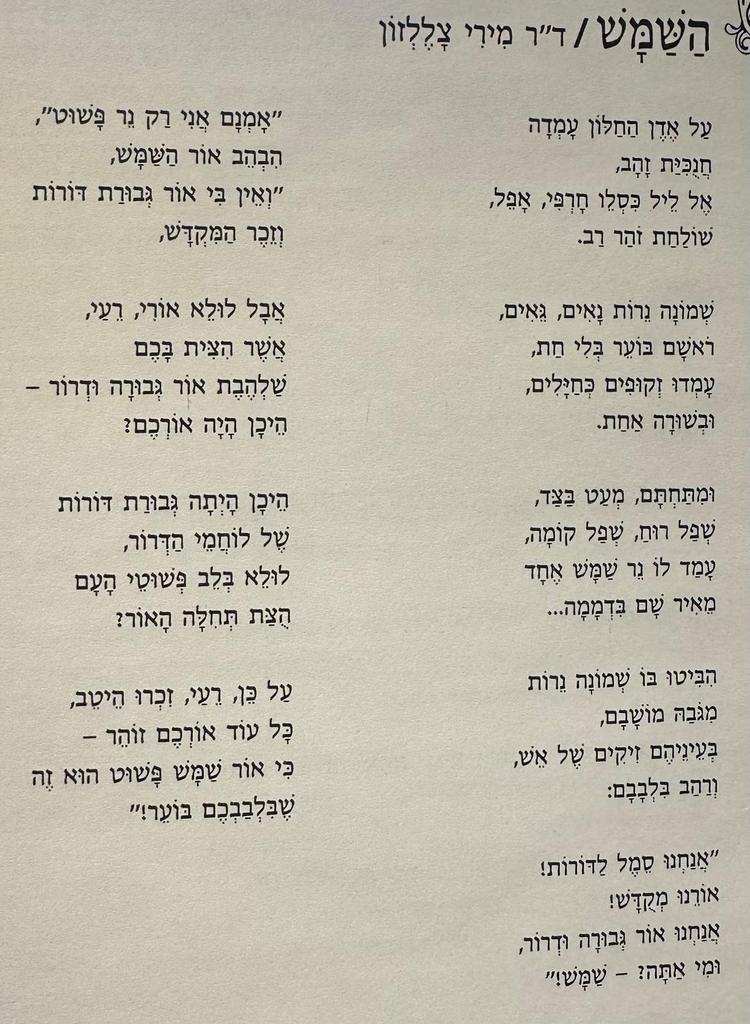
flickered the light of the shamash,
“and yet the light of generations of heroes
and of the holy mountain
the flame that kindled within you
the burning strength of generation after generation—
where was your light?
of the fighters throughout the ages?
Was it only in my warm, simple heart
that the first spark of light was lit?
as long as your light shines,
it is the simple shamash’s glow
that burns within your hearts!”
a golden menorah.
Toward the wintry night it hovered, dark,
sending out abundant radiance.
their heads burning without fear,
stood upright like wicks,
in a single perfect row.
amid the scent of rising dough,
stood one shamash candle,
shining there in silence…
from their lofty seats,
and in their eyes sparks of fire,
and a stirring in their hearts:
Our light is consecrated!
You are but a light of strength and service—
and who are you, Shamash?”
flickered the light of the shamash,
“and yet the light of generations’ heroism
and of the holy Temple—
ignite within you
the flaming brightness of courage through the ages—
where was your light?
of the fighters of long ago?
Was it only in my warm and humble heart
that the first spark of light was kindled?
as long as your light still shines,
it is the simple shamash’s glow
that burns within your hearts!”
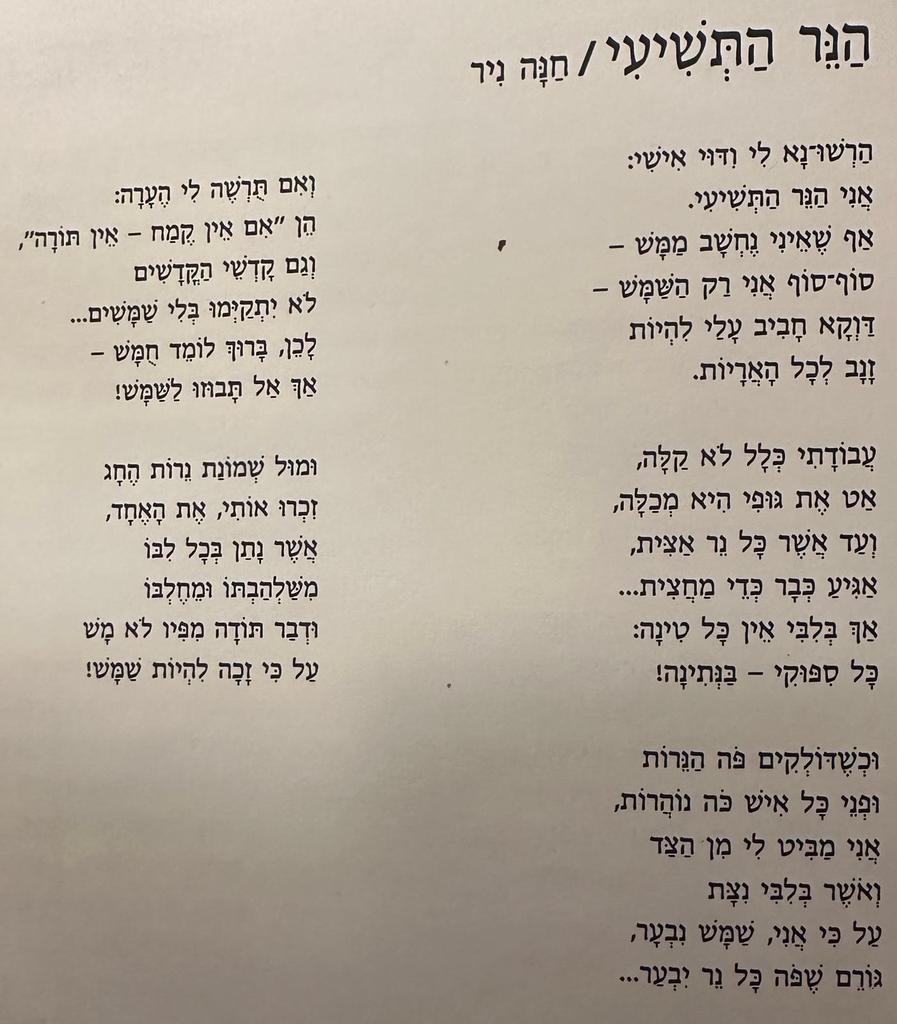
I am the ninth candle.
Even though I sit off to the side—
in the end, I am only the shamash!
Yet it is dear to me to be so,
a follower (tail) for all the lions.
For as I work, my body is consumed.
And by the time I ignite each candle,
I am already worn down by half…
Yet in my heart there is no bitterness:
all my satisfaction is in kindling!
and every person’s face is glowing so,
I look quietly on from the side,
and joy stands firm in my heart—
for I, the chosen shamash,
am the one who makes every candle burn…
for “without flour, there is no Torah,”
and even the Holy of Holies
cannot be sustained without attendants…
Therefore, blessed is the one who studies the Humash—
but do not weep for the shamash!
remember me—the one
who gave with all his heart
from his flame and from his strength,
and whose words of Torah never ceased—
for this is what it means to be a shamash!
