
Terumah 5786 - Can two walk together without having met? Creating sacred space | The magnetic pull of the energy field between the two cheruvim atop the Ark
The two cheruvim atop the Ark: the space between is where God comes to meet us; the space between where we meet one another, face to face

(ג) הֲיֵלְכ֥וּ שְׁנַ֖יִם יַחְדָּ֑ו בִּלְתִּ֖י אִם־נוֹעָֽדוּ׃

(3) Can two walk together

Without having met?

How do we meet one another? How do we meet the presence of God?
In Parashat Terumah, we will read - in great detail - about the dwelling place that we are to make, so that God can dwell among us:

(ח) וְעָ֥שׂוּ לִ֖י מִקְדָּ֑שׁ וְשָׁכַנְתִּ֖י בְּתוֹכָֽם׃

(8) And let them make Me a sanctuary that I may dwell among them.

"a sanctuary" - מִקְדָּ֑שׁ (mikdash) - from the verbal root √קָדַשׁ (kadash), to set apart, to be made sacred, to consecrate.
"I will dwell [among them]" - וְשָׁכַנְתִּ֖י בְּתוֹכָֽם (shachanti) - from the verbal root √שָׁכַן (shachan) - to dwell, reside, abide; from which we have the word מִשְׁכָּן (mishkan) - dwelling place.
During the forty days that Moses is "on the mountain" in intimate conversation with God, he will receive exceptionally detailed instructions about how the Ark, the Tabernacle, and its implements are to be constructed (in this week's parsha, Parashah Terumah) and also how the priestly garments and ritual objects are to be crafted (in next week's parsha, Parashah Tetzaveh) - divine blueprints for the setting the stage for connecting with God.

(מ) וּרְאֵ֖ה וַעֲשֵׂ֑ה בְּתַ֨בְנִיתָ֔ם אֲשֶׁר־אַתָּ֥ה מׇרְאֶ֖ה בָּהָֽר׃ {ס}

(40) Note well, and follow the patterns for them that are being shown you on the mountain.

There’s something poignant about this: a paradox that is at the heart of our experience as Jews: we are not to make physical representations of God; we are an “aniconic religion”. It’s fascinating that here, with the description of the ark cover and the cheruvim seated on top of it, we have a detailed description of factors that will create a potential space for God to visit with us (as we similarly have extremely detailed instructions regarding the construction of the ark, the Tabernacle that encloses the ark, priestly garments and utensils, etc).
As I write this commentary (mid-February 2026 | late Shevat 5786), at a time when the simple interpersonal skill of looking at and being with another person seems to be vanishing from the public square, I am moved to focus on one element of the instructions for the construction of the mishkan: the two cheruvim that will sit atop the Ark, in the most interior place in the mishkan, the place deepest inside the Holy of Holies.
I invite you to join me in exploring what we can learn from the two cheruvim, their placement, their attitude vis-a-vis one another:

(יח) וְעָשִׂ֛יתָ שְׁנַ֥יִם כְּרֻבִ֖ים זָהָ֑ב מִקְשָׁה֙ תַּעֲשֶׂ֣ה אֹתָ֔ם מִשְּׁנֵ֖י קְצ֥וֹת הַכַּפֹּֽרֶת׃ (יט) וַ֠עֲשֵׂ֠ה כְּר֨וּב אֶחָ֤ד מִקָּצָה֙ מִזֶּ֔ה וּכְרוּב־אֶחָ֥ד מִקָּצָ֖ה מִזֶּ֑ה מִן־הַכַּפֹּ֛רֶת תַּעֲשׂ֥וּ אֶת־הַכְּרֻבִ֖ים עַל־שְׁנֵ֥י קְצוֹתָֽיו׃ (כ) וְהָי֣וּ הַכְּרֻבִים֩ פֹּרְשֵׂ֨י כְנָפַ֜יִם לְמַ֗עְלָה סֹכְכִ֤ים בְּכַנְפֵיהֶם֙ עַל־הַכַּפֹּ֔רֶת וּפְנֵיהֶ֖ם אִ֣ישׁ אֶל־אָחִ֑יו אֶ֨ל־הַכַּפֹּ֔רֶת יִהְי֖וּ פְּנֵ֥י הַכְּרֻבִֽים׃ (כא) וְנָתַתָּ֧ אֶת־הַכַּפֹּ֛רֶת עַל־הָאָרֹ֖ן מִלְמָ֑עְלָה וְאֶל־הָ֣אָרֹ֔ן תִּתֵּן֙ אֶת־הָ֣עֵדֻ֔ת אֲשֶׁ֥ר אֶתֵּ֖ן אֵלֶֽיךָ׃ (כב) וְנוֹעַדְתִּ֣י לְךָ֮ שָׁם֒ וְדִבַּרְתִּ֨י אִתְּךָ֜ מֵעַ֣ל הַכַּפֹּ֗רֶת מִבֵּין֙ שְׁנֵ֣י הַכְּרֻבִ֔ים אֲשֶׁ֖ר עַל־אֲר֣וֹן הָעֵדֻ֑ת אֵ֣ת כׇּל־אֲשֶׁ֧ר אֲצַוֶּ֛ה אוֹתְךָ֖ אֶל־בְּנֵ֥י יִשְׂרָאֵֽל׃ {פ}

(18) Make two cheruvim of gold—make them of hammered work—at the two ends of the cover. (19) Make one cherub at one end and the other cherub at the other end; of one piece with the cover shall you make the cherubim at its two ends. (20) The cheruvim shall have their wings spread out above, shielding the cover with their wings. They shall confront each other, the faces of the cherubim being turned toward the cover. (21) Place the cover on top of the Ark, after depositing inside the Ark the Pact that I will give you. (22) There I will meet with you, and I will impart to you—from above the cover, from between the two cheruvim that are on top of the Ark of the Pact—all that I will command you concerning the Israelite people.
The second part of Verse 20, and Verse 22, are of particular interest here: Verse 20: "They shall confront each other, the faces of the cheruvim being turned toward the cover." (JPS translation)
וּפְנֵיהֶ֖ם אִ֣ישׁ אֶל־אָחִ֑יו אֶ֨ל־הַכַּפֹּ֔רֶת יִהְי֖וּ פְּנֵ֥י הַכְּרֻבִֽים׃
I suggest an alternate translation, rather than "they shall confront each other: "and their faces, each towards their companion, are above the covering, and turned toward the covering". We will read in Verse 22 that this space between the two cheruvim, as they face each other, is the precise place in which God will meet with Moses and by extension, with "us":

(כב) וְנוֹעַדְתִּ֣י לְךָ֮ שָׁם֒ וְדִבַּרְתִּ֨י אִתְּךָ֜ מֵעַ֣ל הַכַּפֹּ֗רֶת מִבֵּין֙ שְׁנֵ֣י הַכְּרֻבִ֔ים אֲשֶׁ֖ר עַל־אֲר֣וֹן הָעֵדֻ֑ת אֵ֣ת כׇּל־אֲשֶׁ֧ר אֲצַוֶּ֛ה אוֹתְךָ֖ אֶל־בְּנֵ֥י יִשְׂרָאֵֽל׃ {פ}

(22) There I will meet with you, and I will impart to you—from above the cover, from between the two cherubim that are on top of the Ark of the Pact—all that I will command you concerning the Israelite people.

Verse 22: The Divine presence will meet with Moses from between the two cherubim: "I will meet with you.. from between the two cheruvim that are on top of the Ark of the Pact..." (JPS translation)
וְנוֹעַדְתִּ֣י לְךָ֮ שָׁם֒ וְדִבַּרְתִּ֨י אִתְּךָ֜ מֵעַ֣ל הַכַּפֹּ֗רֶת מִבֵּין֙ שְׁנֵ֣י הַכְּרֻבִ֔ים
What kind of meeting will this be?
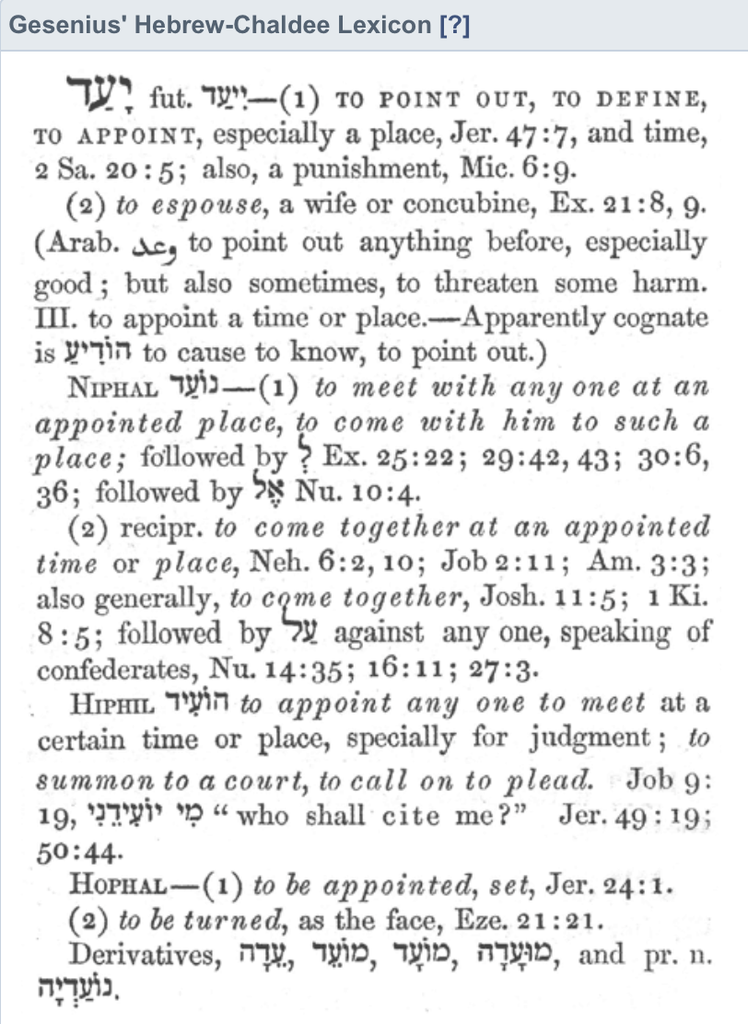
The verb here for "I will meet [with you]" - וְנוֹעַדְתִּ֣י (no-ad-ti) - from the verbal root √יָעַד (ya-ad) - is a relatively rare word in Tanakh (only 29 occurrences) and denotes a special kind of meeting - to meet with someone at an appointed time or place - suggesting intentionality and mutual agreement; in our verse, it is in binyan niphal:
User uploaded image
Other examples of this verb in Tanakh (in addition to the verse from Amos with which I opened this commentary, which asks the profound question: Can two walk together without having met?):

(מב) עֹלַ֤ת תָּמִיד֙ לְדֹרֹ֣תֵיכֶ֔ם פֶּ֥תַח אֹֽהֶל־מוֹעֵ֖ד לִפְנֵ֣י יהוה אֲשֶׁ֨ר אִוָּעֵ֤ד לָכֶם֙ שָׁ֔מָּה לְדַבֵּ֥ר אֵלֶ֖יךָ שָֽׁם׃

(42) a regular burnt offering throughout the generations, at the entrance of the Tent of Meeting before GOD.
For there I will meet with you, and there I will speak with you,

(ה) וְהַמֶּ֣לֶךְ שְׁלֹמֹ֗ה וְכׇל־עֲדַ֤ת יִשְׂרָאֵל֙ הַנּוֹעָדִ֣ים עָלָ֔יו אִתּ֖וֹ לִפְנֵ֣י הָאָר֑וֹן מְזַבְּחִים֙ צֹ֣אן וּבָקָ֔ר אֲשֶׁ֧ר לֹֽא־יִסָּפְר֛וּ וְלֹ֥א יִמָּנ֖וּ מֵרֹֽב׃

(5) Meanwhile, King Solomon and the whole community of Israel, who were assembled with him before the Ark, were sacrificing sheep and oxen in such abundance that they could not be numbered or counted.

(יא) וַֽיִּשְׁמְע֞וּ שְׁלֹ֣שֶׁת ׀ רֵעֵ֣י אִיּ֗וֹב אֵ֣ת כׇּל־הָרָעָ֣ה הַזֹּאת֮ הַבָּ֣אָה עָלָיו֒ וַיָּבֹ֙אוּ֙ אִ֣ישׁ מִמְּקֹמ֔וֹ אֱלִיפַ֤ז הַתֵּֽימָנִי֙ וּבִלְדַּ֣ד הַשּׁוּחִ֔י וְצוֹפַ֖ר הַנַּֽעֲמָתִ֑י וַיִּוָּעֲד֣וּ יַחְדָּ֔ו לָב֥וֹא לָנֽוּד־ל֖וֹ וּֽלְנַחֲמֽוֹ׃

(11) When Job’s three friends heard about all these calamities that had befallen him, each came from his home—Eliphaz the Temanite, Bildad the Shuhite, and Zophar the Naamathite. They met together to go and console and comfort him.

(יט) אִם־לְכֹ֣חַ אַמִּ֣יץ הִנֵּ֑ה וְאִם־לְ֝מִשְׁפָּ֗ט מִ֣י יוֹעִידֵֽנִי׃

(19) If a trial of strength—[God] is the strong one;If a trial in court—who will make the arrangements for me?

We understand that the space between the two cheruvim - מִבֵּין֙ שְׁנֵ֣י הַכְּרֻבִ֔ים - is the place where God will meet us - וְנוֹעַדְתִּ֣י - in this special sense of meeting: a coming together, with intention and specificity.
I’ve always thought of these two cheruvim as setting up a sort of energetic force field between them: like two strong magnets that are positioned at a distance from each other. Many if not most of us have had the experience of holding two magnets apart and feeling the pulsing of the energy field between them, the potential space that is vibrating with energy, with the potential for recognition and connection.
And so with our cheruvim: there is a space between them, delimited by the fixed positions in which they face each other; this space is filled with profound potential, a space where God tells us that God will come to meet with us, speak with, instruct us, and connect with us. When I imagine the two cheruvim, and try to picture them, I am always reminded of the very particular energy that arises between another human being and me, when I am present, and curious, and deeply interested in the other person's experiences. The empty space between is a space where fullness and connection can enter
Here I will allow myself both poetic and rabbinic license: I have always heard (in my ear) a connection between cheruvim - כְּרֻבִ֖ים - and the verb that means to draw near, to approach: √קרב (karav). You will note that these words begin with different letters: כְּרֻבִ֖ים with the letter כ (kaf) and קרב with the letter ק (kuf). They are not the same letter; however, their pronunciation - to a modern ear - will sound very similar.
Is it reasonable to conflate these two words, that start with differently shaped - although similarly sounding - letters? I am taking the liberty of doing so. The cheruvim - in their seemingly fixed positions - are continuously in a state of drawing near to one another, and holding the space where God will draw near to us.
What does each of these two letters - כ (kaf) and ק (kuf) connote?
In Kabbalah / Jewish mysticiam the kaf כ is said to represent an open palm of the hand (the word for which is indeed kaf). The palm of the hand can be thought of as a vessel that shapes, receives, and crafts; thus, the letter kaf is said to represent the power to actualize spiritual potential into physical reality. Kaf is connected with the Divine crown, כֶּתֶר (keter).
The letter kaf has two forms: the "bent" form - כ – as in our word כְּרֻבִ֖ים cheruvim, and the "straight" form -ך – which we see then this letter is the final one in the word. In Kabbalah, the bent kaf is said to represent the introverted or inverted king—who remains isolated within his internalized world, and the straight kaf is said to represent the king who descends from his high level and reaches down to others in order to communicate with and rule. Very significantly: when kaf is added to the end of a word as a suffix, it carries the meaning of "you" (second person signular) - you / your. Thus, the kaf in both its forms teaches us that we can unbend ourselves to regard the other, the "you".
The letter kuf ק connotes a profound polarity: the most holy, קָדוֹשׁ (kadosh) and the material shells or husks - קְלִיפּוֹת (k'lipot), which resulted from the shattering of the unity of God's light during creation; these husks - קְלִיפּוֹת (k'lipot) - are thought of as containing holy sparks that are imprisoned. Thus the letter kuf represents the descent of the soul into the physical world; its long vertical element, extending below the line on which it's written, represents the possibility of rectification of the "fallen sparks". Some see the letter kuf, in its shape, as representing the "eye of a needle", and thus suggestive of spiritual focusing and intentionality. Its name sounds like the Hebrew word for "monkey" - kof - which in Kabbalah was understood as representing mimicry or illusion. Thus, the letter kuf signifies the ability to distinguish between illusion and truth.
Kafכְּרֻבִ֖ים כ cheruvim - instrumentality: actions that facilitate for the paradoxical drawing near and manifestation, into the material world, of the ineffable.
Kuf - √קקרבkarav - drawing near.

(ה) וַיֹּ֖אמֶר אַל־תִּקְרַ֣ב הֲלֹ֑ם שַׁל־נְעָלֶ֙יךָ֙ מֵעַ֣ל רַגְלֶ֔יךָ כִּ֣י הַמָּק֗וֹם אֲשֶׁ֤ר אַתָּה֙ עוֹמֵ֣ד עָלָ֔יו אַדְמַת־קֹ֖דֶשׁ הֽוּא׃

(5) And [God] said, “Do not come closer! Remove your sandals from your feet, for the place on which you stand is holy ground!”

We will encounter the verbal root numerous times in next week's parsha, Parashat Tetzaveh. And in the third book of the Torah, the Book of Leviticus, this verb for "drawing near" is represented many times (102 of the total 263 times this verb appears in Tanakh) in the context of sacrifices - korbanot (from the same verbal root) which are a means of drawing close to God.
This idea of being close / drawing near is in one of my very favorite verses in the Torah, which we hear chanted on Yom Kippur:

(יג) וְלֹא־מֵעֵ֥בֶר לַיָּ֖ם הִ֑וא לֵאמֹ֗ר מִ֣י יַעֲבׇר־לָ֜נוּ אֶל־עֵ֤בֶר הַיָּם֙ וְיִקָּחֶ֣הָ לָּ֔נוּ וְיַשְׁמִעֵ֥נוּ אֹתָ֖הּ וְנַעֲשֶֽׂנָּה׃ (יד)כִּֽי־קָר֥וֹב אֵלֶ֛יךָ הַדָּבָ֖ר מְאֹ֑ד בְּפִ֥יךָ וּבִֽלְבָבְךָ֖ לַעֲשֹׂתֽוֹ׃ {ס}

(13) Neither is it beyond the sea, that you should say, “Who among us can cross to the other side of the sea and get it for us and impart it to us, that we may observe it?” (14) No, the thing is very close to you, in your mouth and in your heart, to observe it.

"the thing is very close to you"... כִּֽי־קָר֥וֹב אֵלֶ֛יךָ ki karov elecha - which reminds us that at every moment, we are capable of taking actions to repair the broken world, to repair ourselves.
Returning to the two cheruvim: they face one another and thus, delimit the space where God will come and meet with us, where God will draw near to us. For many years, my Torah study, and my understanding and practice of ethics, have been deeply informed by the ideas of French Jewish philosopher Emmanuel Levinas (1906-1995); his prodigious body of work focuses on the relationship of ethics to metaphysics and ontology (the nature of being). A theme running through Levinas' work is that of the Face of the Other; in plain language: what are the ethics of my obligations to others? How do I prioritize my obligations to others and act on these obligations?
Whenever I read about "faces" in Tanakh, I soon find myself applying a Levinasian filter, if you will, to the text with which I am engaging. Now, admittedly the cheruvim are not persons; they are representative figures. Nevertheless, the emphasis on their faces and on the physical positioning of their faces suggests to me that the space between them - the space where God will come - is imbued with the fundamental question of obligations, responsibilities, to others - and after all, this sort of obligation, arguably, is part of the essence of Jewish values, mitzvot, halakhah.
I have written about Levinas and his exploration of the face of the other in two other recent Torah commentaries that are available here on Sefaria:
Vayeshev 5786 - You must leave a pledge... the challenges of facelessness
Explores the episode of Tamar and Judah with a consideration of adverse results of not "seeing" the "other"
and
Bo 5786 - Night vision: What can we see in the dark? Learning from Levinas.
The plague of darkness: can we see others' suffering in the dark? Learning from Levinas and Rav Hirsch
How we can bring considerations of our obligations to others into our Torah study, and thence into our actions in the world?
"[T]his facing of the face in its expression—in its mortality—summonsme, demands me, claims me: as if the invisible death faced by theface of the other—pure otherness, separated somehow from all unity—were 'my business.' As if, unknown to the other whom, in the nakednessof his face, it already concerns, it 'regarded me' before its confrontationwith me, before being the death that looks me square in myown face. The death of the other man puts me in question, as if in that death that is invisible to the other who exposes himself to it, I, through my eventual indifference, became the accomplice; and as if, even beforebeing doomed to it myself, I had to answer for this death of the other,and not leave the other alone in his death-bound solitude. It is precisely in this call to my responsibility by the face that summons me, that demands me, that claims me—it is in this questioning that the other is my neighbor. This way of demanding me, of putting me in question and ofappealing to me, to my responsibility for the death of the other, is so irreducible a meaning that it is in terms of this that the meaning of deathmust be understood, beyond the abstract dialectic of being and its nega-tion, to which (once violence is reduced to negation and annihilation) death is reduced. Death signifies in the concreteness of what for me isthe impossibility of abandoning the other to his aloneness, in the prohibition addressed to me of that abandonment. Its meaning begins in the inter-human." Emmanuel Levinas, "From the One to the Other: Transcendence and Time" in entres nous - On Thinking-of-the-Other Translated from the French by Michael B. Smith and Barbara Harshav Columbia University Press 1998, pages 145-146 (emphasis added)
In my thinking, this is similar to what happens when we meet with another human being, with steady focus and presence: we cultivate a space for the Divine to join us, and to speak with us, to teach us and guide us. God’s presence can be manifested in the field that’s created between two people, or in a group of people, or between us and God.
For example, as we learn in Pirkei Avot:

(ב) אֲבָל שְׁנַיִם שֶׁיּוֹשְׁבִין וְיֵשׁ בֵּינֵיהֶם דִּבְרֵי תוֹרָה, שְׁכִינָה שְׁרוּיָה בֵינֵיהֶם...

:

(2) but if two sit together and there are words of Torah [spoken] between them, then the Shekhinah abides among them...

The cheruvim, part of the covering of the Ark, which will contain the most fundamental values, similalry are manifesting a space where Shekinah will abide in the space between.
A teaching from the Baal Shem Tov:
Toldot Yaakov Yosef (Rabbi Yaakov Yosef of Polnoye, Ukraine, 1710-1784), Parashat Terumah
"As for the commandment, “make me a Sanctuary, that I may dwell amongst them,” behold, a person is like a small world, in which there is Sanctuary and a Tabernacle… If so, then a person is the pattern of the Tabernacle. That is why it is called a Mishkan - that is, a dwelling - bec within a person there is a dwelling of one part of the soul in the heart, and a dwelling of another part of the soul in the mind. So a person must make themselves into a seat for the dwelling of the Divine Presence, in their heart and in their mind.."
מצוה ועשו לי מקדש ושכנתי בתוכם הנה האדם שהוא עולם קטן ויש בו מקדש ומשכן...וא״כ האדם הוא תבנית המשכן ולפי׳ זה יש לפרש טעם שנקי משכן כי באדם יש משכן הנפש בלב האדם ומשכן הנשמה במוח וצריך האדם שיעשה א״ע כסא להשראת שכינה בלב ומוח
At this time in our lives, in our world, when it seems that so many are inclined to turn away from others who are suffering and being subjected to injustices... may we turn to face one another, to regard one another, to strive to understand, to study together, to do good together.

(קסט)תִּקְרַ֤ב רִנָּתִ֣י לְפָנֶ֣יךָ יהוה כִּדְבָרְךָ֥ הֲבִינֵֽנִי׃

(169) May my plea reach [draw near to] You, O ETERNAL One; grant me understanding according to Your word.

s
