The Haggadah After October 7


 Save
Save Copy
Copy Add to Collection
 Export to Google Docs
 Share
ShareThis episode explores the kibbutz tradition of rewriting the Haggadah, featuring voices from communities who continue to shape Jewish ritual in response to contemporary experience, including the aftermath of October 7.
Don't miss an episode! Subscribe to the Madlik podcast:
Spotify | Apple Podcasts | YouTube
Link to Substack post: here
Spotify | Apple Podcasts | YouTube
Link to Substack post: here
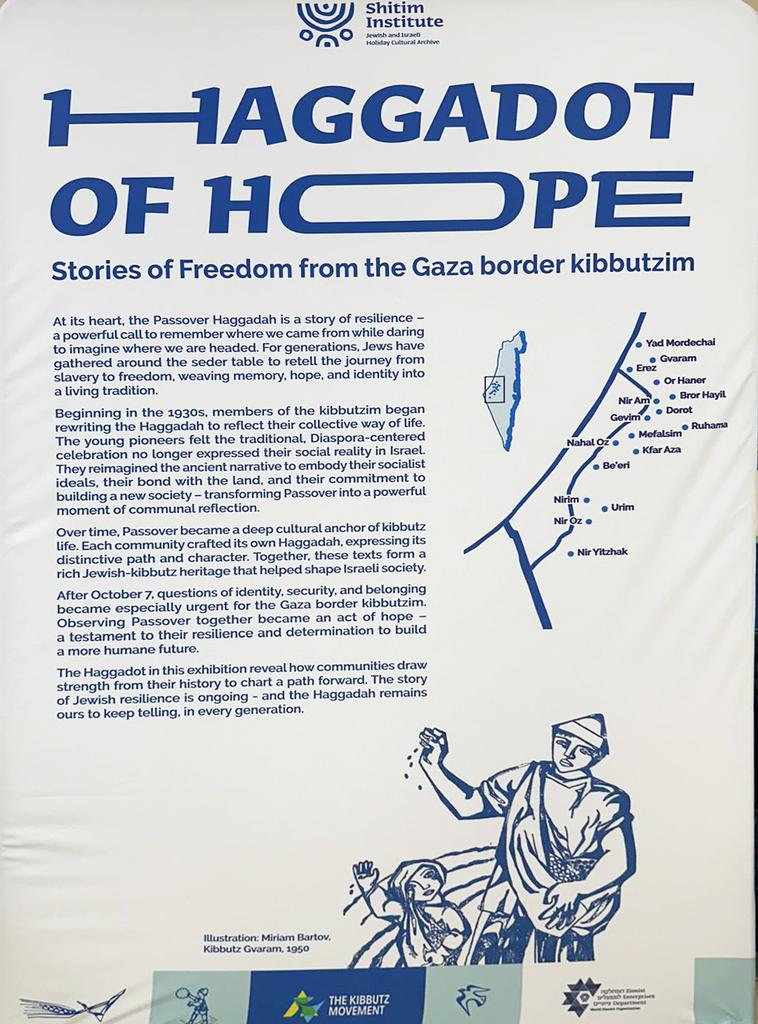
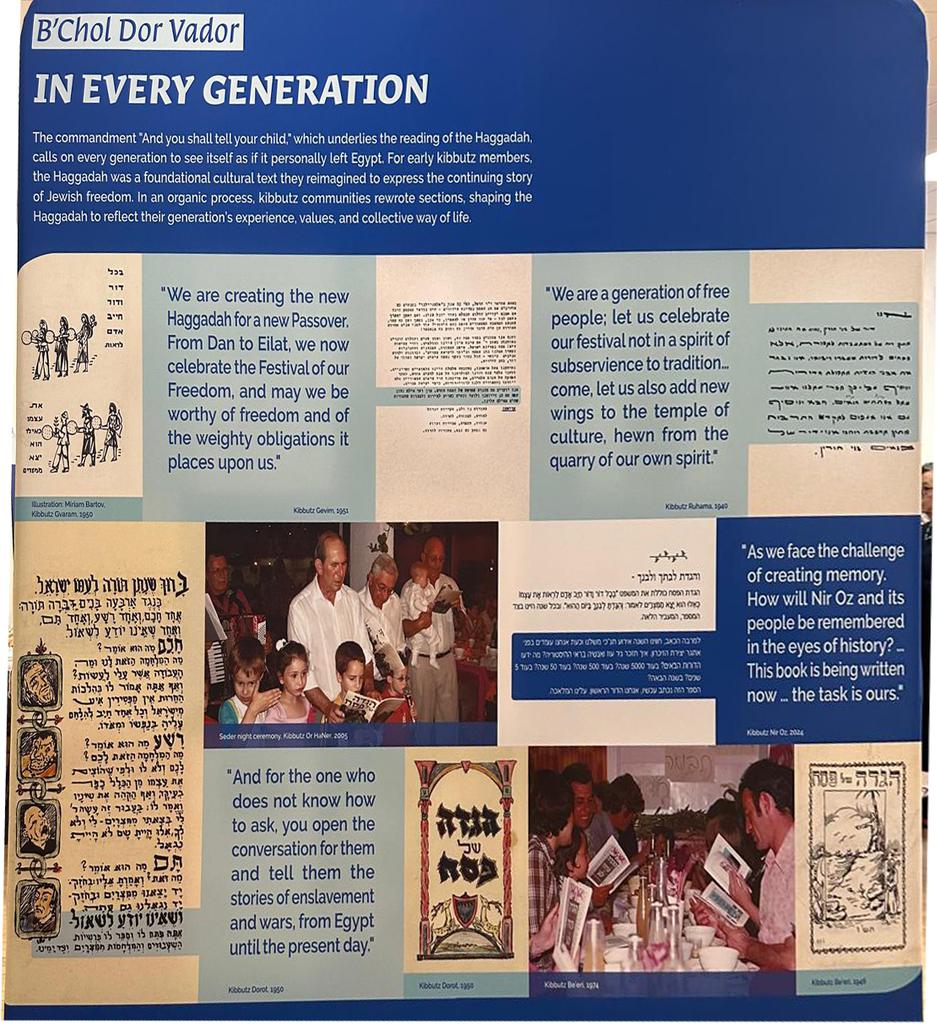
Eran Yarkoni CEO of The Shittim Institute explains that the revolutionary contribution of the kibbutzim to the Passover Seder was to treat it as a continuing story, not a finished one. Rather than simply remembering the Exodus, they embraced the idea that “every generation needs to see himself like he did the Exodus,” placing themselves within an unbroken chain from biblical times to modern pioneers. This vision is captured visually in Haggadot from Kibbutz Gvar Am (1950) and Kibbutz Givim (1951), where figures from the Bible evolve into contemporary settlers on the Gaza border.
Early kibbutz texts also reframed freedom as responsibility. As expressed in a kibbutz Haggadah spanning the land “from Dan to Eilat,” they wrote: “We are creating the new Haggadah for a new Passover… and may we be worthy of freedom and of the weighty obligations it places upon us.” The Seder became not just a ritual, but a moral compass—a “lighthouse” guiding communal values.
This approach extended into the reinterpretation of traditional passages. In a Haggadah from Kibbutz Dorot (early years of the state), even the child who does not know how to ask is taught by telling “the stories of enslavement and wars from Egypt until the present day,” making clear that the Exodus narrative continues through contemporary history.
That same framework persists today. In a 2024 Haggadah written just months after October 7 by Kibbutz Nirim (near Gaza), the community reflects:
“When we face the challenge of creating memory… how will [we] be remembered in the eyes of history? The book is being written now. The task is ours.”
“When we face the challenge of creating memory… how will [we] be remembered in the eyes of history? The book is being written now. The task is ours.”
The core insight is striking: the Seder is not only about recalling the past—it is about recognizing that we are living the story now, and responsible for how it will be written and remembered in the future.
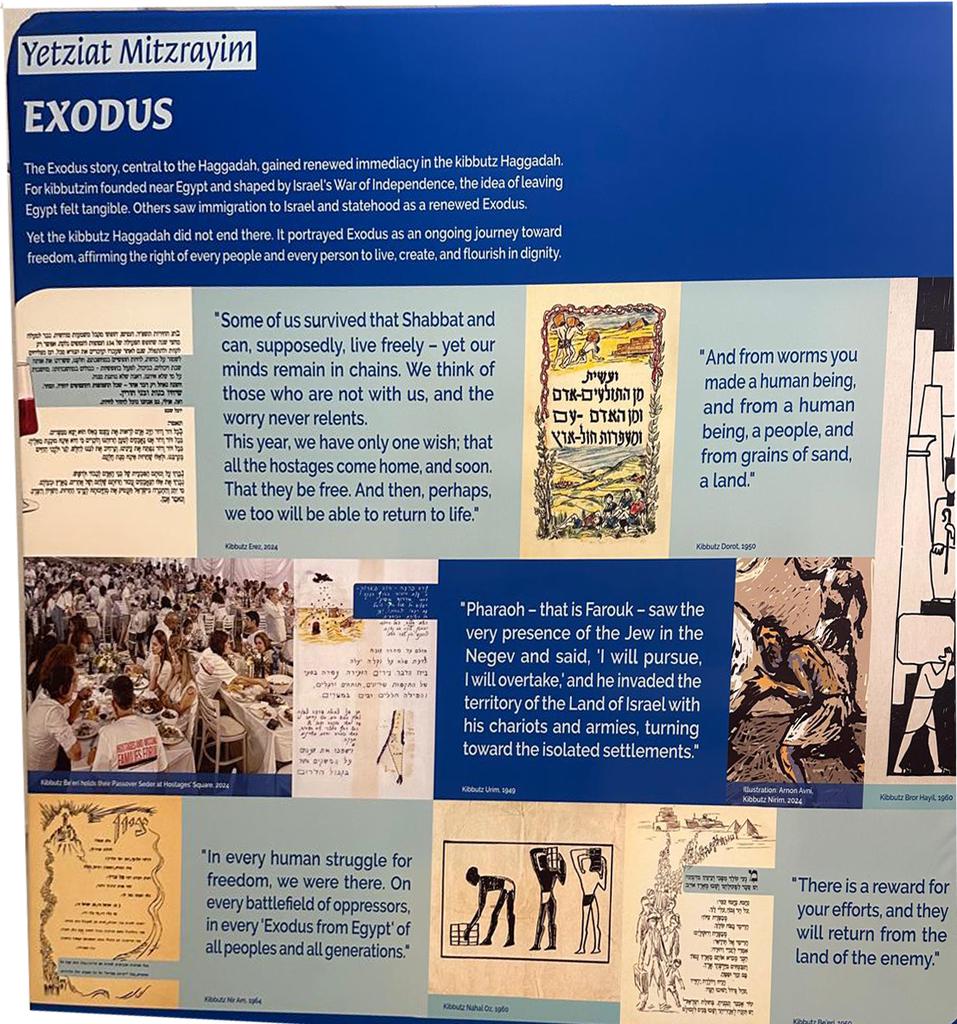
The discussion turns from the obligation to tell the story to the meaning of Yitziat Mitzrayim—leaving Egypt. For kibbutzim on the Gaza border, this is not abstract. As Anton Marks of Shittim explains, “this idea of Yitziat Mitzrayim isn’t a metaphor. It’s real… it’s something that’s now… something that’s continuous.” The Seder becomes a way to ask not only what happened then, but “where are we now? And what is our Yitziat Mitzrayim today?”
Kibbutz Haggadot bring this idea to life by merging biblical narrative with contemporary history. In Kibbutz Urim (1949), just after the War of Independence, the Exodus story is rewritten through the lens of modern conflict:
“Pharaoh, that is Farouk… said, I will pursue, I will overtake… and he invaded… with his chariots and armies.”
Here, the ancient Pharaoh becomes Egypt’s King Farouk, collapsing past and present into a single, continuous struggle.
“Pharaoh, that is Farouk… said, I will pursue, I will overtake… and he invaded… with his chariots and armies.”
Here, the ancient Pharaoh becomes Egypt’s King Farouk, collapsing past and present into a single, continuous struggle.
Other Haggadot expand the story beyond the Jewish experience. In Kibbutz Nir Am (1964), the Exodus becomes universal:
“In every human struggle for freedom, we were there… in every exodus from Egypt, of all peoples and all generations.”
The narrative shifts from a particular history to a shared human condition.
“In every human struggle for freedom, we were there… in every exodus from Egypt, of all peoples and all generations.”
The narrative shifts from a particular history to a shared human condition.
The kibbutzim also expressed these ideas visually. In Kibbutz Be’eri (1950), hand-drawn illustrations connect multiple moments of exile and return: Egyptian pyramids, the Ma’apilim (illegal immigrants to Israel), and the Babylonian exile—all part of one continuous journey toward the land of Israel. Another image contrasts “slavery in Egypt” with “the green rolling hills… the kibbutzim, the kids, the next generation,” linked by the chain of Kol Dor Vador.
The core message is clear: the Exodus is not a single event in the distant past. It is an ongoing process, lived and reinterpreted in every generation—historically, politically, and personally.
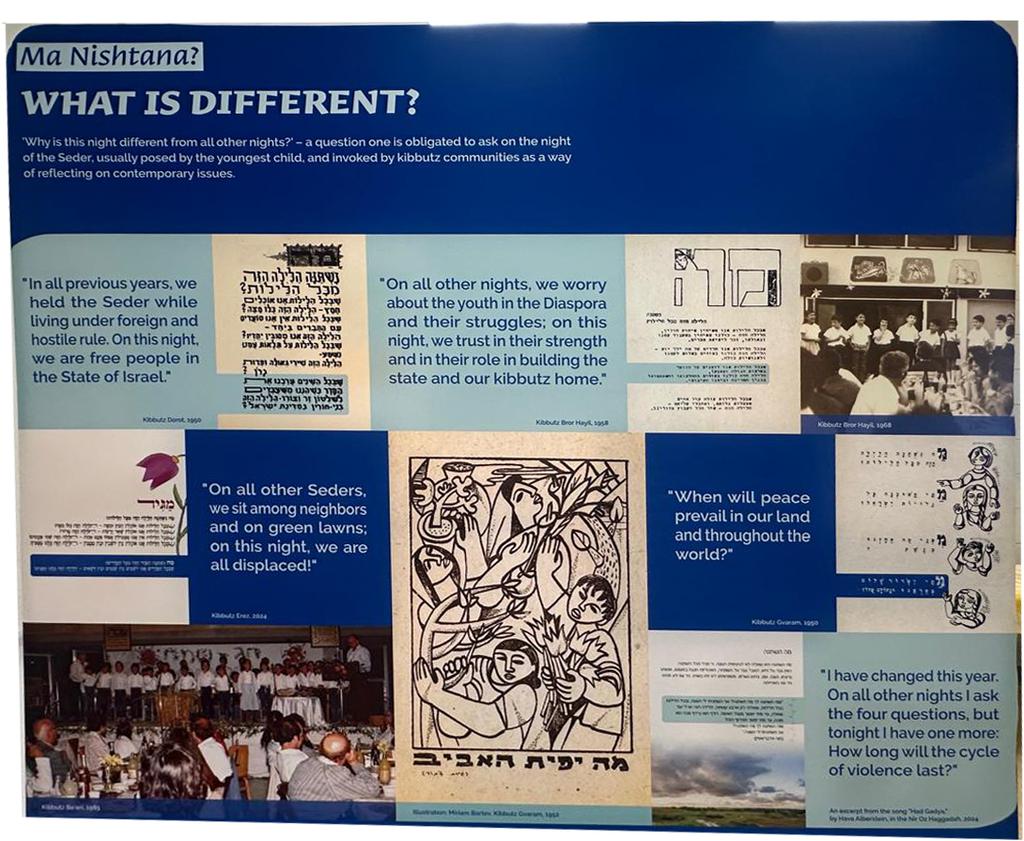
The discussion turns to the Ma Nishtana, traditionally the child’s set of questions, and how the kibbutzim transformed it from a performance into a communal and generational dialogue. Instead of singling out one child, the kibbutz places the entire group of children at the center, conveying a powerful message: “You are an important part of this community… you have a role and you have a mission.”
At the same time, the children turn to the adults with an implicit challenge: “The future is what you create and what you build for us.”
The result is a symbiotic relationship between generations, each responsible for shaping the future.
At the same time, the children turn to the adults with an implicit challenge: “The future is what you create and what you build for us.”
The result is a symbiotic relationship between generations, each responsible for shaping the future.
The Ma Nishtana itself becomes a tool for confronting present realities, not just recalling the past. In Kibbutz Erez (2024), in the aftermath of October 7, the question is rewritten with stark immediacy:
“On all of our Seders, we sit among neighbors and on green lawns. On this night, we are displaced. What is different on this night?”
Here, the ritual question becomes a direct reflection of lived experience.
“On all of our Seders, we sit among neighbors and on green lawns. On this night, we are displaced. What is different on this night?”
Here, the ritual question becomes a direct reflection of lived experience.
Other kibbutzim use the Ma Nishtana to express enduring hopes and broader aspirations. In Kibbutz Gvar Am (1950), the question expands outward:
“When will peace prevail in our land and throughout the world?”
The local longing for peace becomes a universal one.
“When will peace prevail in our land and throughout the world?”
The local longing for peace becomes a universal one.
Similarly, in Kibbutz Bur Chayil (1958), the question bridges Israel and the diaspora:
“On all other nights we worry about the youth in the diaspora and their struggles. On this night we trust in their strength and their role in building the state and our kibbutz home.”
This reflects a shared, mutual responsibility between communities.
“On all other nights we worry about the youth in the diaspora and their struggles. On this night we trust in their strength and their role in building the state and our kibbutz home.”
This reflects a shared, mutual responsibility between communities.
The central insight is that the Manishtana is no longer just a set of ritual questions—it becomes a framework for asking the most urgent questions of the present, engaging both young and old in shaping the future together.

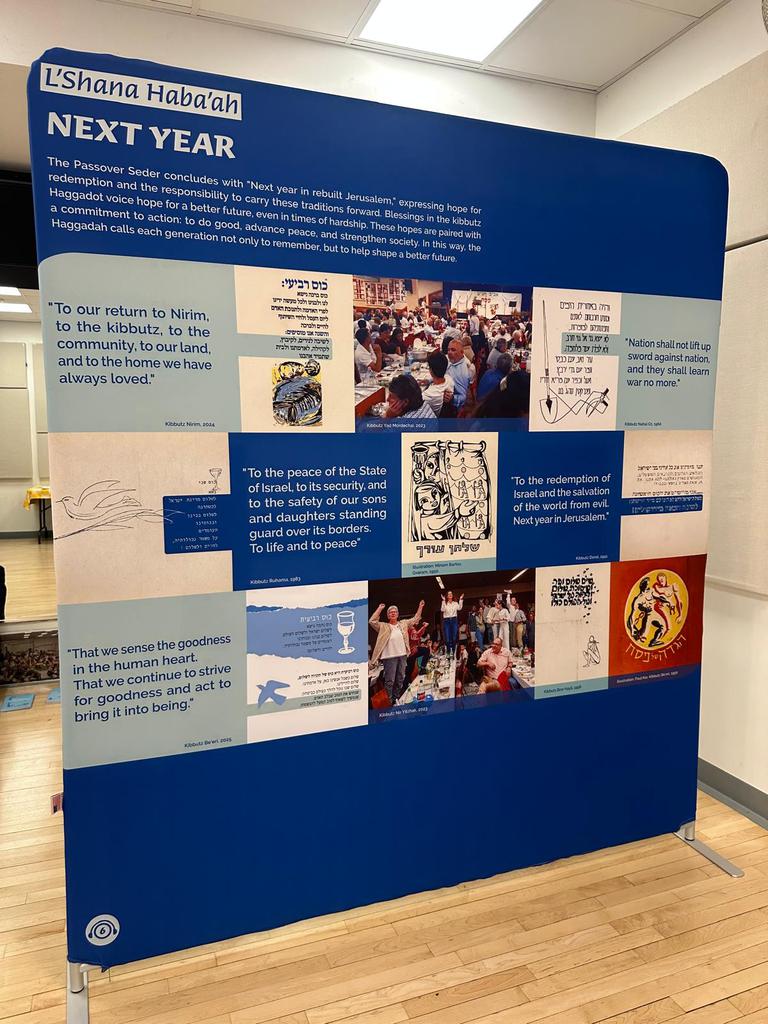
The focus shifts to the blessings of the Seder, revealing how kibbutz communities reimagined traditional brachot as opportunities to express their own values, labor, and lived reality. Rather than only blessing God in abstract terms, early kibbutzim chose to honor human action and contribution. In Kibbutz Beit Alfa (1937), the blessing reads:
“Blessed are you, the farmer who produces bread from the land. Blessed are you, the gardener who grows the crops. Blessed are you, the vine grower who plants the grapevine.”
Here, the focus is on the doers—those cultivating the land and sustaining the community.
“Blessed are you, the farmer who produces bread from the land. Blessed are you, the gardener who grows the crops. Blessed are you, the vine grower who plants the grapevine.”
Here, the focus is on the doers—those cultivating the land and sustaining the community.
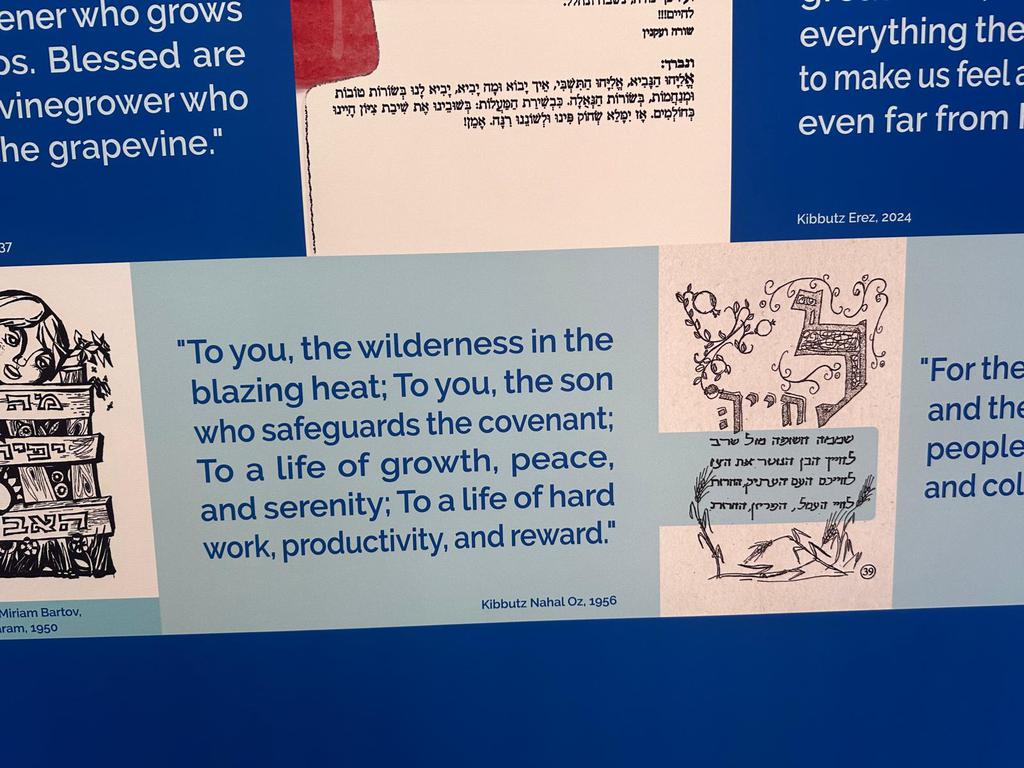
This blending of tradition and contemporary mission continues in Kibbutz Nachal Oz (1956), where biblical language is infused with pioneering purpose:
“To you the wilderness and the blazing heat… to a life of growth, peace, and serenity. To a life of hard work, productivity, and reward.”
Ancient imagery merges seamlessly with the ethos of Zionist labor and renewal.
“To you the wilderness and the blazing heat… to a life of growth, peace, and serenity. To a life of hard work, productivity, and reward.”
Ancient imagery merges seamlessly with the ethos of Zionist labor and renewal.
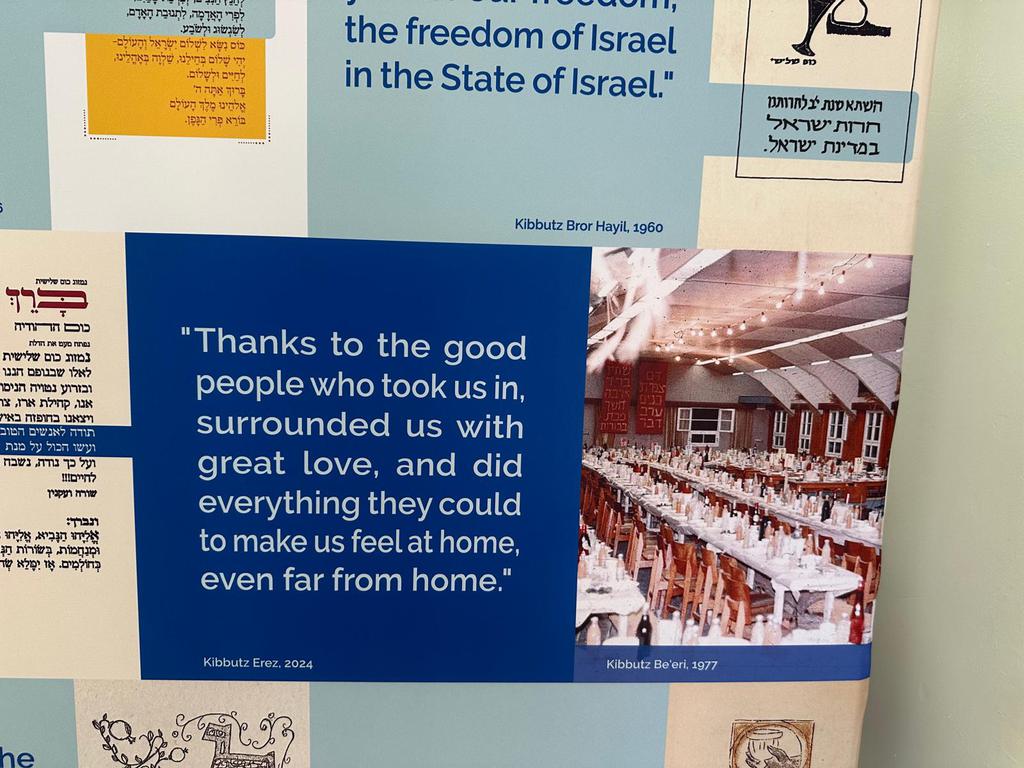
The most powerful example comes from the present. In a Haggadah written during displacement by Kibbutz Erez (2024)—after the trauma of October 7—the blessing becomes an expression of gratitude and resilience:
“Thanks to the good people who took us in, surrounded us with great love, and did everything they could to make us feel at home, even far from home.”
Unable to gather as a single community, families conducted parallel Seders across more than forty locations, united by a shared text despite physical separation.
“Thanks to the good people who took us in, surrounded us with great love, and did everything they could to make us feel at home, even far from home.”
Unable to gather as a single community, families conducted parallel Seders across more than forty locations, united by a shared text despite physical separation.
The central insight is that blessings, like the rest of the Haggadah, are not fixed formulas—they are living expressions of what a community chooses to honor: work, land, solidarity, and ultimately, the human capacity to endure and rebuild.