


From Chanukah to Tisha B’Av


 Save
Save Copy
Copy Add to Collection
 Export to Google Docs
 Share
ShareAn examination of how we went from the Hasmoneans to the Destruction of the Second Temple
From Chanukah to Tisha B’Av “on one foot”:
The story of Chanukah happened in 165 BCE. The Second Temple was destroyed by the Romans in 70 CE. The 235 years in between were highly eventful.
The story of Chanukah happened in 165 BCE. The Second Temple was destroyed by the Romans in 70 CE. The 235 years in between were highly eventful.
The first part of the story:
Tracing from the last of the Maccabee brothers (Simon, brother of Judah) to the last of the Hasmoneans (killed by Herod the Great):
https://voices.sefaria.org/sheets/690920?lang=bi
https://voices.sefaria.org/sheets/690920?lang=bi
The Short Version
- Things weren’t great under the Romans.
- Then the Romans stole the Temple Treasury.
- The Jews revolted.
- After 7 years of rebellion, the Second Temple was burned on the 9th of Av, and the Jews on Masada killed themselves.
- Things weren’t great under the Romans.
- Then the Romans stole the Temple Treasury.
- The Jews revolted.
- After 7 years of rebellion, the Second Temple was burned on the 9th of Av, and the Jews on Masada killed themselves.
The Long Version
When we last left off..…
- Herod had killed his wife Mariamne, and their two sons (Alexander and Aristobulus), thus ending the Hasmonean line.
- Herod also built many things, like the fortress at Masada, a massive renovation of the Second Temple (both because he loved architecture and to win the appreciation of the Jews), the city of Caeasarea (named for Augustus Caesar) on the site of Strato’s Tower, and a shrine over the Cave of Machpelah in Hebron. He also rebuilt the Biblical city of Samaria and called it Sebaste (the Royal City) in honor of Augustus. This was all done with forced labor and heavy taxation.
- Herod also economically favored the non-Jews in Judaea in order to win favor with Rome.
- There were groups that had developed among the Jews.
- The Sadducees tended to be the aristocratic Jews, allying themselves with those who had political and religious power. They had a stricter interpretation of Judaism.
- The Pharisees tended to be from among the people. The Rabbis came from the Pharisees, and they tended to be more responsive to people’s needs.
- While the Sadducees and Pharisees had political power under the Hasmoneans, under Herod and the Romans there was no open discussion of politics and so these two groups were more involved in discussing interpretations of Jewish law and in adjudicating civil and religious cases.
- In general, Jewish democracy flourished at the local level, run by councils of elders and scribes, and judged by courts of 3 or 7 (or 23 in the biggest cities) depending on the level of the issue. Herod let communities have internal government as long as it was contained to their area.
- The Great Sanhedrin (Greek for “Council”) had started as an advisory body of priests and elders for the High Priest upon the return from Babylonia, along with the Great Assembly that met on special occasions and represented the entire people. The last time the Great Assembly met was to confirm Simon the Hasmonean as the hereditary ruler of the Jews. Simon’s successors continued the Great Assembly, now calling it the Sanhedrin with 71 members. They were appointed by the king or filled their own vacancies, and served as a Supreme Court. At first the High Priest presided, but as this became a politically-appointed position by the Romans it became customary for him to send a designee known as the “Av Beit Din”, “Father of the Court”. Because the Romans wanted to deal with any threats to their power themselves, they stripped the Sanhedrin of the ability to judge criminal cases, so it only dealt with civil and religious matters.
- The Essenes withdrew from the Jerusalem community and went to live at Qumran by the Dead Sea.
- The underground resistance developed in response to Herod’s repression. Later, these became the Zealots, or Sicarii, who assassinated anybody whom they thought was working with the Romans, starting after King Herod Agrippa’s death in 44 CE.
- Herod also built many things, like the fortress at Masada, a massive renovation of the Second Temple (both because he loved architecture and to win the appreciation of the Jews), the city of Caeasarea (named for Augustus Caesar) on the site of Strato’s Tower, and a shrine over the Cave of Machpelah in Hebron. He also rebuilt the Biblical city of Samaria and called it Sebaste (the Royal City) in honor of Augustus. This was all done with forced labor and heavy taxation.
- Herod also economically favored the non-Jews in Judaea in order to win favor with Rome.
- There were groups that had developed among the Jews.
- The Sadducees tended to be the aristocratic Jews, allying themselves with those who had political and religious power. They had a stricter interpretation of Judaism.
- The Pharisees tended to be from among the people. The Rabbis came from the Pharisees, and they tended to be more responsive to people’s needs.
- While the Sadducees and Pharisees had political power under the Hasmoneans, under Herod and the Romans there was no open discussion of politics and so these two groups were more involved in discussing interpretations of Jewish law and in adjudicating civil and religious cases.
- In general, Jewish democracy flourished at the local level, run by councils of elders and scribes, and judged by courts of 3 or 7 (or 23 in the biggest cities) depending on the level of the issue. Herod let communities have internal government as long as it was contained to their area.
- The Great Sanhedrin (Greek for “Council”) had started as an advisory body of priests and elders for the High Priest upon the return from Babylonia, along with the Great Assembly that met on special occasions and represented the entire people. The last time the Great Assembly met was to confirm Simon the Hasmonean as the hereditary ruler of the Jews. Simon’s successors continued the Great Assembly, now calling it the Sanhedrin with 71 members. They were appointed by the king or filled their own vacancies, and served as a Supreme Court. At first the High Priest presided, but as this became a politically-appointed position by the Romans it became customary for him to send a designee known as the “Av Beit Din”, “Father of the Court”. Because the Romans wanted to deal with any threats to their power themselves, they stripped the Sanhedrin of the ability to judge criminal cases, so it only dealt with civil and religious matters.
- The Essenes withdrew from the Jerusalem community and went to live at Qumran by the Dead Sea.
- The underground resistance developed in response to Herod’s repression. Later, these became the Zealots, or Sicarii, who assassinated anybody whom they thought was working with the Romans, starting after King Herod Agrippa’s death in 44 CE.
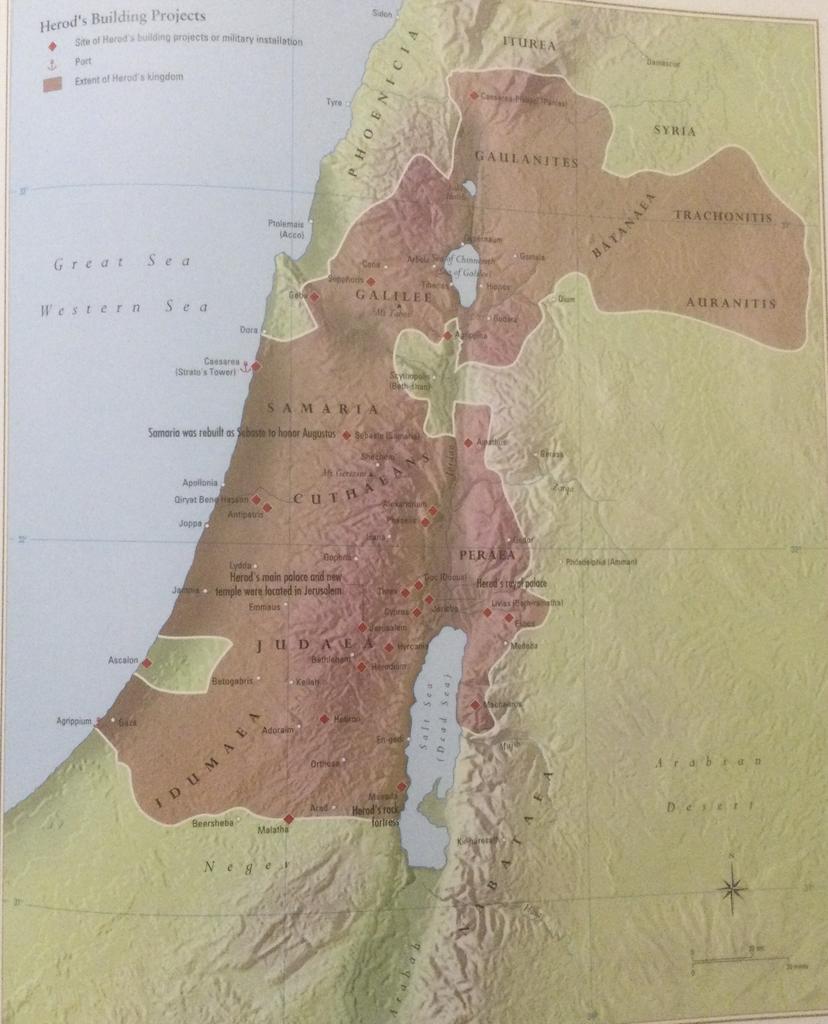
This map, from Dr. Ian Barnes’ Historical Atlas of the Bible, shows Herod’s building projects. Masada is by the southwestern shore of the Dead Sea.
Herod Divides His Kingdom - 4 BCE
- When Herod died in 4 BCE, his will divided his kingdom into 3 parts.
- Archelaus, Herod’s son by a Samaritan wife, was to rule from Jerusalem over Judaea, Idumea, and Samaria. This included the Hellenized cities of Sebaste and Caesaria.
- Herod Antipas, Archelaus’s (full) younger brother, was to be tetrarch over Galilee and Perea, areas separated by the cities of the Decapolis.
- Their half-brother Philip, son of a Jewish wife of Herod (he had 10 wives total), became tetrarch of the area north and east of the Sea of Galilee. This was mostly non-Jewish and also relatively poor.
- Herod’s sister Salome got the area around Jamnia, Azotus, Phaselis, and Herod’s palace in the free city of Ascalon.
- The governor of Syria controlled the Hellenized cities of Gaza on the coast, and Gadara and Hippus on the eastern side of the Jordan River by the Sea of Galilee.
- Over all of these smaller areas was Rome.
- When Herod died in 4 BCE, his will divided his kingdom into 3 parts.
- Archelaus, Herod’s son by a Samaritan wife, was to rule from Jerusalem over Judaea, Idumea, and Samaria. This included the Hellenized cities of Sebaste and Caesaria.
- Herod Antipas, Archelaus’s (full) younger brother, was to be tetrarch over Galilee and Perea, areas separated by the cities of the Decapolis.
- Their half-brother Philip, son of a Jewish wife of Herod (he had 10 wives total), became tetrarch of the area north and east of the Sea of Galilee. This was mostly non-Jewish and also relatively poor.
- Herod’s sister Salome got the area around Jamnia, Azotus, Phaselis, and Herod’s palace in the free city of Ascalon.
- The governor of Syria controlled the Hellenized cities of Gaza on the coast, and Gadara and Hippus on the eastern side of the Jordan River by the Sea of Galilee.
- Over all of these smaller areas was Rome.
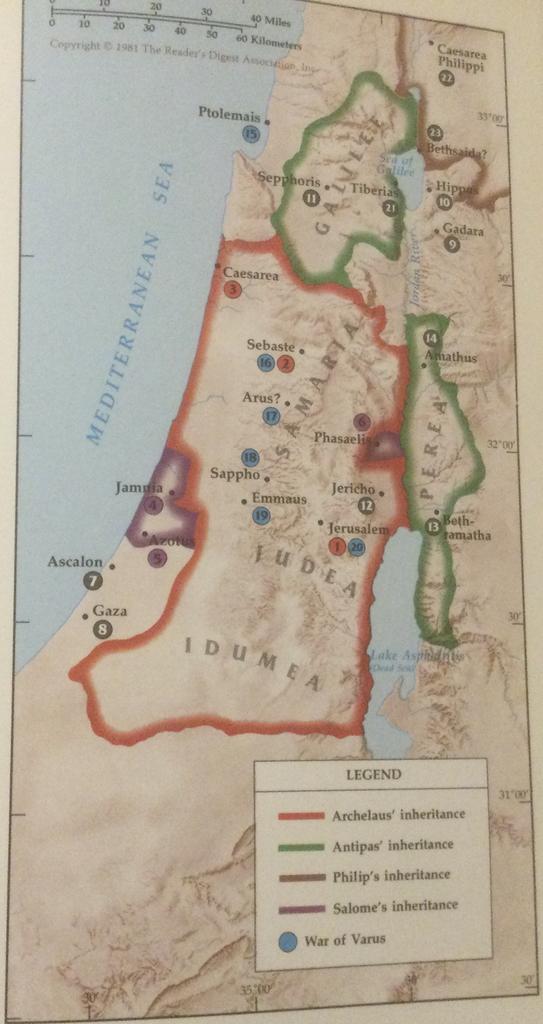
This map, from Joseph Gardner’s Atlas of the Bible, shows who controlled where after Herod died.
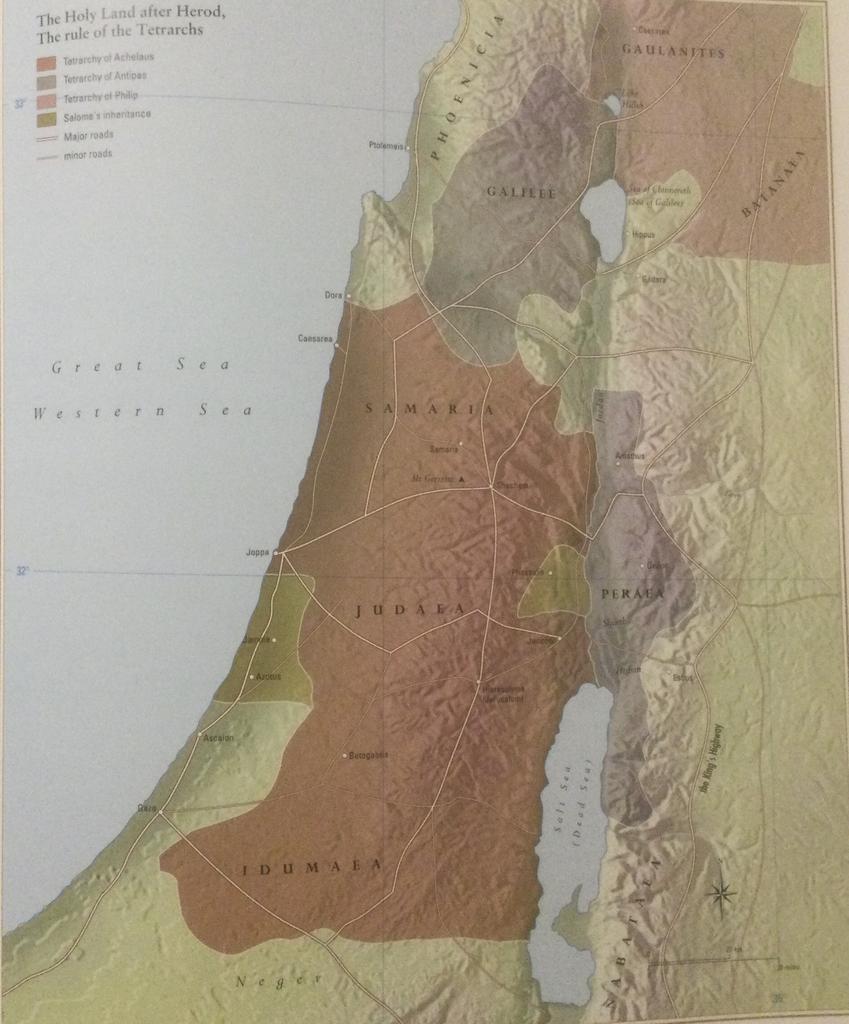
This map, from Dr. Ian Barnes’ Historical Atlas of the Bible, also shows who controlled where after Herod died.
Problems Develop - 4 BCE
- Emperor Augustus had to ratify this arrangement, so Archelaus went to Rome, leaving from Caesaria.
- However, there was a protest in Jerusalem during Passover because Herod had executed 2 rabbis before he died.
- Before he left, Archelaus called out troops, who killed 3,000 Jews.
- Antipas also went to Rome, because he said that a previous will had made him the ruler of all of Herod’s kingdom.
- Philip went to Rome to support Archelaus, because this gave him an area to rule.
- With all of them gone, Varus, the governor of Syria, sent a legion to impose control.
- His financial officer, Sabinus, tried to take Herod’s treasure for the emperor, but this stirred people up further.
- Archelaus’ troops kept the Jews from getting more upset at Varus’ troops.
- At Shavuot, the pilgrimage to Jerusalem brought more people to join the rebellion.
- Many of Herod’s veterans joined the rebels, while Roman soldiers and 3,000 auxiliaries from Sebaste tried to crush them.
- In the countryside, 2,000 of Herod’s veterans drove troops led by Herod’s cousin Achiab from the plains into the hills.
- Athronges, a shepherd, claimed to be the king and led his followers in guerilla warfare.
- In the Galilee, Judas (not the one with Jesus) captured Sepphoris and plundered the royal palace.
- A former slave of Herod, Simon, burned the royal palaces at Jericho and Beth-ramatha. After he was beheaded, his followers burned the palace at Amathus in Perea.
- Varus returned from Syria with 2 legions and cavalry, along with Nabatean cavalry and infantry on loan from Aretas IV.
- They burned Sepphoris and sold its inhabitants as slaves.
- Although Sebaste was spared, first Varus used Arus as a place to prepare for marching on Jerusalem, and after he left the Nabateans burned Arus and Sappho while Varus burned Emmaus.
- Varus captured Jerusalem, crucifying 2,000 Jews.
- Achiab got 10,000 men to surrender, sending their leaders to Rome where they were released unless they were related to Herod.
- Emperor Augustus had to ratify this arrangement, so Archelaus went to Rome, leaving from Caesaria.
- However, there was a protest in Jerusalem during Passover because Herod had executed 2 rabbis before he died.
- Before he left, Archelaus called out troops, who killed 3,000 Jews.
- Antipas also went to Rome, because he said that a previous will had made him the ruler of all of Herod’s kingdom.
- Philip went to Rome to support Archelaus, because this gave him an area to rule.
- With all of them gone, Varus, the governor of Syria, sent a legion to impose control.
- His financial officer, Sabinus, tried to take Herod’s treasure for the emperor, but this stirred people up further.
- Archelaus’ troops kept the Jews from getting more upset at Varus’ troops.
- At Shavuot, the pilgrimage to Jerusalem brought more people to join the rebellion.
- Many of Herod’s veterans joined the rebels, while Roman soldiers and 3,000 auxiliaries from Sebaste tried to crush them.
- In the countryside, 2,000 of Herod’s veterans drove troops led by Herod’s cousin Achiab from the plains into the hills.
- Athronges, a shepherd, claimed to be the king and led his followers in guerilla warfare.
- In the Galilee, Judas (not the one with Jesus) captured Sepphoris and plundered the royal palace.
- A former slave of Herod, Simon, burned the royal palaces at Jericho and Beth-ramatha. After he was beheaded, his followers burned the palace at Amathus in Perea.
- Varus returned from Syria with 2 legions and cavalry, along with Nabatean cavalry and infantry on loan from Aretas IV.
- They burned Sepphoris and sold its inhabitants as slaves.
- Although Sebaste was spared, first Varus used Arus as a place to prepare for marching on Jerusalem, and after he left the Nabateans burned Arus and Sappho while Varus burned Emmaus.
- Varus captured Jerusalem, crucifying 2,000 Jews.
- Achiab got 10,000 men to surrender, sending their leaders to Rome where they were released unless they were related to Herod.
After that mess
- Emperor Augustus accepted Herod’s will but demoted Archelaus from king to ethnarch (still higher than tetrarch) because he was clearly not going to be a good ruler.
- Augustus turned out to be right -— Archelaus did not have his father’s abilities, nor even the decency to refrain from openly violating Jewish religious sensibilities.
- Archelaus ruled for 10 years (4 BCE-6 CE), and then a delegation of Jews and Samaritans complained to Augustus that Archelaus was too harsh.
- Archelaus was summoned to Rome, deposed, and exiled to Gaul.
- Samaria, Judaea, and Idumea all became the Roman province of Judaea in 6 CE, ruled by procurators.
- Antipas ruled for 43 years (4 BCE-39 CE), and brought peace and prosperity to Galilee and Perea.
- Antipas managed to not offend his Jewish subjects, gaining Pharisee support, and also built Tiberius as his capital, named for the emperor at the time.
- He went to Jerusalem for the Jewish pilgrimage festivals and made sure that his coins didn’t offend the Jews (through pictures of people, since they were created in the image of G-d, nor through calling himself the king, since he was not from the line of David nor was he allowed to by the Romans).
- Antipas also rebuilt the cities of the Galilee and Perea which had been destroyed by Varus.
- On the other hand, Antipas divorced his wife, who was the daughter of Aretas IV of Nabatea, so that he could marry Herodias, former wife of his younger half-brother Herod. This led to war with Aretas IV, which Antipas was defeated in.
- Moreover, Herodias nagged her new husband to go to Rome and demand to be made the king of Judaea. Emperor Caligula deposed him and exiled him to Lyons (Lugdunum) in Gaul.
- Philip was the most successful heir to Herod, ruling in a gentle, moderate fashion.
- Antipas’ and Philip’s peace also was true during the first 3 Roman governors of Judaea. The center of government was shifted from Jerusalem to Caesarea, which had a direct sea-link to Rome, and there were no legions stationed in Judaea (only 3,000 local troops from Sebaste and Caesaria).
- Judaea‘s problems started when Valerius Gratus, the first governor under Emperor Tiberius, came in 15 CE (to 26 CE). He deposed Annas, the High Priest (6 CE-15 CE).
- After much turnover, the High Priest became Annas’ son-in-law, Joseph Caiaphas (18 CE-37 CE), who worked with the next governor / procurator, Pontius Pilate (26-36 CE). Pilate was eventually removed by the Romans after 10 years for his cruelty and maladministration. For example, he robbed the Temple treasury to pay for an aqueduct to Jerusalem instead of using taxes, and when the people protested he had plainclothes soldiers mingle with the protesters and then kill them.
- Emperor Augustus accepted Herod’s will but demoted Archelaus from king to ethnarch (still higher than tetrarch) because he was clearly not going to be a good ruler.
- Augustus turned out to be right -— Archelaus did not have his father’s abilities, nor even the decency to refrain from openly violating Jewish religious sensibilities.
- Archelaus ruled for 10 years (4 BCE-6 CE), and then a delegation of Jews and Samaritans complained to Augustus that Archelaus was too harsh.
- Archelaus was summoned to Rome, deposed, and exiled to Gaul.
- Samaria, Judaea, and Idumea all became the Roman province of Judaea in 6 CE, ruled by procurators.
- Antipas ruled for 43 years (4 BCE-39 CE), and brought peace and prosperity to Galilee and Perea.
- Antipas managed to not offend his Jewish subjects, gaining Pharisee support, and also built Tiberius as his capital, named for the emperor at the time.
- He went to Jerusalem for the Jewish pilgrimage festivals and made sure that his coins didn’t offend the Jews (through pictures of people, since they were created in the image of G-d, nor through calling himself the king, since he was not from the line of David nor was he allowed to by the Romans).
- Antipas also rebuilt the cities of the Galilee and Perea which had been destroyed by Varus.
- On the other hand, Antipas divorced his wife, who was the daughter of Aretas IV of Nabatea, so that he could marry Herodias, former wife of his younger half-brother Herod. This led to war with Aretas IV, which Antipas was defeated in.
- Moreover, Herodias nagged her new husband to go to Rome and demand to be made the king of Judaea. Emperor Caligula deposed him and exiled him to Lyons (Lugdunum) in Gaul.
- Philip was the most successful heir to Herod, ruling in a gentle, moderate fashion.
- Antipas’ and Philip’s peace also was true during the first 3 Roman governors of Judaea. The center of government was shifted from Jerusalem to Caesarea, which had a direct sea-link to Rome, and there were no legions stationed in Judaea (only 3,000 local troops from Sebaste and Caesaria).
- Judaea‘s problems started when Valerius Gratus, the first governor under Emperor Tiberius, came in 15 CE (to 26 CE). He deposed Annas, the High Priest (6 CE-15 CE).
- After much turnover, the High Priest became Annas’ son-in-law, Joseph Caiaphas (18 CE-37 CE), who worked with the next governor / procurator, Pontius Pilate (26-36 CE). Pilate was eventually removed by the Romans after 10 years for his cruelty and maladministration. For example, he robbed the Temple treasury to pay for an aqueduct to Jerusalem instead of using taxes, and when the people protested he had plainclothes soldiers mingle with the protesters and then kill them.
The next while (36-66 CE)
- Things muddled along in Judaea, with the Jews being resentful but not pushed over the edge.
- In general, Roman administration was harsh, and the Jews continued to have nationalistic aspirations. Non-Jews in the area continued to be given preference in economic matters by the Romans.
- There was a respite under Herod the Great’s grandson, King Herod Agrippa I (41-44 CE), who was respectful of and well-liked by his Jewish subjects.
- Emperor Caligula appointed him as king of Upper Galilee in 38 CE, and Emperor Claudius expanded that in 41 CE to include Judaea and Samaria, meaning that he now ruled everything his grandfather did.
- Among other things, Agrippa I began building a wall of defense around Jerusalem.
- The non-Jews complained that Agrippa I was too even-handed in his dealings with the Jews instead of favoring the non-Jews, so his son Herod Agrippa II was given territory outside of Judaea and the procurators returned.
- After Herod Agrippa I, tensions rose as each procurator seemed more corrupt, oppressive, and contemptuous of Jewish religious practices than the last. The last 2 procurators, Albinus (62-64 CE) and Gessius Florus (64-66 CE) were particularly venal, corrupt, and brutal.
- In 62 CE, the Romans took away Jewish citizenship after a fight between Jews and Syrians.
- In 65 CE, the Romans stopped paying people to work on finishing Agrippa I’s wall of defense, leading to high unemployment.
- Things muddled along in Judaea, with the Jews being resentful but not pushed over the edge.
- In general, Roman administration was harsh, and the Jews continued to have nationalistic aspirations. Non-Jews in the area continued to be given preference in economic matters by the Romans.
- There was a respite under Herod the Great’s grandson, King Herod Agrippa I (41-44 CE), who was respectful of and well-liked by his Jewish subjects.
- Emperor Caligula appointed him as king of Upper Galilee in 38 CE, and Emperor Claudius expanded that in 41 CE to include Judaea and Samaria, meaning that he now ruled everything his grandfather did.
- Among other things, Agrippa I began building a wall of defense around Jerusalem.
- The non-Jews complained that Agrippa I was too even-handed in his dealings with the Jews instead of favoring the non-Jews, so his son Herod Agrippa II was given territory outside of Judaea and the procurators returned.
- After Herod Agrippa I, tensions rose as each procurator seemed more corrupt, oppressive, and contemptuous of Jewish religious practices than the last. The last 2 procurators, Albinus (62-64 CE) and Gessius Florus (64-66 CE) were particularly venal, corrupt, and brutal.
- In 62 CE, the Romans took away Jewish citizenship after a fight between Jews and Syrians.
- In 65 CE, the Romans stopped paying people to work on finishing Agrippa I’s wall of defense, leading to high unemployment.
The Rebellion Against Rome - 66-73 CE
- The last of the Roman procurators, Florus, was very corrupt. He got his position because his wife was friends with the wife of Emperor Nero.
- In late spring 66 CE, Florus seized a large amount of money from the Temple, and then brought in Roman soldiers who were under orders to kill anyone who jeered at them.
- The people protested this desecration anyway, and Florus turned his troops on them, killing 3,600.
- The Jews, under Eleazar son of the High Priest, refused to continue the daily sacrifice for the Emperor, which was viewed as an act of treason. (This sacrifice replaced the worship of the emperor which Rome insisted on everywhere else in their empire.)
- The Jews gained control of the Temple area back from the Romans and captured the arsenal at Masada, bringing the weapons back to Jerusalem.
- By August 66 CE, Jerusalem Jews compelled Florus and his soldiers to retreat to Caesarea, which was the Roman administrative center for Judaea.
- The governor of Syria, Cestius Gallus, then marched on Jerusalem (in time for Sukkot) with the veteran Roman Twelfth Legion via Caesarea, Joppa, and Lydda, and they were repulsed with heavy losses (including siege artillery) near Beth-Horon in October 66 CE.
- Judaea was broken into 7 districts under the command of various Jewish generals, and the wall of defense around Jerusalem was completed.
- Nero sent his most able general, Vespasian, to Judaea with 60,000 soldiers (3 infantry legions, a siege train, cavalry, and a corps of engineers) in December 66 CE.
- Vespasian systematically subdued the rebellion, starting in the Galilee in spring 67 CE (Sepphoris, Jotapata, Japhia, Mount Gerizim, Taricheae, Gamala, Mount Tabor, Gischala).
- By the end of 67 CE all of the Galilee and the coast (Joppa, Jamnia, and Azotus) was captured. The general in the Galilee, Josephus, surrendered; he became an author of one of the primary sources for this period (“The Jewish War”).
- After taking Tiberius (where the Jews also fought from boats on the Sea of Galilee), Vespasian sent his troops to winter at Caesaria.
- The Zealots feuded with other Jewish groups in Jerusalem, so Vespasian focused on Perea on the other side of the Jordan and north of the Dead Sea. He took all of that, down to but not including the fortress of Macherus on the east side of the Dead Sea.
- By late spring 68 CE, Antipatris, Lydda, and Jamnia were taken, a legion was stationed outside Emmaus, and the Romans went through Samaria to take Jericho, where they stationed another legion.
- By the end of 68 CE, almost all of Judaea and Idumea had been subdued, except for strongholds like Jerusalem and Masada.
- The Essenes hid their library in caves in Qumran around 68 CE. These texts became known as the Dead Sea Scrolls when they were found 19 centuries later.
- The last of the Roman procurators, Florus, was very corrupt. He got his position because his wife was friends with the wife of Emperor Nero.
- In late spring 66 CE, Florus seized a large amount of money from the Temple, and then brought in Roman soldiers who were under orders to kill anyone who jeered at them.
- The people protested this desecration anyway, and Florus turned his troops on them, killing 3,600.
- The Jews, under Eleazar son of the High Priest, refused to continue the daily sacrifice for the Emperor, which was viewed as an act of treason. (This sacrifice replaced the worship of the emperor which Rome insisted on everywhere else in their empire.)
- The Jews gained control of the Temple area back from the Romans and captured the arsenal at Masada, bringing the weapons back to Jerusalem.
- By August 66 CE, Jerusalem Jews compelled Florus and his soldiers to retreat to Caesarea, which was the Roman administrative center for Judaea.
- The governor of Syria, Cestius Gallus, then marched on Jerusalem (in time for Sukkot) with the veteran Roman Twelfth Legion via Caesarea, Joppa, and Lydda, and they were repulsed with heavy losses (including siege artillery) near Beth-Horon in October 66 CE.
- Judaea was broken into 7 districts under the command of various Jewish generals, and the wall of defense around Jerusalem was completed.
- Nero sent his most able general, Vespasian, to Judaea with 60,000 soldiers (3 infantry legions, a siege train, cavalry, and a corps of engineers) in December 66 CE.
- Vespasian systematically subdued the rebellion, starting in the Galilee in spring 67 CE (Sepphoris, Jotapata, Japhia, Mount Gerizim, Taricheae, Gamala, Mount Tabor, Gischala).
- By the end of 67 CE all of the Galilee and the coast (Joppa, Jamnia, and Azotus) was captured. The general in the Galilee, Josephus, surrendered; he became an author of one of the primary sources for this period (“The Jewish War”).
- After taking Tiberius (where the Jews also fought from boats on the Sea of Galilee), Vespasian sent his troops to winter at Caesaria.
- The Zealots feuded with other Jewish groups in Jerusalem, so Vespasian focused on Perea on the other side of the Jordan and north of the Dead Sea. He took all of that, down to but not including the fortress of Macherus on the east side of the Dead Sea.
- By late spring 68 CE, Antipatris, Lydda, and Jamnia were taken, a legion was stationed outside Emmaus, and the Romans went through Samaria to take Jericho, where they stationed another legion.
- By the end of 68 CE, almost all of Judaea and Idumea had been subdued, except for strongholds like Jerusalem and Masada.
- The Essenes hid their library in caves in Qumran around 68 CE. These texts became known as the Dead Sea Scrolls when they were found 19 centuries later.
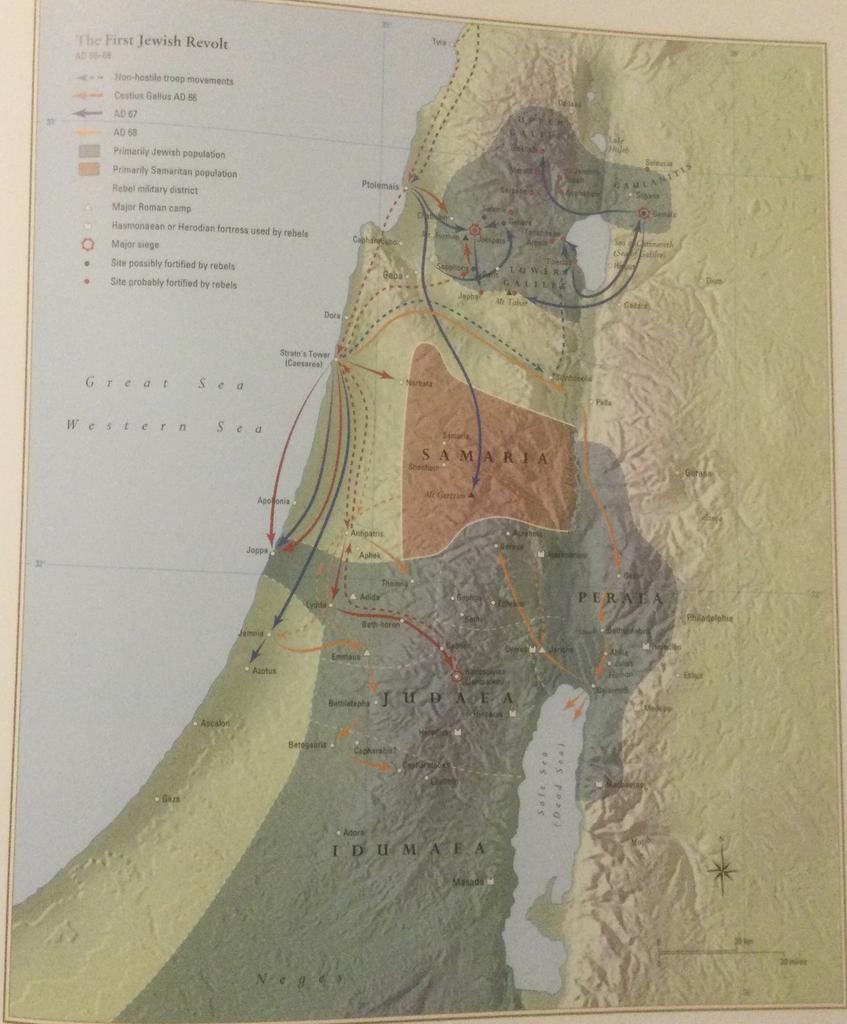
This map, from Dr. Ian Barnes’ Historical Atlas of the Bible, shows the revolt from 66-68 CE.
- According to the Talmud (Gittin 56a:15-56b:6) Yochanan ben Zakkai was smuggled out of Jerusalem by his students in a coffin. He met with Vespasian in 69 CE and requested that he, his students, and the family of Rabban Gamliel (a descendant of Hillel) be allowed to travel to Yavneh, in the north. Vespasian knew that Yochanan ben Zakkai was a moderate voice for peace, and so he granted this request, thus inadvertently allowing Judaism to survive and evolve after the suppression of the revolt. While Josephus doesn’t mention this, he might not have known about it and he does confirm the guards around Jerusalem (Wars of the Jews 4:6:3). Either way, somehow Rabbi Yochanan ben Zakkai and his students ended up in Yavneh.
- Vespasian was proclaimed emperor in 69 CE (possibly because of his successes in putting down the revolt). Before leaving for Rome via Alexandria, he mopped up the rest of Judaea, including Hebron, just leaving Jerusalem, Macherus, Herodium, and Masada.
- Vespasian was proclaimed emperor in 69 CE (possibly because of his successes in putting down the revolt). Before leaving for Rome via Alexandria, he mopped up the rest of Judaea, including Hebron, just leaving Jerusalem, Macherus, Herodium, and Masada.
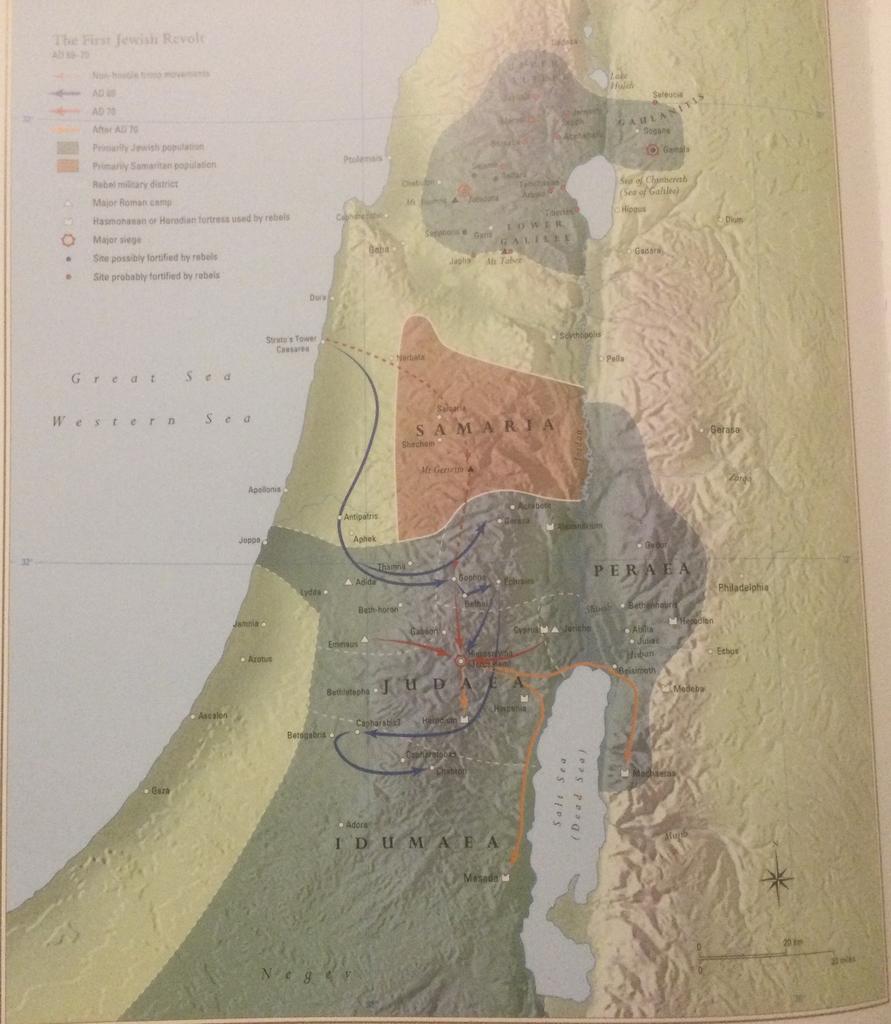
This map, from Dr. Ian Barnes’ Historical Atlas of the Bible, shows the revolt from 69-70 CE.
- Titus, Vespasian’s son, began the siege of Jerusalem in the spring of 70 CE. He had 2 legions from Caesarea, plus the legions at Emmaus and Jericho, plus cavalry and auxiliary forces, so about 80,000 soldiers, camped on Mount Scopus. After building the siege wall, he attacked the north wall of the city (the other 3 sides were on steep valleys and thus the walls were impregnable).
- The Jews knew that they faced death or slavery if conquered, so they united to resist fiercely. Strike forces hampered the placement of siege towers and battering rams. Volleys of missiles were exchanged with heavy losses on both sides (the Jews had the catapults captured from Cestius 4 years earlier).
- On May 25, 70 CE, the Romans breached the outer wall, pouring through to take control of the northern quarter known as Bezetha (New City).
- On May 30, they breached the second wall, but getting trapped in a labyrinth of narrow streets and alleyways they were pushed back beyond the wall.
- The second wall was broken through for good on the 17th of the month of Tammuz (early June).
- To work on the first and oldest wall, the Romans built a wall of their own across from it, and from the top of that they hurled stones and arrows against the defenders.
- The Jews repulsed attacks, undermined the opposing wall, and made sorties and routed portions of the enemy forces.
- This became harder, though, because Titus decided to starve the Jews, either so they would submit or be too weak to resist, crucifying anybody caught trying to sneak food into Jerusalem (sometimes as many as 500 people a day).
- After a few weeks of mounting death tolls from starvation, Titus went back to work on the Antonia, the fortress Herod built next to the Temple. The battering rams kept going until on July 24, the Romans broke through, driving the Jews before them in close fighting.
- The great timbered gates of the Temple did not give way to the battering rams, so they were set on fire, thus burning down the entire Second Temple on the 9th of the month of Av.
- By September 70, after a last-ditch stand in Herod’s palace, the city and the Temple were destroyed and the Jews of Jerusalem were killed or sold into slavery. Titus celebrated with sacrifices to the Roman gods in front of the ruins of the Temple.
- The Jews knew that they faced death or slavery if conquered, so they united to resist fiercely. Strike forces hampered the placement of siege towers and battering rams. Volleys of missiles were exchanged with heavy losses on both sides (the Jews had the catapults captured from Cestius 4 years earlier).
- On May 25, 70 CE, the Romans breached the outer wall, pouring through to take control of the northern quarter known as Bezetha (New City).
- On May 30, they breached the second wall, but getting trapped in a labyrinth of narrow streets and alleyways they were pushed back beyond the wall.
- The second wall was broken through for good on the 17th of the month of Tammuz (early June).
- To work on the first and oldest wall, the Romans built a wall of their own across from it, and from the top of that they hurled stones and arrows against the defenders.
- The Jews repulsed attacks, undermined the opposing wall, and made sorties and routed portions of the enemy forces.
- This became harder, though, because Titus decided to starve the Jews, either so they would submit or be too weak to resist, crucifying anybody caught trying to sneak food into Jerusalem (sometimes as many as 500 people a day).
- After a few weeks of mounting death tolls from starvation, Titus went back to work on the Antonia, the fortress Herod built next to the Temple. The battering rams kept going until on July 24, the Romans broke through, driving the Jews before them in close fighting.
- The great timbered gates of the Temple did not give way to the battering rams, so they were set on fire, thus burning down the entire Second Temple on the 9th of the month of Av.
- By September 70, after a last-ditch stand in Herod’s palace, the city and the Temple were destroyed and the Jews of Jerusalem were killed or sold into slavery. Titus celebrated with sacrifices to the Roman gods in front of the ruins of the Temple.
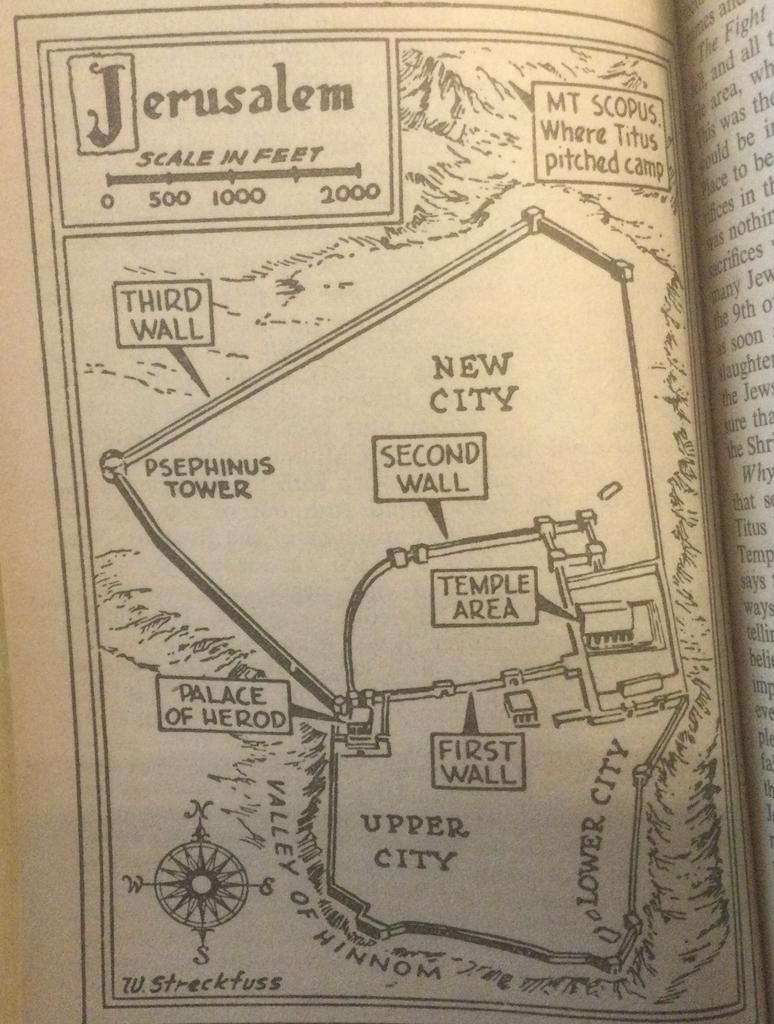
This map, from Solomon Grayzel’s History of the Jews, shows the fight for Jerusalem.
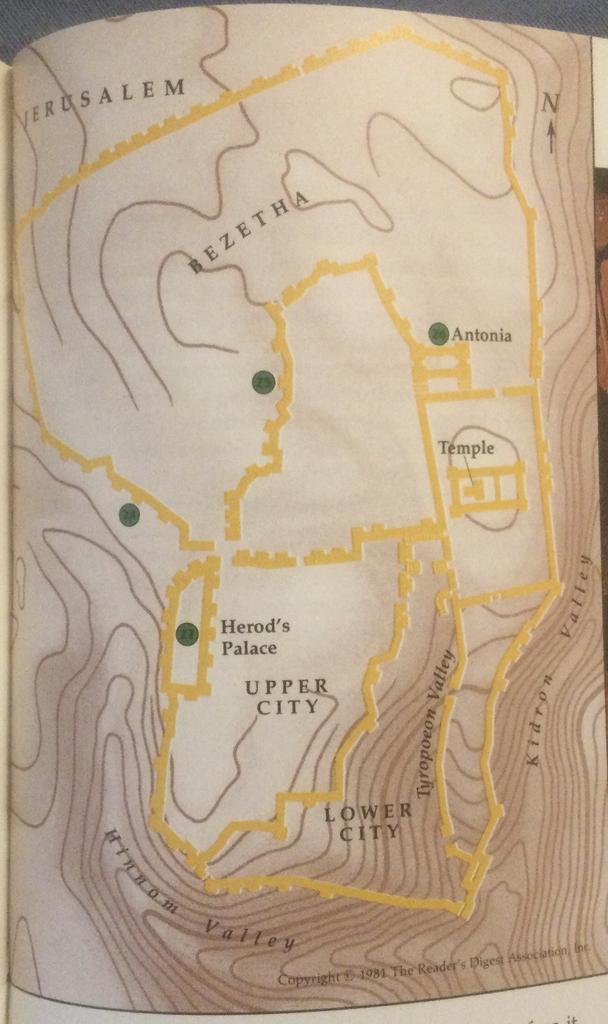
This map, from Joseph Gardner’s Atlas of the Bible, also shows the fight for Jerusalem.
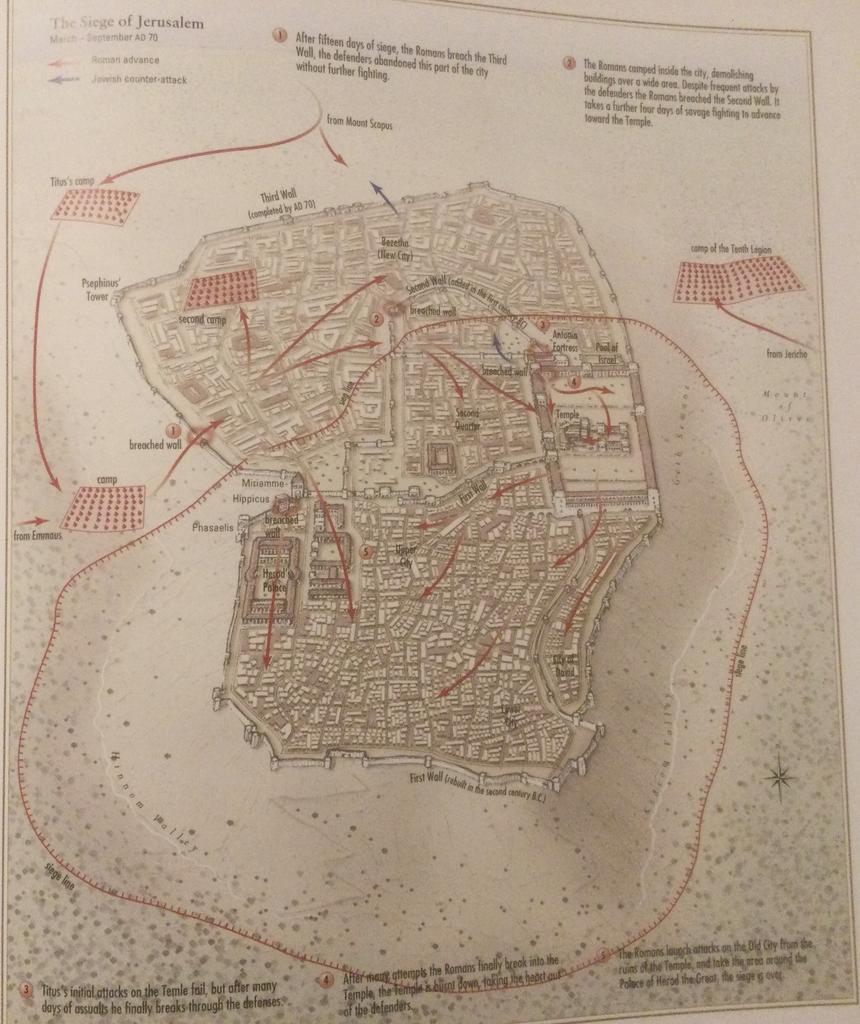
This map, from Dr. Ian Barnes’ Historical Atlas of the Bible, shows the siege of Jerusalem from March to September 70 CE.
- In 71 CE, there was a “triumph”, a procession in Rome where treasures from the Temple were carried (the seven-branched Menorah, but also the golden table from the Temple hall and also the Levites’ instruments), and 700 handsome young men from among the Jewish captives walked in chains (they were then condemned to die as gladiators). This is shown on the Arch of Titus, which was put up on the spot overlooking the Forum where the procession first came into view.
- Emperor Vespasian also had the coins of that time inscribed with the words “Judaea Capta” - “Judaea is taken”.
- Emperor Vespasian also had the coins of that time inscribed with the words “Judaea Capta” - “Judaea is taken”.
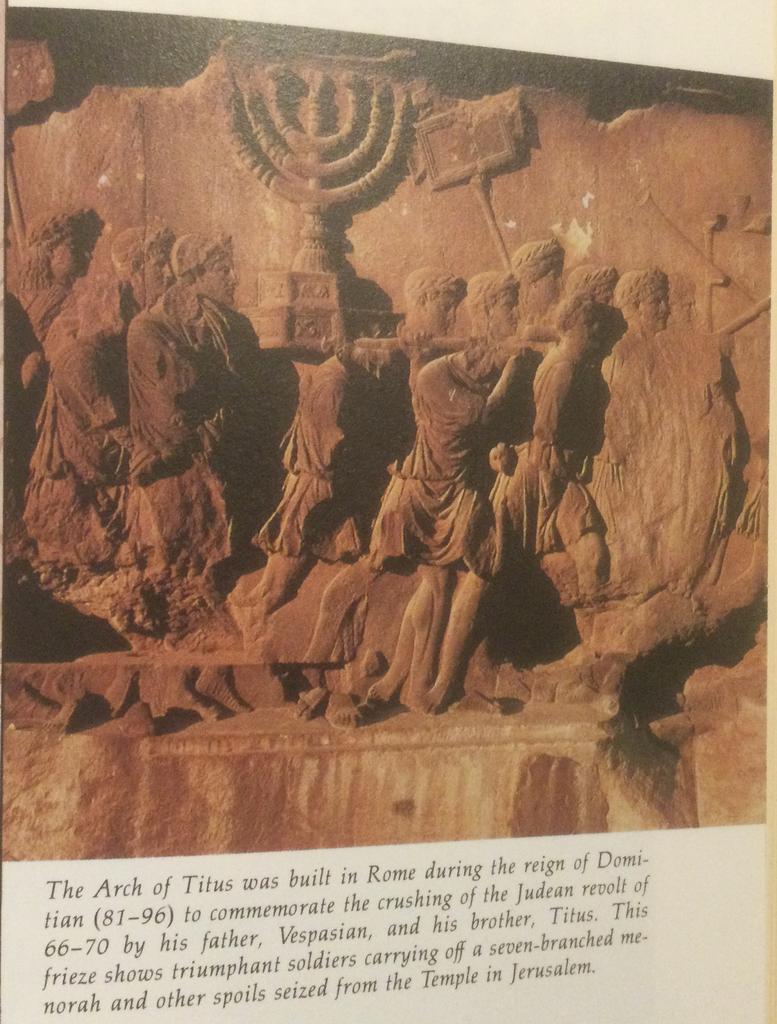
This illustration is from Joseph Gardner’s Atlas of the Bible.
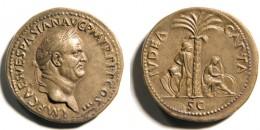
This coin shows Vespasian on one side and “Judea Capta” on the other, with a woman sitting under a palm tree (https://www.biblicalarchaeology.org/daily/news/judaea-capta-coin-uncovered-in-bethsaida-excavations/).
- From 70-73 CE, other strongholds were conquered: Herodium (south of Jerusalem), Machaerus (east of Lake Asphaltitus, now called the Dead Sea), and finally Masada.
- For Masada, first the Romans made a siege wall around the mountain to prevent escape or supplies.
- Then Jewish slaves were forced to build a ramp to the summit, more than 1000 feet above the shore of the Dead Sea. A platform and siege tower were built on top of the ramp as a mount for an iron battering ram.
- In May of 73 CE, the ram broke through the main wall and the defenders retreated behind a secondary wall of timber and earth.
- On the night before the final assault, the defenders killed their families and themselves.
- The war was over when Masada fell.
- For Masada, first the Romans made a siege wall around the mountain to prevent escape or supplies.
- Then Jewish slaves were forced to build a ramp to the summit, more than 1000 feet above the shore of the Dead Sea. A platform and siege tower were built on top of the ramp as a mount for an iron battering ram.
- In May of 73 CE, the ram broke through the main wall and the defenders retreated behind a secondary wall of timber and earth.
- On the night before the final assault, the defenders killed their families and themselves.
- The war was over when Masada fell.
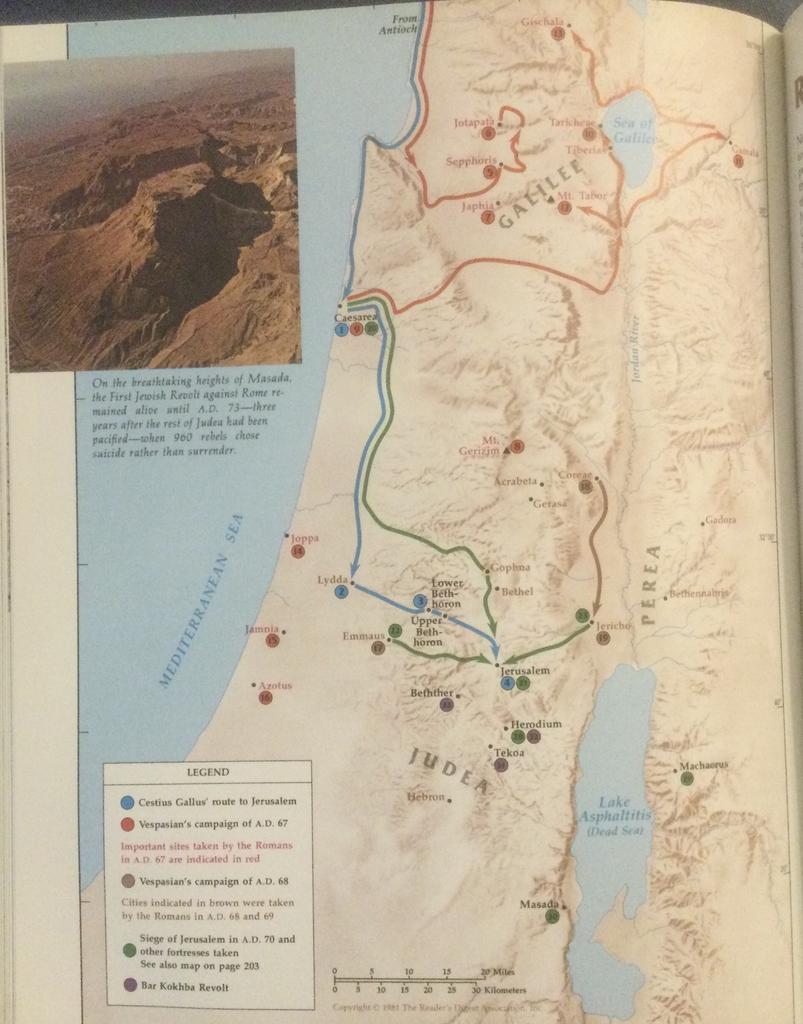
This map, from Joseph Gardner’s Atlas of the Bible, shows where the various battles happened.
Note: While Josephus’ “War of the Jews” is the main source for this time period (https://www.sefaria.org/The_War_of_the_Jews.2.1.1?lang=bi), the Roman historian Tacitus writes about it in his “Histories” (https://www.gutenberg.org/files/16927/16927-h/16927-h.htm#conquest_Judea). Cassius Dio publishes an 80-volume “Roman Histories” that talks about this in Volumes 66 (https://www.gutenberg.org/files/10890/10890-h/10890-h.htm#b66). Suetonius writes about this in his work “The Twelve Caesars” (https://www.gutenberg.org/files/6400/6400-h/6400-h.htm#link2H_4_0011 and https://www.gutenberg.org/files/6400/6400-h/6400-h.htm#linknoteref-779)
With appreciation to: Dr. Ian Barnes’ Historical Atlas of the Bible, Joseph Gardner’s Atlas of the Bible, Solomon Grayzel’s History of the Jews
